Throughout this question use natural units with . For zero potential and nonzero kinetic energy, the homogeneous canonical scalar field has , so . Its equation of motion becomes , giving and thereforeThe same scaling follows from cosmological energy conservation with constant equation-of-state parameter . If the field is exactly constant, both and vanish and their ratio is undefined; that is the separate empty solution.
Write for the reduced Planck mass. For a nontrivial power law with , , , and . Matching its time dependence to the kinetic and Friedmann equation terms requires . The scalar field equation of motion and the Friedmann equation then reduce toSolving gives the exponential-potential scalar-dominated power-law solutionChoose and the positive square root for . The existence conditions for exponential-potential scaling matter: if , a finite real requires , rather than an inclusive bound on signed . At , nonzero is incompatible with this logarithmic ansatz. If , the corresponding scaling solution instead requires . The sign of changes the field's rolling direction, not . For the potential is constant and this finite- ansatz does not apply; with positive , a constant field gives de Sitter spacetime expansion.
The scaling solution has and . ThereforeMore generally any real canonical scalar field with positive total energy density obeys , so it cannot have . A negative potential does not reverse this conclusion.
The proper particle horizon is . For the lower-limit integral diverges exactly when . Thus, assuming the same power law extends to the initial boundary, there is no finite particle horizon for . For the strict inequality, , the proper cosmological event horizon and present age areAt , has an infinite particle-horizon integral but also an infinite future event-horizon integral, so no finite event horizon exists. The age remains . The constant-potential case is separate: its flat de Sitter patch has event-horizon radius and no finite-age power-law Big Bang.
For a single constant- perfect fluid in a flat expanding FLRW metric model, cosmological energy conservation gives and . With , the luminosity distance follows by integrating the radial null geodesic:The constant-equation-of-state luminosity distance is consequentlyThis includes regularly, giving . Restoring conventional units multiplies the distance formulas by . Expanding about givesThe second result also follows directly from the Friedmann acceleration equation. The expansion agrees with the general coefficient of .
For phantom energy, , put . Integration of with givesBecause , the scale factor diverges at the Big Rip timeThis is a property of the stipulated constant- fluid model; it is not realizable by the positive-density canonical scalar of the preceding parts.
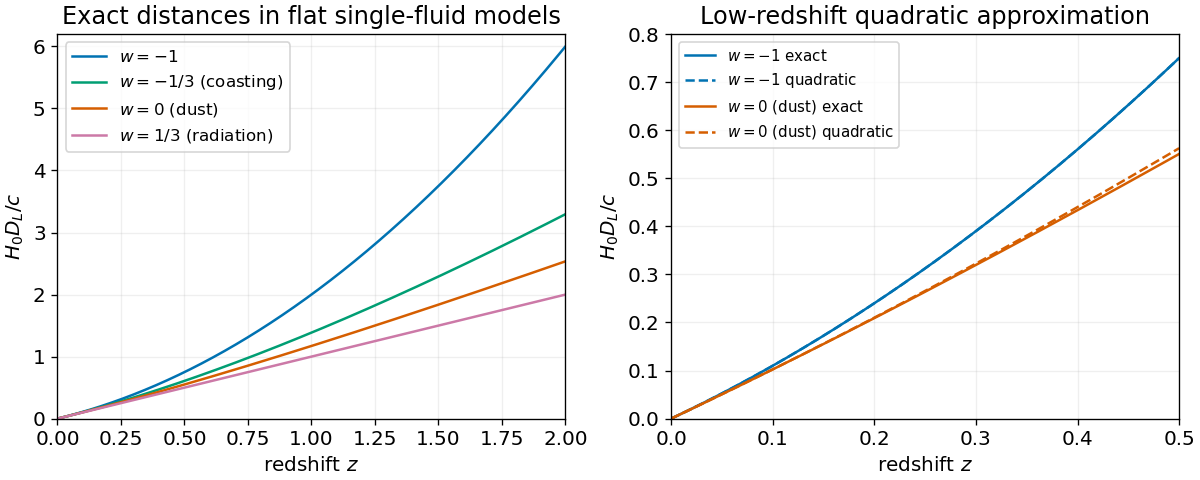
Exact flat single-fluid luminosity distances for several constant equations of state, including the logarithmic coasting case
. Details. 
Articles by others on the same topic
There are currently no matching articles.