Source paper: www-thphys.physics.ox.ac.uk/people/AndreiStarinets/TUTORIALS_NOTES_GR/gr_cosmology_exam_paper_2013.pdf
The lettered subdivisions index the successive separately marked blocks of each source question.
Use metric signature , , and retain terms linear in or . The inverse metric is and . In the Christoffel symbol formulathe differentiated metric perturbation is already first order, so the prefactor can be replaced by the flat inverse metric. For example and . Evaluating the remaining components givesThe lower-index symmetry follows from the torsion-free connection. Products of these first-order Christoffel symbols are beyond the retained weak-field approximation.
A pressureless relativistic fluid has stress-energy tensor , with four-velocity normalized by . In its rest frame, , so . Here is rest-frame mass density, or energy density divided by .
For the linearized Ricci tensor and scalar, discard the quadratic connection terms. The contracted connection is . Differentiation then givesThe Ricci scalar uses the zeroth-order inverse metric, , because multiplying first-order curvature by another metric perturbation would again be second order. These are the linearized curvature of a two-potential weak-field metric in the paper's Riemann curvature tensor sign convention.
The Einstein tensor is . Thus , where the time raising introduces the minus sign. Substitution cancels the and time-derivative terms in that component and givesThe right sides follow from the Einstein field equations with zero cosmological constant. The full equations also contain the momentum constraint for dust at rest to this order. Specifying arbitrary time-dependent potentials without that constraint would not give a solution of all the Einstein field equations.
For a massive particle parametrized by proper time, the geodesic equation isThe weak-field approximation alone does not imply Newtonian motion. Also take a nonrelativistic limit, , in the usual quasistatic regime so the potentials' time variation does not compensate for the small velocity factors. Reparametrizing by coordinate time and retaining the leading velocity-independent spatial term givesIn empty space the first field equation gives . For static potentials, the spatial equations imply and then . The difference is at most affine; isolated-system boundary conditions fixing both potentials to zero at infinity remove it. Thus andthe empty-space Newton-Poisson equation. With the same quasistatic assumptions and dust present it becomes . Keeping rapid time dependence instead leaves in vacuum, so the static qualification matters.
Although for a scalar field, its first derivative is a covector field. ThereforeCommuting partial derivatives and using the torsion-free connection gives . For a vector field, differentiate the tensor with both its indices included:Subtract the expression with exchanged. Second derivatives of cancel; the terms multiplying first derivatives cancel pairwise, and the final lower-index connection terms cancel by symmetry. The remaining coefficient of isThis is the curvature commutator. On a covariant index the sign reverses, giving the curvature commutator on a covariant tensor used in the next part.
For a torsion-free connection, the connection terms in the antisymmetrized covariant derivative cancel: . Thus the electromagnetic field tensor is the exterior derivative of the four-potential. It is a tensor, is invariant under , and obeys the homogeneous Maxwell equations . The covariant divergence equation is the generally covariant form of the local source equation; use its minus sign as specified in the paper.
Expand that equation before imposing the Lorenz gauge condition:The curvature commutator on a covariant tensor givesHere the contraction accounts for the second sign reversal. Hence in Lorenz gaugeThis curved-spacetime electromagnetic potential wave equation contains a Ricci tensor term even in a locally inertial coordinate system: a connection can vanish at one point while its derivatives and curvature remain nonzero.
Write , with the prime denoting . The metric and inverse metric are and . Since depends only on , the Christoffel symbols reduce toConsequentlyFor the stated de Sitter spacetime scale factor, . The factor is required because the prime is not differentiation with respect to itself.
For a minimally coupled massless scalar field, the covariant wave operator isThe Fourier mode therefore satisfiesSubstituting leaves . ThusThis is an unrescaled de Sitter massless scalar mode. For , the opposite-frequency time solution supplies the second independent mode; a real scalar field combines appropriate conjugate spatial modes. For the particular ansatz gives only the constant solution, while the full homogeneous solution is . The requested ansatz was not a general zero-mode parametrization.
Use mass density units for the appearing in the Friedmann equation; an actual energy density is . Conservation, , gives for pressureless matter and radiation in cosmology, respectively, with . The first scaling counts dilution of particle number, while the second includes the cosmological redshift of each photon's energy.
Define the present cosmological density parameters by . ThenFor , conformal time gives , so the expanding branch obeys . Set at the Big Bang. Integrating givesand hence the flat matter-radiation conformal solutionThe limiting pure-radiation and pure-matter cases follow continuously.
At matter-radiation equality, , so . Evaluating the integrated square-root relation givesThis assumes both present densities are positive and uses the same Big Bang origin for conformal time.
For dust alone, write , whereSet and . Differentiation gives once is used, verifying the Friedmann equation. Integrating the time relation from the Big Bang yields the closed matter-dominated Friedmann solutionThe Hubble parameter and the cosmological density parameter areThe first decreases from positive infinity through zero at maximum expansion to negative infinity at the Big Crunch. The second approaches one near either singular endpoint and diverges at maximum expansion. This is a density-parameter divergence at a cosmological turnaround: makes the critical density vanish even though the physical dust density there is finite.
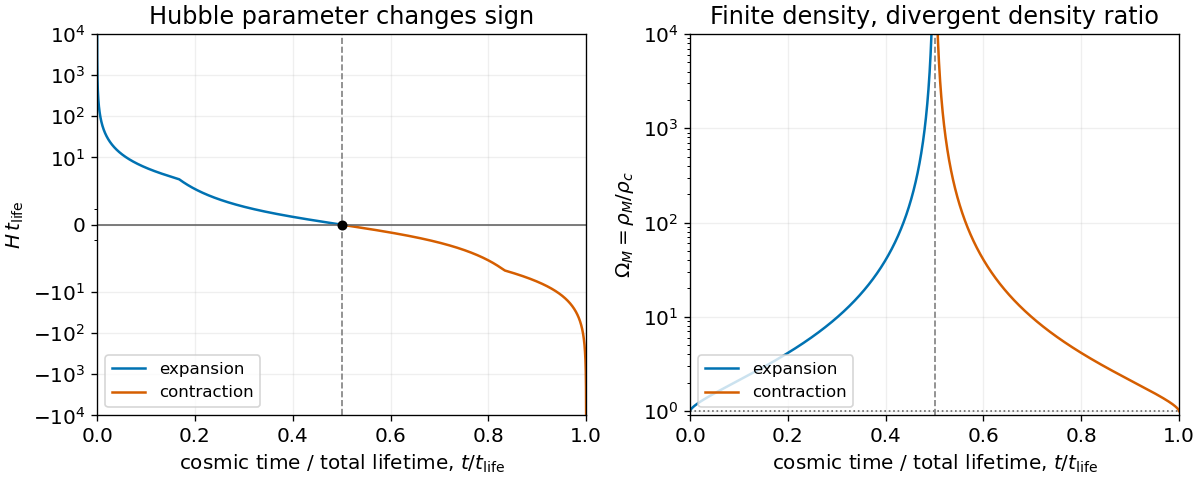
Closed dust universe: the Hubble parameter changes sign and the density parameter diverges at maximum expansion
. Details. 
At maximum expansion, . With , the present Friedmann equation gives , so positive curvature requires . Taking for the presently expanding branch givesThe lifetime of a closed dust universe follows by setting . The deceleration parameter follows from the Friedmann acceleration equation, . Thus this model always decelerates while expanding. Its total lifetime includes the elapsed age; it is not the remaining lifetime.
The supernova discovery of accelerating expansion does not support this dust-only recollapse model as a description of the observed expansion history. Already the 1998 and 1999 Type Ia supernova analyses favoured accelerating expansion, requiring ingredients beyond this zero-cosmological constant, positive-curvature dust model within the usual FLRW metric interpretation.[ref]
Observational Evidence from Supernovae for an Accelerating Universe and a Cosmological Constant by Adam Riess and others. Abstract: evidence for present acceleration
[ref]Throughout this question use natural units with . For zero potential and nonzero kinetic energy, the homogeneous canonical scalar field has , so . Its equation of motion becomes , giving and thereforeThe same scaling follows from cosmological energy conservation with constant equation-of-state parameter . If the field is exactly constant, both and vanish and their ratio is undefined; that is the separate empty solution.
Write for the reduced Planck mass. For a nontrivial power law with , , , and . Matching its time dependence to the kinetic and Friedmann equation terms requires . The scalar field equation of motion and the Friedmann equation then reduce toSolving gives the exponential-potential scalar-dominated power-law solutionChoose and the positive square root for . The existence conditions for exponential-potential scaling matter: if , a finite real requires , rather than an inclusive bound on signed . At , nonzero is incompatible with this logarithmic ansatz. If , the corresponding scaling solution instead requires . The sign of changes the field's rolling direction, not . For the potential is constant and this finite- ansatz does not apply; with positive , a constant field gives de Sitter spacetime expansion.
The scaling solution has and . ThereforeMore generally any real canonical scalar field with positive total energy density obeys , so it cannot have . A negative potential does not reverse this conclusion.
The proper particle horizon is . For the lower-limit integral diverges exactly when . Thus, assuming the same power law extends to the initial boundary, there is no finite particle horizon for . For the strict inequality, , the proper cosmological event horizon and present age areAt , has an infinite particle-horizon integral but also an infinite future event-horizon integral, so no finite event horizon exists. The age remains . The constant-potential case is separate: its flat de Sitter patch has event-horizon radius and no finite-age power-law Big Bang.
For a single constant- perfect fluid in a flat expanding FLRW metric model, cosmological energy conservation gives and . With , the luminosity distance follows by integrating the radial null geodesic:The constant-equation-of-state luminosity distance is consequentlyThis includes regularly, giving . Restoring conventional units multiplies the distance formulas by . Expanding about givesThe second result also follows directly from the Friedmann acceleration equation. The expansion agrees with the general coefficient of .
For phantom energy, , put . Integration of with givesBecause , the scale factor diverges at the Big Rip timeThis is a property of the stipulated constant- fluid model; it is not realizable by the positive-density canonical scalar of the preceding parts.
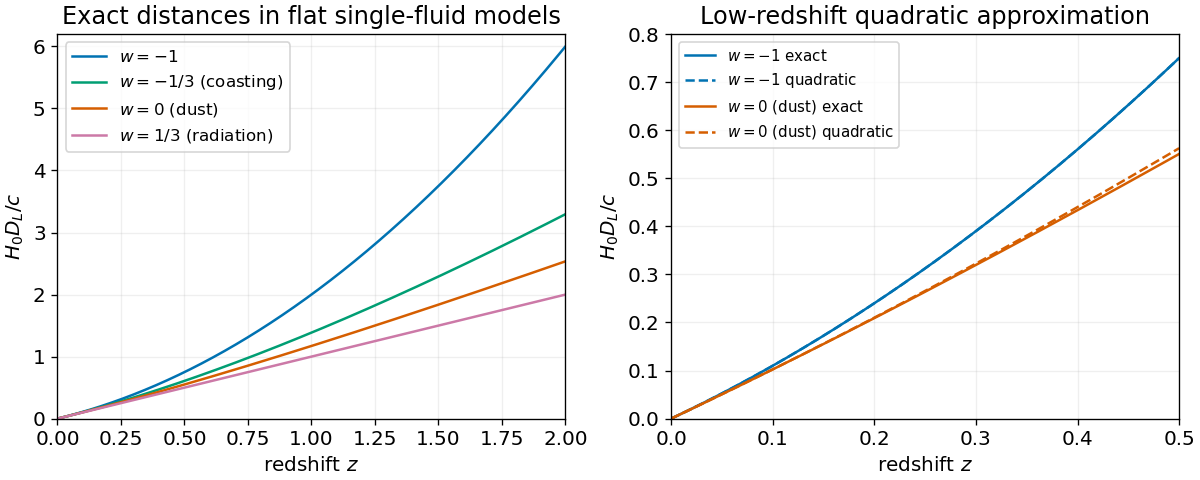
Exact flat single-fluid luminosity distances for several constant equations of state, including the logarithmic coasting case
. Details. 
Articles by others on the same topic
There are currently no matching articles.