Let and work in the exterior , with . The affinely parametrized geodesic Lagrangian isIts polar-angle equation isThe initial data , therefore remain in that plane. Rotational symmetry allows the axes to be chosen so that any nonradial initial trajectory has those data: its conserved angular-momentum direction fixes an orbital plane through the centre. Radial trajectories can also be placed in an equatorial plane.
The coordinates are cyclic in , so their canonical momenta are constant:The corresponding Killing vector fields are and . With the displayed signature, and , explaining the sign in the second canonical momentum. Thus is conserved energy per unit rest mass for a massive particle parametrized by proper time, and is its axial angular momentum per unit rest mass. For a photon, affine rescaling rescales both constants; after the tangent is normalized to the physical four-momentum they represent its energy at infinity and axial angular momentum. Their ratio is the signed impact parameter.
In the equatorial plane, the photon satisfies the null geodesic constraintwhich givesFor , put and . Thenand consequentlyThe radial case is not represented by as an orbit parameter.
There is a circular photon orbit at , but it is unstable. The radial effective potential isA circular orbit requires and , givingIts second derivative isIt is a maximum, rather than a minimum, so radial perturbations depart from the orbit. Equivalently the second-order orbit equation is . Linearizing about gives , with modes and . The existence of a growing mode directly contradicts the printed stability claim. Exact initial data can remain circular, but that does not make the orbit stable.
The supplied implicit expression describes the critical-energy family with , as fixed by the circular orbit. DefineRationalizing once gives andDifferentiating gives , soThis verifies the first-order equation for every allowed integration constant on its real branch. For the derivative argument is replaced by direct substitution: is constant and solves the critical equation. The displayed family does not solve the equation at an independently arbitrary value of .
For , write . On the physical exterior branch,As , andThus for the photon remains exactly on the circular orbit. For it approaches from outside through indefinitely many revolutions in the negative- limit. With increasing , this same branch peels away outward and reaches infinity when . Reversing the direction of motion gives an incoming critical ray asymptotically approaching the photon circle. These are separatrix trajectories, not evidence of stability.
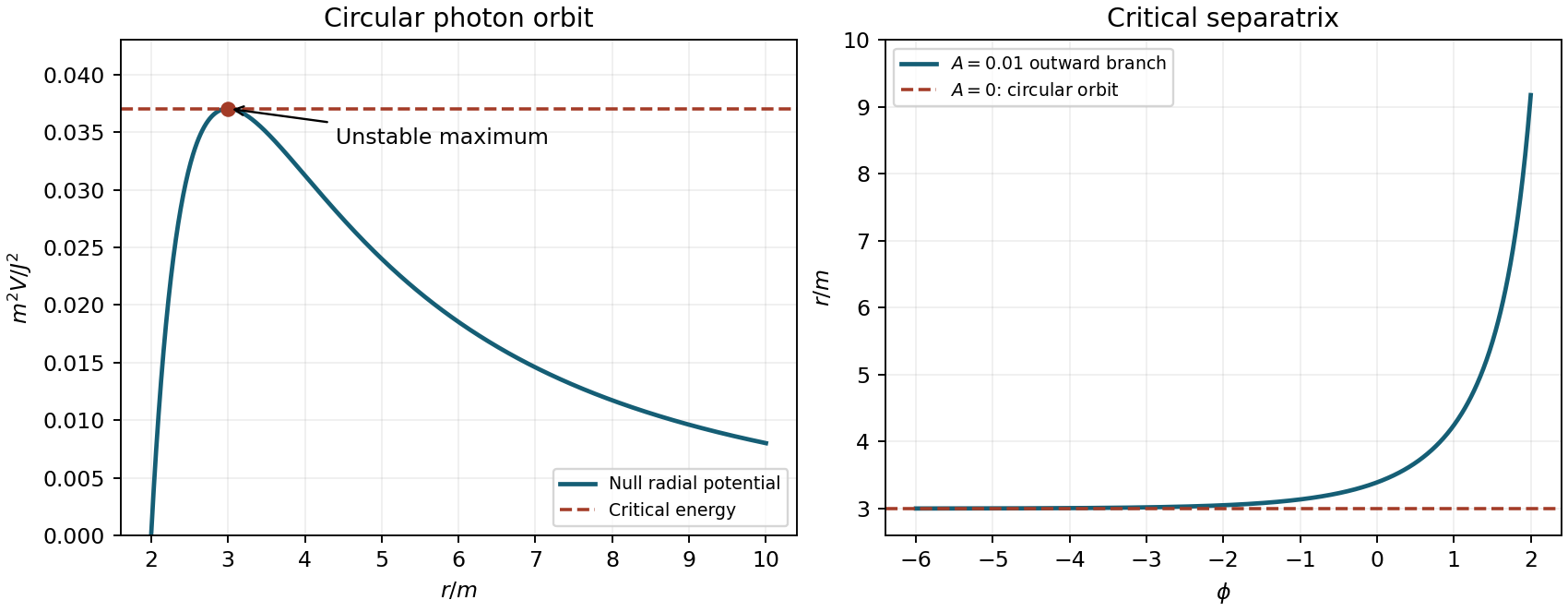

The potential maximum and the outward-growing radial separation display the same instability in two complementary descriptions.
Articles by others on the same topic
There are currently no matching articles.