For an affinely parametrized geodesic , the energy Lagrangian is . The coordinate is cyclic, so the Euler-Lagrange equation gives , a constant. Parametrize a nonconstant geodesic by hyperbolic arc length; thenIf , is constant: these are vertical lines. If , on intervals with ,Integration gives . The two branches join smoothly at the highest point. Conversely these curves satisfy the geodesic equations, or are images of vertical lines under half-plane Möbius transformations that are isometries. Thus the complete nonconstant geodesics arenamely vertical lines and upper semicircles orthogonal to the real axis. Their subarcs give geodesic segments.
The Cayley transform maps the upper half-plane conformally onto the unit disc. Its inverse is , withTransporting the given hyperbolic metric therefore gives the Poincare disc modelThe Cayley transform is an isometry for this metric, so it carries the half-plane geodesics to disc geodesics. A Möbius transformation sends generalized circles to generalized circles and preserves angles. Hence these are exactly diameters and arcs of circles meeting the unit circle orthogonally. Multiplying this Riemannian metric by any positive constant leaves the unparametrized geodesics unchanged.
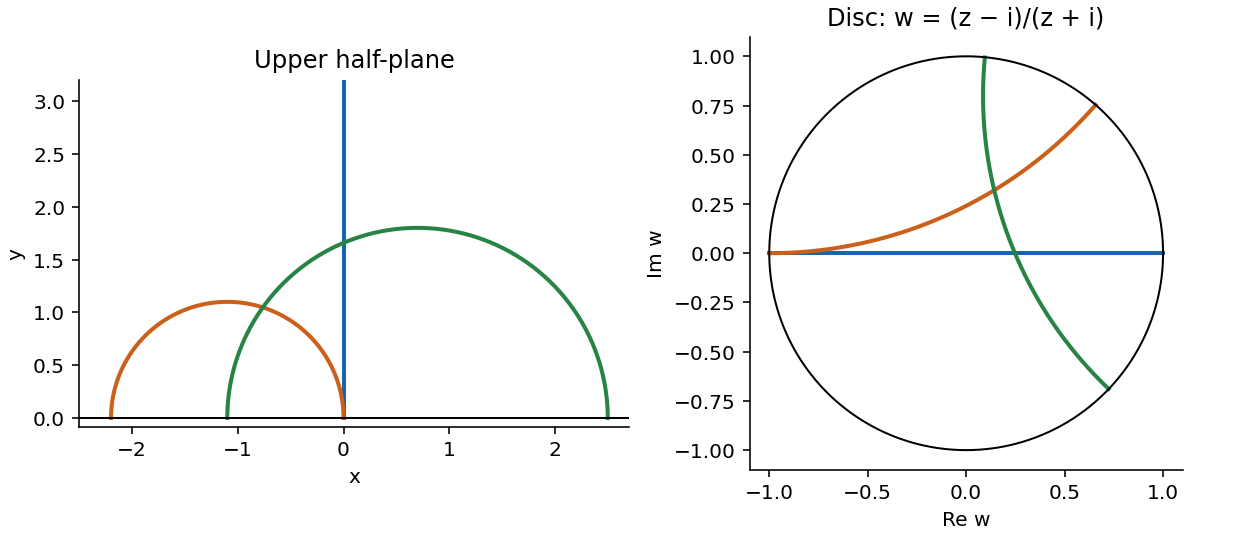

For distinct points on a geodesic, the given disc isometry sends to zero. Choose so that the image of is the positive numberAn orthogonal-circle geodesic through zero is a diameter, so this normalizes the geodesic as required.
There are two hyperbolic metric normalizations to distinguish. For the metric transferred from the stated half-plane, the radial length isThe diameter is minimizing. Indeed, any path from zero to has , so its length is at least , with equality on the radial segment. Therefore the distance consistent with the given half-plane metric isFor the alternative disc metric , every length is halved and the same isometries and geodesics remain. In that convention,The printed distance corresponds to the latter convention. It is obtained from one quarter of the given half-plane metric, rather than its direct transfer. The equal-point case gives distance zero in both conventions. This is the normalization of the Poincare disc metric.
Articles by others on the same topic
There are currently no matching articles.