The classification of compact surfaces says that every compact connected surface without boundary is homeomorphic to exactly one of the following: the sphere, an orientable surface obtained as the connected sum of tori, or a nonorientable surface obtained as the connected sum of real projective planes. The integers and are unique, and the orientable and nonorientable families do not overlap. Including makes the sphere the genus-zero member of the orientable family.
Their Euler characteristics are and , respectively. Thus orientability and the Euler characteristic determine the closed connected surface. If boundaries are allowed, one additionally specifies the number of boundary circles and removes that many open discs from a closed model.
For a finite polygonal CW complex decomposition of a compact surface, with vertices, edges and faces after all identifications,This is the Euler characteristic, independent of the chosen subdivision. In a polygonal presentation, count equivalence classes of vertices and paired edges, rather than their number before gluing.
Use a square with boundary word , identifying opposite sides with matching labels and arrows. All four vertices become one, the four sides form two edge classes, and there is one face. Therefore the torus has
A polygonal model of the real projective plane is a bigon with boundary word , with the equally labelled arrows identified. Its two vertices become one, its sides form one edge, and it has one face. ThusEquivalently, glue antipodal boundary points of a disc.
A square with boundary word gives the Klein bottle. The side identifications produce one vertex, two edges and one face. ConsequentlyUnlike the torus, this surface is nonorientable; its equal Euler characteristic alone does not distinguish them.
Glue two triangular discs along their boundaries to obtain a sphere. The resulting CW complex decomposition has three vertices, three edges and two faces, givingThe two triangles represent the two closed hemispheres, with an equator subdivided into three edges.
For , the standard commutator-word polygon has one face, paired edge classes and a single vertex class. ThusAn orientable surface admits continuously compatible local orientations; for a smooth surface, this is equivalently a continuous choice of unit normal vector in an oriented ambient three-dimensional space when such an embedding is available. In a polygonal model, orientability means the faces can be oriented so that induced boundary directions on each glued edge oppose one another. Here each edge label occurs once positively and once negatively. The orientation of the polygon therefore descends consistently across every seam. Hence is orientable, and it is the closed orientable surface of genus .
For a regular parametric surface , setThe first fundamental form is the induced Riemannian metricThe second fundamental form, for this choice of unit normal vector, isThe Gaussian curvature is the product of the principal curvatures, equivalently the determinant of the shape operator:Reversing the normal reverses the second fundamental form and both principal curvatures, while leaving unchanged.
Work on a regular patch with . Differentiating the surface of revolution givesThe arc-length condition gives , , . Also , so takeThe second derivatives yieldThus the first fundamental form and second fundamental form areThe opposite normal reverses the second displayed form. At a smooth pole the revolution coordinates degenerate, so curvature is understood by a regular local chart or by continuity.
Differentiating the arc-length identity gives . Multiply by and use to obtainThis derivation does not divide by , so it remains valid where . Inserting the first fundamental form and second fundamental form computed above gives the Gaussian curvature of a surface of revolution:
Choose and for . Adding the smooth poles at the endpoints gives the unit sphere. Its meridian is parametrized by arc length, and away from the poles, hence everywhere by continuity. Thus the unit sphere has constant Gaussian curvature one.
There is no compact smooth surface of revolution without boundary of constant Gaussian curvature minus one in this setting. On a compact such surface, the distance from the rotation axis attains a positive maximum. The maximum lies on a regular revolution patch, where the meridian arc length coordinate gives . Hence there, contradicting . Equivalently, constant negative curvature would require , excluding any positive radial maximum. Compact patches with boundary would not be excluded by this argument, but they are not closed surfaces.
For an affinely parametrized geodesic , the energy Lagrangian is . The coordinate is cyclic, so the Euler-Lagrange equation gives , a constant. Parametrize a nonconstant geodesic by hyperbolic arc length; thenIf , is constant: these are vertical lines. If , on intervals with ,Integration gives . The two branches join smoothly at the highest point. Conversely these curves satisfy the geodesic equations, or are images of vertical lines under half-plane Möbius transformations that are isometries. Thus the complete nonconstant geodesics arenamely vertical lines and upper semicircles orthogonal to the real axis. Their subarcs give geodesic segments.
The Cayley transform maps the upper half-plane conformally onto the unit disc. Its inverse is , withTransporting the given hyperbolic metric therefore gives the Poincare disc modelThe Cayley transform is an isometry for this metric, so it carries the half-plane geodesics to disc geodesics. A Möbius transformation sends generalized circles to generalized circles and preserves angles. Hence these are exactly diameters and arcs of circles meeting the unit circle orthogonally. Multiplying this Riemannian metric by any positive constant leaves the unparametrized geodesics unchanged.
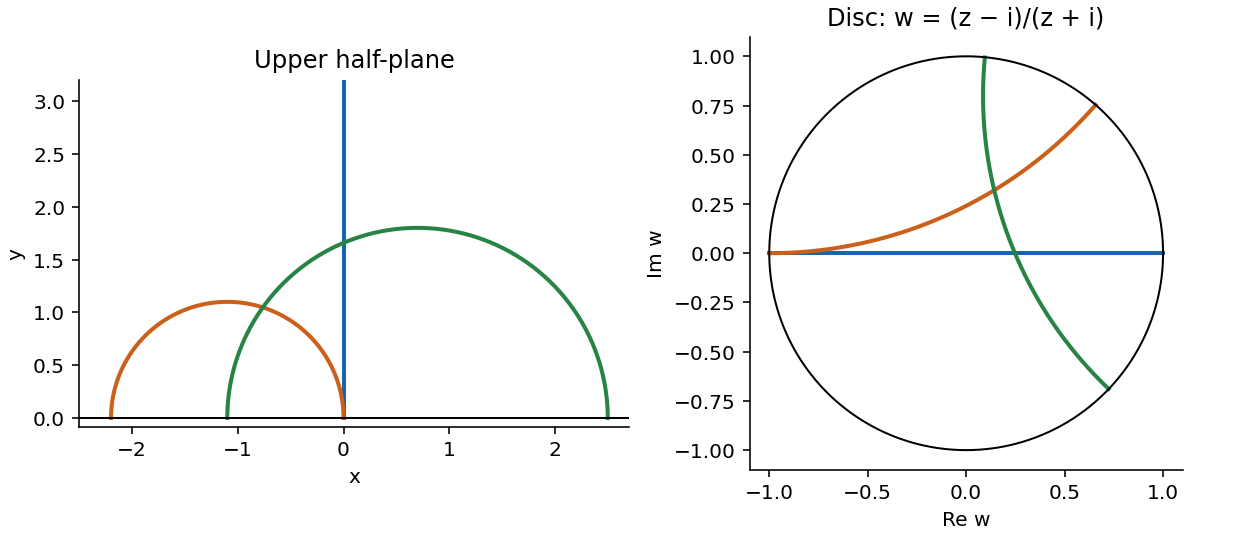

For distinct points on a geodesic, the given disc isometry sends to zero. Choose so that the image of is the positive numberAn orthogonal-circle geodesic through zero is a diameter, so this normalizes the geodesic as required.
There are two hyperbolic metric normalizations to distinguish. For the metric transferred from the stated half-plane, the radial length isThe diameter is minimizing. Indeed, any path from zero to has , so its length is at least , with equality on the radial segment. Therefore the distance consistent with the given half-plane metric isFor the alternative disc metric , every length is halved and the same isometries and geodesics remain. In that convention,The printed distance corresponds to the latter convention. It is obtained from one quarter of the given half-plane metric, rather than its direct transfer. The equal-point case gives distance zero in both conventions. This is the normalization of the Poincare disc metric.
Articles by others on the same topic
There are currently no matching articles.