Take eastward , upward , positive wavenumbers , and a real instantaneous amplitude . A common growing factor does not affect the phase geometry. Put and , using the hyperbolic cosine and hyperbolic sine. The prescribed streamfunction iswhereFollowing a fixed phase givesTherefore the streamfunction pattern tilts westward with height. The lower boundary leads the upper boundary eastward.
In the conventional quasi-geostrophic streamfunction normalization, hydrostatic balance gives . ThereforeFor the phase calculation, multiplication by the constant is immaterial. Define a continuous phase ; this avoids a spurious discontinuity at . ThenThe buoyancy perturbation pattern tilts eastward with height, opposite to the streamfunction pattern. At , while , so the two fields are a quarter wavelength apart there.
Both perturbation amplitudes are largest at the boundaries. Indeed,which increase with . The physical reason is particularly clear through stratified quasi-geostrophic inversion: the Eady model has no interior background potential-vorticity gradient, and a growing normal mode has zero interior potential vorticity anomaly. The independent thermal anomalies reside at the rigid upper and lower boundaries, where meridional motion advects the basic horizontal buoyancy gradient. Each Eady edge wave induces an interior balanced flow that decays away from its boundary on scale . Their interacting, phase-locked combination produces the growing baroclinic instability. Boundary confinement of the thermal sources, rather than a rigid-wall requirement , explains the amplitude pattern.
For a sketch with a quarter-wavelength difference between the boundary streamfunction patterns, chooseAn upper positive streamfunction crest is then west of its lower counterpart, where . The buoyancy perturbation crests slope the other way. The quarter-wavelength boundary assumption is used for the streamfunction; differentiating in fixes the buoyancy perturbation and does not generally give it the same boundary phase separation.
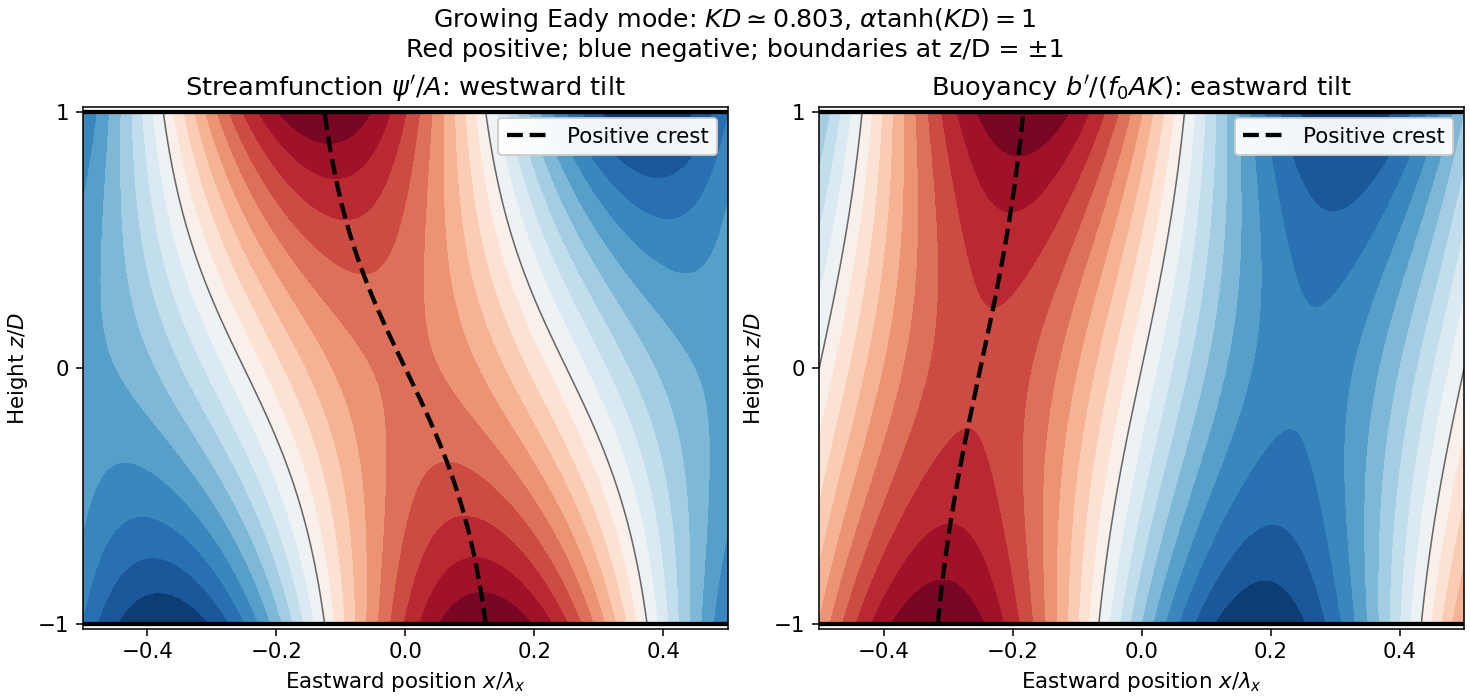
Original Eady model sketch: streamfunction crests tilt westward and buoyancy perturbation crests eastward. Dashed curves follow positive maxima; the streamfunction boundary phase difference is a quarter wavelength.
Details. 
The connection to poleward heat transport can be checked without relying on the sketch. The meridional geostrophic flow and buoyancy perturbation areAverage over one zonal wavelength, using equal averages for squared sine and cosine and zero for their product:In the Northern Hemisphere this is positive: warm anomalies preferentially move northward and cold anomalies southward. For the same eastward-increasing basic thermal wind in the Southern Hemisphere, and the basic buoyancy gradient reverses; the negative northward eddy buoyancy flux is again poleward. For thermal expansion coefficient and specific heat capacity at constant pressure , the corresponding sensible heat flux in a thermal Boussinesq approximation is . The growing amplitude makes this flux grow as . The tilt supplies the correlation absent in an untilted disturbance and reduces the background available potential energy.
Articles by others on the same topic
There are currently no matching articles.