The actual resource is a two-component Bell resource in dense coding. Applying the same local encoder togives a superposition of the intended Bell state with amplitude magnitude and its phase-label partner with amplitude magnitude . A Bell-basis measurement therefore reports the wrong Bell state with probability , independently of . With our labeling, only the phase bit flips:The first bit of each pair passes through a binary symmetric channel with error ; the second bit is correct. A uniformly chosen bit from the full stream consequently has
This bit error probability depends on the Bell labeling. The Bell-label Hamming distance and bit errors rule multiplies the wrong-symbol probability by the number of bit positions changed. For example, relabel as . Both wrong-state partner pairs then differ in two bits, giving bit error probability instead of . The physical wrong-Bell-state probability remains .
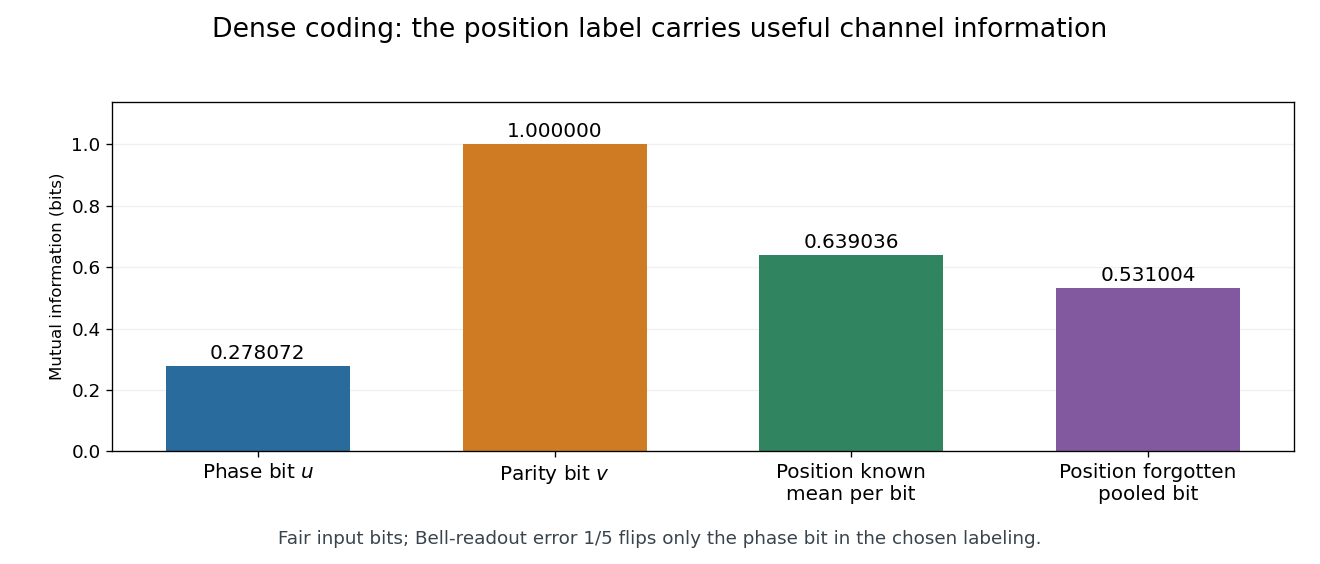
For the entropy-matched independent source in part 2, the transmitted bit stream is fair, and consecutive two-bit labels are uniform. Write the binary entropy as . If a bit position is chosen uniformly and its phase/parity position is forgotten, the pooled corresponding-bit pair is a binary symmetric channel with error . Its mutual information is
The bit-position information in a binary channel distinguishes this pooled quantity from the information in the decoded blocks. Alice and Bob know which bit is first in each Bell label. Conditioned on that position , the first bit gives bits and the second gives one bit. ThusEquivalently, the joint mutual information between the two-bit input and output labels is bits per transmitted Bell label for the prescribed Bell measurement. Pooling without the position loses usable side information; it is not interchangeable with this block rate. The stated fair-input values use the optimal source distribution above; biased source bits require their actual joint distribution.

Articles by others on the same topic
There are currently no matching articles.