Only supplied question extracts are held. Oxford's C2 support-page records attribute them to 2006; they do not establish the historical stage or sitting date.
Source extract: users.physics.ox.ac.uk/~Foot/C2/pdf/C22006Q5.pdf
The year is attributed from the preserved Oxford support-page record; it is not printed on the held page.
For one input bit, a Boolean function is specified by the pair , and counts its satisfying assignments. In the ordered computational basis , the supplied phase oracle convention givesHere is exclusive or: the oracle changes the sign of the inputs with . With the identity matrix and the Pauli Z gate, all four cases areThe two middle cases are balanced Boolean functions; the others are constant functions. The specified zero-state sign change and the Hadamard gate are
Use the top qubit as the first tensor product factor. Write the controlled unitary gate as . Reading the bracketed quantum circuit from left to right, its four operations are , , , . Thus the target operation in its control-one branch iswhere the rightmost matrix acts first. The control-zero branch is the identity operator. The Hadamard conjugation of a controlled gate identity givesIndeed, on control zero the replacement applies to the target, while on control one both sides apply . By linearity, the identity holds on every quantum superposition and therefore in every repetition of the bracket. This replaces the two internal controlled Hadamard gates as a pair.
The global phase of a controlled quantum gate must be preserved: , whereas . Consequently the minus signs in and the special phase oracles cannot be discarded as an unobservable global phase of the complete quantum circuit.
Define the Hadamard basis states . The initial two Hadamard gates prepare . For one bracket, the two control branches giveUsing the Pauli X gate , unitary conjugation by the Hadamard gate gives , so . Keeping every sign, the target states along the control-one branch, in the exact gate order, areThe last column also includes the final target Hadamard gate, which lies outside the bracket. Writing , applying the final top Hadamard gate gives the exact normalized two-qubit quantum stateThus the complete outputs, in top-then-bottom computational basis order, areFor the first qubit, the Pauli matrix has expectation value by the Born rule. The two cases each have , while the and cases are deterministic. Equivalently, this Hadamard test measuresThis explains the approximate quantum counting interpretation: repeated preparations estimate the expectation value, and hence . A single top-qubit computational-basis measurement need not identify .
For brackets the control-zero branch still does nothing, and the control-one branch applies to the target. Immediately before the final two Hadamard gates, the quantum state isFor the constant function with , the phase oracle is , so . Since is an eigenstate of the Pauli X gate with eigenvalue , for every integer . The final two Hadamard gates therefore giveIn particular, the first qubit always ends in .
For the constant function with , and , so . Thus the target remains in , and the top qubit before its final Hadamard gate is . The sign is a relative quantum phase between the control branches. The Hadamard gate converts it into the integer parity of :The first qubit is therefore for even and for odd , including all requested .
Source extract: users.physics.ox.ac.uk/~Foot/C2/pdf/C22006Q7.pdf
The year is attributed from the preserved Oxford support-page record; it is not printed on the held page.
In superdense coding, Alice applies a local Pauli operator to her half of the shared Bell state. Choose a phase bit and a parity bit , and encode them using on Alice's qubit. With the standard definitions of the Bell states,Alice sends her qubit to Bob. He now holds both halves and performs a Bell-basis measurement, recovering without error. Equivalently, a CNOT gate with Alice's qubit as control, followed by a Hadamard gate on that qubit, maps these states to their computational labels up to global phases. Four distinguishable alternatives give two classical bits per transmitted qubit, with one shared entangled pair consumed per use.
The initial entanglement distribution is independent of the later message and can be completed beforehand. Bob's local reduced density matrix before Alice's transmission is for every encoding, so quantum no-signalling prevents it from carrying her choice. This does not make the entangled pair free: if a qubit transmission is used to distribute it, counting that transmission as well gives two qubit transmissions for the two-bit message. The quoted dense-coding rate counts the subsequent message-bearing transmission with entanglement already shared.
A realized message has self-information . The average information per source message is its Shannon entropy,The average reaches bits per message at . Individual rare realizations can have larger self-information; this bound concerns the average.
The given strings form a prefix code with lengths and . To attain the entropy bound without redundancy, the resulting long bit stream must carry one bit of information per bit: unbiased bits with no predictable dependence. For an independent source, the dyadic source matched to a complete prefix code hasThese probabilities make the encoded stream equivalent to parsing independent fair bits using the code tree. Its expected codeword length and source entropy agree:Here “optimal” means attaining the Shannon bound. If it means only an optimal prefix code among symbol-by-symbol binary prefix codes, the probabilities are not unique: for three positive-probability symbols, this tree is optimal whenever is a largest probability. Huffman coding need not attain entropy exactly for nondyadic probabilities.
Concatenating the specified source-message encodings givesPack consecutive bits in pairs, rather than allocating a fresh Bell pair to each variable-length source word:Under the mapping in part 1, transmitThe block uses six message-bearing qubit transmissions and six preshared Bell pairs. Source-message boundaries are recovered by parsing the decoded prefix bit stream.
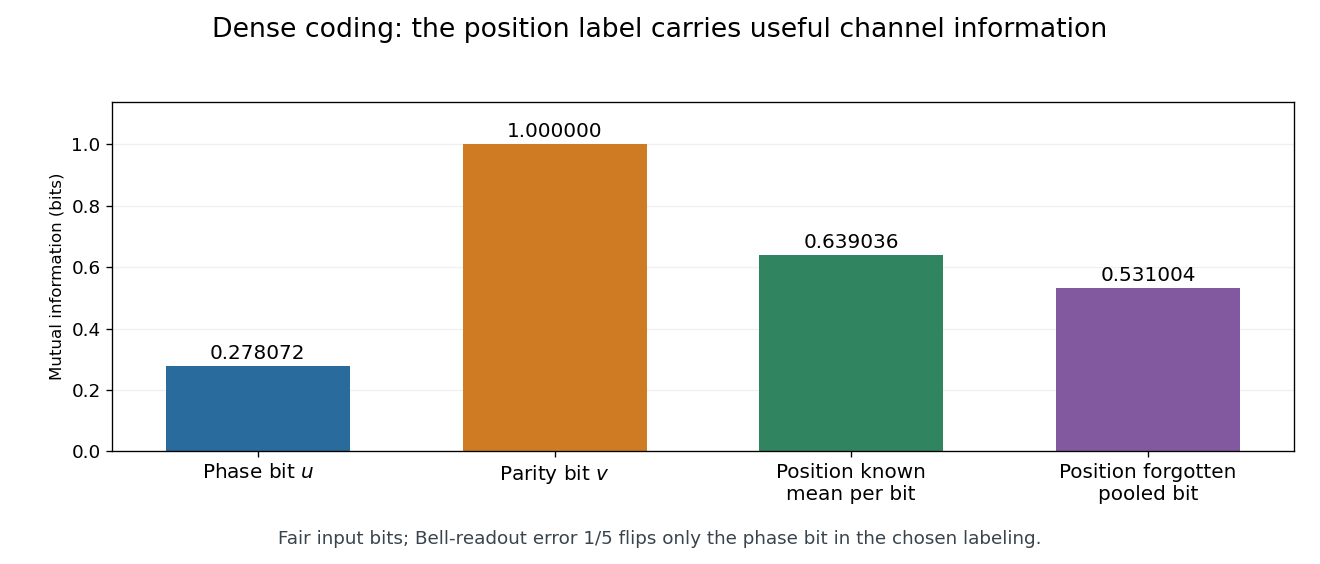
The actual resource is a two-component Bell resource in dense coding. Applying the same local encoder togives a superposition of the intended Bell state with amplitude magnitude and its phase-label partner with amplitude magnitude . A Bell-basis measurement therefore reports the wrong Bell state with probability , independently of . With our labeling, only the phase bit flips:The first bit of each pair passes through a binary symmetric channel with error ; the second bit is correct. A uniformly chosen bit from the full stream consequently has
This bit error probability depends on the Bell labeling. The Bell-label Hamming distance and bit errors rule multiplies the wrong-symbol probability by the number of bit positions changed. For example, relabel as . Both wrong-state partner pairs then differ in two bits, giving bit error probability instead of . The physical wrong-Bell-state probability remains .
For the entropy-matched independent source in part 2, the transmitted bit stream is fair, and consecutive two-bit labels are uniform. Write the binary entropy as . If a bit position is chosen uniformly and its phase/parity position is forgotten, the pooled corresponding-bit pair is a binary symmetric channel with error . Its mutual information is
The bit-position information in a binary channel distinguishes this pooled quantity from the information in the decoded blocks. Alice and Bob know which bit is first in each Bell label. Conditioned on that position , the first bit gives bits and the second gives one bit. ThusEquivalently, the joint mutual information between the two-bit input and output labels is bits per transmitted Bell label for the prescribed Bell measurement. Pooling without the position loses usable side information; it is not interchangeable with this block rate. The stated fair-input values use the optimal source distribution above; biased source bits require their actual joint distribution.

Articles by others on the same topic
There are currently no matching articles.