Use the time-ordered network , , . On bits its successive values areThus the network exchanges the two computational-basis states. Since the gates are linear, this basis proof also establishes SWAP gate on arbitrary quantum states.
The Bell states and obeyThe antisymmetric spin singlet state alone has eigenvalue . Its standalone sign is a global phase; a Fredkin gate can make that sign observable relative to the control branch, as in part d.
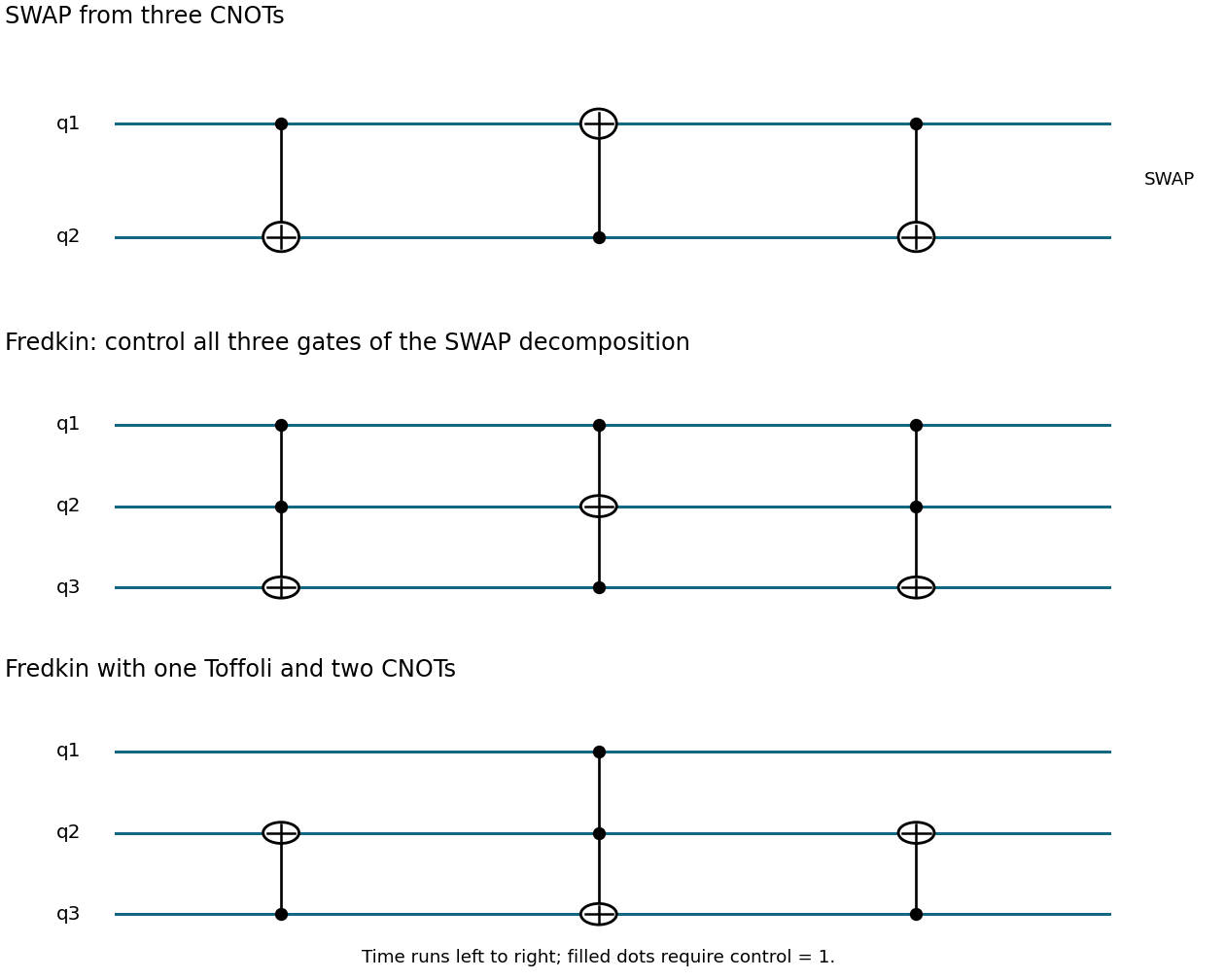
Three controlled-X gates for SWAP, and two decompositions of the Fredkin gate
. Details. 
Control all three CNOTs of the SWAP gate decomposition by qubit 1. This gives, in temporal order,When the first qubit is 0, all three Toffoli gates do nothing. When it is 1, the three lower-wire CNOTs implement SWAP gate. The middle panel of the original diagram shows this controlled network.
Only one Toffoli gate is actually needed. An equivalent circuit isFor input , the first gate forms on wire 2. The second changes wire 3 to , and the final gate gives wire 2 the value . For this is ; for it is . The last panel displays the circuit.
The Hamming-weight obstruction to Fredkin-only Toffoli synthesis means that a network of Fredkin gates alone cannot implement a Toffoli gate on the same three wires: each Fredkin gate preserves computational-basis Hamming weight, whereas Toffoli gate maps to . The same obstruction holds if fixed ancillary bits must be returned unchanged. Conservative classical computation can use extra encoded wires and input-dependent garbage, but that is not an ancilla-free coherent three-qubit Toffoli gate operation. The resources and output encoding would need to be specified before making a different universality claim.
Use basis order , with the ancilla first, and put , . Initially the ancilla is at the north pole of the Bloch sphere. The other two qubits lie on its equator at azimuths , with Bloch vectors .
The four dotted cuts, in left-to-right order, have the explicit normalized vectorsThe first Hadamard gate copies the lower-register amplitudes into two control branches; the Fredkin gate exchanges them only in the second branch; the final Hadamard gate adds and subtracts these branches.
Summing the squared magnitudes of the first four entries of givesMeanwhile , soIdentical input qubits give ; orthogonal equatorial inputs give . The factor one half is an ancilla-interference effect, not a direct projective measurement of the lower qubits individually.
For any joint lower-register state, the probability is , where is its exchange operator. The Bell-state eigenvalues from part a therefore giveFor the spin singlet state, controlled exchange adds a minus sign to the control-1 branch, so the final Hadamard gate puts the ancilla in . For the three symmetric states the ancilla returns to .
The product-state overlap formula cannot be applied to arbitrary entangled lower inputs. All four Bell states have identical one-qubit reduced states , yet the spin singlet state result differs maximally. The network measures exchange symmetry of the joint state, rather than fidelity of quantum states inferred from its two marginals.
Articles by others on the same topic
There are currently no matching articles.