One implementation uses type-II phase matching for spontaneous parametric down-conversion in a nonlinear birefringent crystal pumped by a coherent laser. A pump photon produces two lower-frequency photons of orthogonal polarizations, subject to energy and momentum phase matching. Collect two spatial modes in which the alternatives “horizontal photon in Alice's mode and vertical photon in Bob's mode” and the reversed assignment are indistinguishable. Compensation crystals, filters and matched optical paths erase polarization-dependent timing and spectral information. The amplitudes then add coherently to give a state proportional to ; a birefringent phase element tunes .
The essential requirement is coherent indistinguishability of the two assignments. Producing two orthogonally polarized photons with information revealing which assignment occurred would instead give a mixture without the required polarization entanglement.
Taking the partial trace over either photon of the pure pair state givesThe two Schmidt coefficients are both , so the entanglement entropy is one bit for every . A local phase gate on Alice maps to , proving local-unitary equivalence. In strict four-vector Bell-basis terminology only give the standard ; every phase nevertheless gives a maximally entangled Bell-type state.
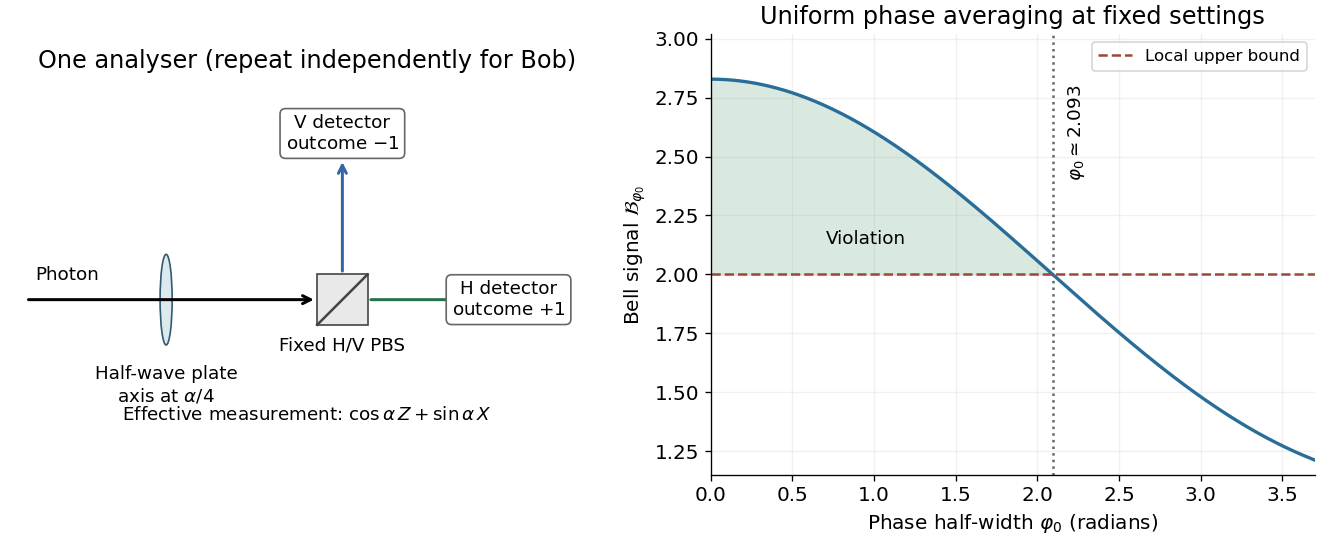
The eigenpolarizations of the requested observable areA polarizing beam splitter with its transmitted polarization axis at angle to horizontal separates these two orthogonal states. Assign outcome to its first detector and to the other. Equivalently, use a fixed horizontal/vertical splitter preceded by a half-wave plate whose fast axis is at ; the diagram shows this equivalent implementation. Bob uses for his splitter axis, or for the preceding half-wave plate.
The pair correlations are , , and . Expanding the two observables therefore givesThe half-angle between the Bloch observable parameter and the physical linear-polarization analyser angle is essential.

For a deterministic local hidden variable, write the four possible measurement results as . Its Bell combination isIf , the first bracket vanishes and the second is ; if , the second vanishes and the first is . Thus for every hidden variable. Averaging over any local hidden-variable distribution gives , and in particular the requested upper bound.
For the specified settings, the correlation formula in part b givesConsequentlyThis violates the local bound precisely whenThe maximum is at modulo . The state remains maximally entangled at other phases, even when this fixed choice of real-plane analyser settings gives no violation. Local phase compensation or adapted measurement settings can recover the optimum.
The phase averaging of a polarization Bell state gives the ensemble density matrixwith by continuity at . This follows from averaging over . An observable's expectation is linear in the density matrix, so averaging the pure-state Bell function is equivalent to evaluating the mixed-state expectation. ThereforeViolation requires . The supplied graph gives the first crossing near radians; solving more accurately givesThe inequality is strict at the upper endpoint. On the sinc function decreases to zero, so this is its only crossing in that interval. For , , excluding later violation windows. The plotted Bell signal shows the same threshold without copying the source illustration.
Articles by others on the same topic
There are currently no matching articles.