Apply a Hadamard gate before a Z-basis measurement: and . The result probabilities areFor measurement statistics the network is followed by . If the measured qubit survives and should be left in the original X eigenstate, append a second after the nondestructive . The resulting instrument has Kraus operators and , not Z-eigenstate outputs.
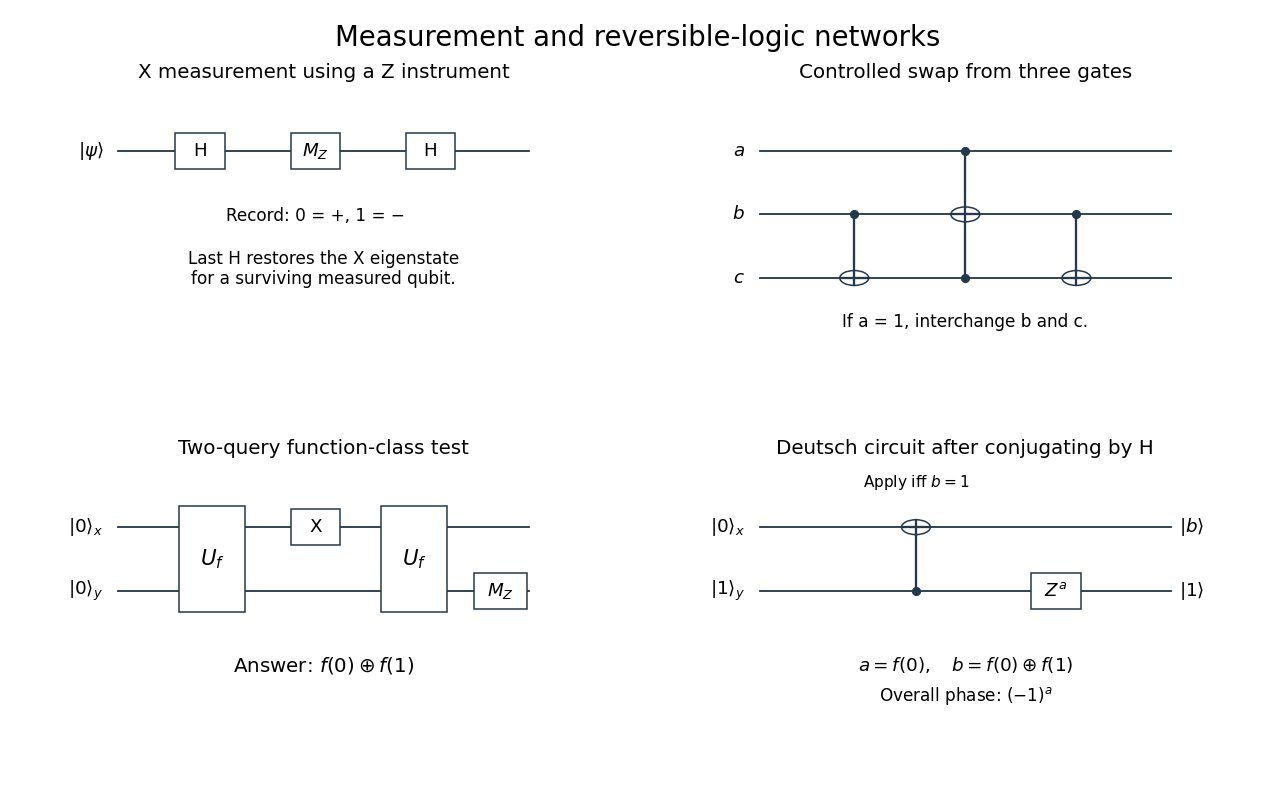
Original networks for X measurement, a controlled swap, two-query parity testing, and the simplified Deutsch circuit
. Time runs left to right. Filled controls and circled targets denote computational-basis controlled-NOT operations. In the last network and ; powers zero omit a gate. Details.
Bob must discard both results. An unread X measurement gives . Each of these two X eigenstates gives Z outcomes with probabilities . The final unread Z measurement therefore givesEquivalently, in the Bloch-vector description the first measurement retains only the X component, and the second retains only the Z component, leaving none. The final state is independent of the original .
Articles by others on the same topic
There are currently no matching articles.