Alice conditions on her observed computational-basis result. For outcome , occurring with probability , her post-measurement density matrix is ; for outcome , occurring with probability , it is . Explicitly,These are the conditional Lüders rule updates for the two rank-one projectors. They assume the corresponding outcome has nonzero probability and Alice knows which one occurred.
Bob knows the initial amplitudes and the measurement basis but not its result, so he averages the two conditional states:The initial matrix had off-diagonal entries and , which the unread measurement removes. Alice's description is conditioned on an available record; Bob's is the nonselective projective measurement mixture. Averaging Alice's records gives exactly Bob's predictions, and communicating the result lets him make the same conditional update. This is a difference of conditioning information, not two inconsistent physical state assignments.
Apply a Hadamard gate before a Z-basis measurement: and . The result probabilities areFor measurement statistics the network is followed by . If the measured qubit survives and should be left in the original X eigenstate, append a second after the nondestructive . The resulting instrument has Kraus operators and , not Z-eigenstate outputs.
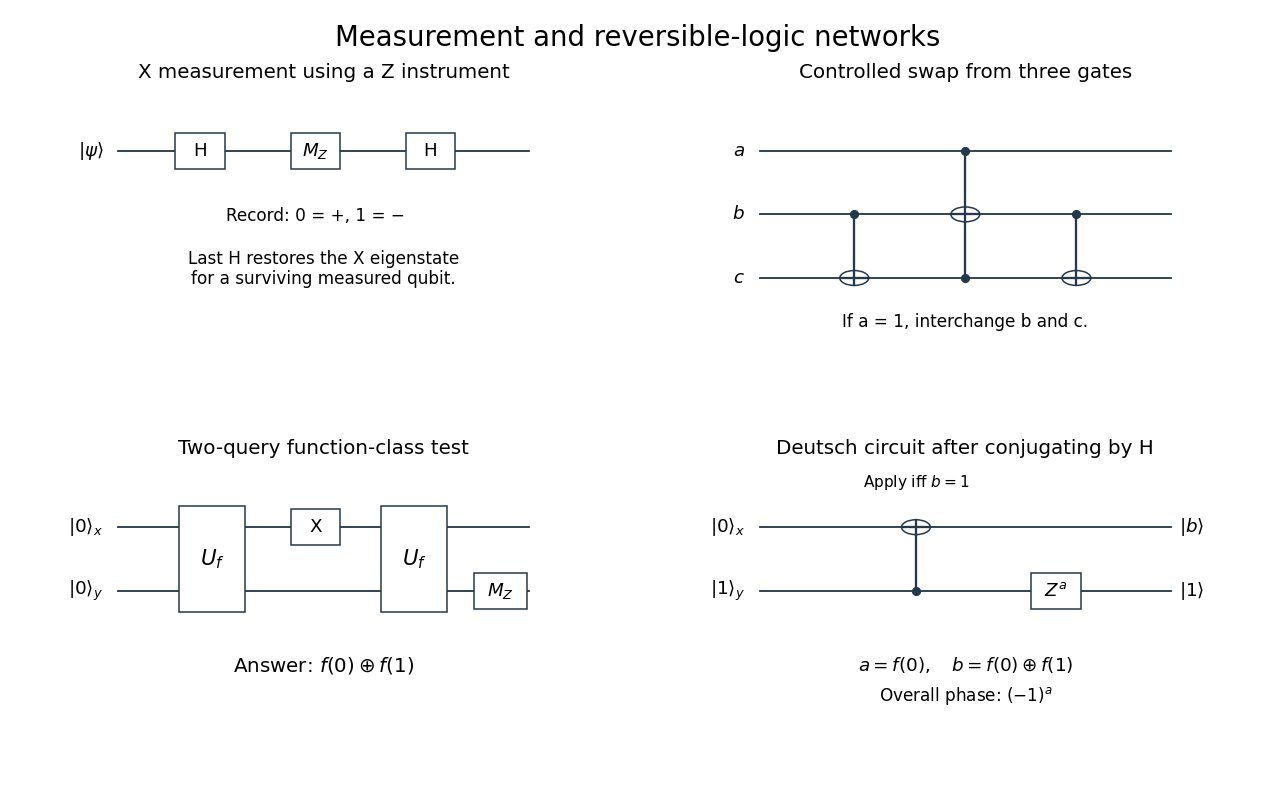
Original networks for X measurement, a controlled swap, two-query parity testing, and the simplified Deutsch circuit
. Time runs left to right. Filled controls and circled targets denote computational-basis controlled-NOT operations. In the last network and ; powers zero omit a gate. Details.
Bob must discard both results. An unread X measurement gives . Each of these two X eigenstates gives Z outcomes with probabilities . The final unread Z measurement therefore givesEquivalently, in the Bloch-vector description the first measurement retains only the X component, and the second retains only the Z component, leaving none. The final state is independent of the original .
Use the fidelity between the original pure state and the measurement output averaged over Calvin's results. Put , so . The output is , andHere is the input Bloch component. If a particular result is specified instead, the conditional fidelities are and ; their outcome-weighted mean is precisely the displayed . This distinction fixes what is meant by the fidelity of the measurement procedure.
Since with , its maximum occurs at or :up to a global phase. These are the eigenstates of the measured observable, so their ideal measurement does not disturb them.
Complete the square: . ThereforeEvery equatorial Bloch-sphere state attains the minimum, not just and . Its unread Z measurement gives , having removed all information contained in its relative phase.
For a uniformly distributed pure qubit on the Bloch sphere, rotational symmetry gives . ThusEquivalently, is uniform on under this measure and . The three positive coordinate-axis states mentioned in the source give , , whose average is the same because this fidelity depends only on the quadratic component . This is a specified uniform-state average, not a statement about every possible prior ensemble.
Assume Alice independently chooses X or Z with equal probabilities and that bit labels identify the corresponding positive and negative eigenstates. If Daisy measures Z, she reads a Z-encoded bit correctly with probability one and an X-encoded bit correctly with probability one half. ThereforeThe probability to read the entire independently encoded -bit check number correctly by this strategy is .
Daisy's random choice of X or Z agrees with Alice's independent random basis with probability . Agreement gives the correct label with certainty and disagreement gives it with probability . Hencethe same result as a fixed Z measurement. Randomizing her basis does not supply the missing information about Alice's choice. These are the probabilities for the two specified strategies, rather than an assertion that they are optimal among all possible quantum measurements.
Alice verifies each submitted qubit in her recorded secret basis and checks its bit against the revealed number. For a forger who chooses X or Z at random and prepares the corresponding known-bit eigenstate, each bit passes with probability . With independent basis choices,The detection probability depends on Daisy's preparation strategy. The question does not restrict her to legitimate X/Z eigenstates. Once the bit is known, for bit zero the averaged acceptance operator isFor bit one it is . Both have largest eigenvalue . Preparing the corresponding eigenstate, a Bloch-vector bisector of the two candidate encodings, achieves this value; for bit zero it is .
The acceptance operator for the whole known check number is , whose largest eigenvalue is , so entangled preparation cannot improve this no-original-note optimum. Therefore unrestricted preparation instead givesThe random-basis value is the elementary protocol calculation; the second value states the best forging strategy allowed by arbitrary state preparation and no access to the original quantum note.
Yes, access to the original qubits can supply information about the secret encoding basis once the bit is known. For bit zero the possibilities are and , whose overlap is ; for bit one they are and with the same overlap magnitude. A Helstrom measurement for two pure states can identify which candidate was supplied more reliably than a blind basis guess. Measuring and preparing a state based on that evidence can improve an additional counterfeit, although the discrimination is not perfect and the measurement can disturb the original.
The no-cloning theorem rules out a deterministic perfect extra copy of both nonorthogonal candidates; it does not imply that access gives no advantage. The task of producing an additional accepted note should also be distinguished from simply returning the unaltered original, which already passes Alice's test. Requiring both the original and the extra note to survive imposes a further information-disturbance tradeoff.
Articles by others on the same topic
There are currently no matching articles.