A version of is an integrable -measurable random variable such thatLet for two versions. It is integrable and -measurable, and its integral over every event is zero. In particular is allowed, giving , so almost surely. Applying the same reasoning to gives almost surely. Therefore almost surely. Equality at every point is not required, since integrals cannot distinguish versions differing on a null set.
conditional dominated convergence theorem states that if almost surely and for an integrable , thenFor an indicator function , , the defining integrals of conditional expectation immediately give the take-out identity: testing on replaces by . Finite linear combinations give it for simple -measurable . Approximating a bounded such by uniformly bounded simple functions and using dominated convergence theorem provesfor bounded .
For the stated unbounded case, clip to . Then and , an integrable bound by hypothesis. conditional dominated convergence theorem and the bounded identity givealmost surely. The equality with the integrable conditional expectation also proves integrability of the final product; it is not necessary to assume that separately.
A process is a supermartingale relative to the given filtration if is -measurable and integrable for each , andIteration gives the equivalent inequality for every . adapted process and integrability are part of the definition, not consequences of the displayed inequality alone.
The products are nonnegative and measurable. independence and the unit means give , so they are integrable.
Let be the natural filtration. It is contained in , so is independent of even if some products have vanished. Using the bounded or integrable nonnegative conditional-product identity,Thus is a martingale in its natural filtration.
Doob's convergence theorem in the form needed here states that a nonnegative supermartingale converges almost surely to a finite integrable limit; more generally a submartingale with uniformly bounded first absolute moments has such an almost sure convergence. Applying it to givesThe expected value bound follows from Fatou's lemma. The theorem does not assert convergence or equality of expected values without a uniform-integrability hypothesis.
There is an indexing error at the printed initial time. The dyadic sigma-algebra is trivial, whereas the stated formula givesThis is not -measurable. Moreover and , so the process cannot be a martingale on all of as printed.
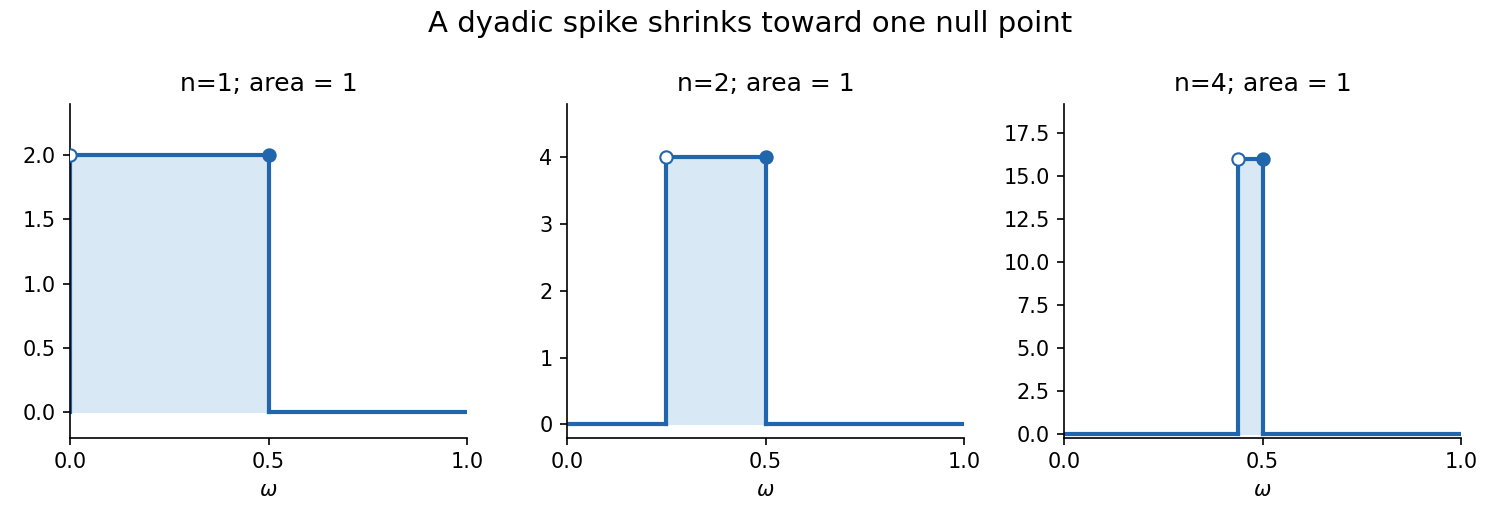
For every , its support is one atom of , so is adapted and integrable with expected value one. At the next dyadic level, splits into two equal-measure children; is zero on its left child and on its right child . Its conditional average on the parent is , and on every other parent it is zero. HenceThus the printed process is a martingale from time one onward. The intended full-index repair is to define and leave all terms unchanged, since then .
If , it eventually lies outside the shrinking intervals, so . At the single null set , the values tend to infinity. ThereforeThe repaired martingale is not uniformly integrable and does not converge in . This is the time-zero correction for a half-point dyadic spike martingale.

Articles by others on the same topic
There are currently no matching articles.