A map between the measurable spaces is measurable whenA real-valued function on is -measurable when it is measurable from to . Equivalently each set is in , since open half-lines generate the Borel sigma-algebra.
A Borel measurable function on the real line is a function measurable with respect to the Borel sigma-algebra on both its domain and range. Continuity is sufficient for this property, but is not required.
Use the characterization of measurability by preimages of open half-lines, allowing intermediate extended-real-valued functions. Put . For each real ,Thus every is measurable. Countable suprema are measurable too, since and the upper half-lines also generate the Borel sigma-algebra. Thereforeis measurable. Its values are real by the stated hypothesis, so it is the required ordinary real-valued measurable function, rather than only an extended-real-valued one.
measurability with respect to gives a Borel set with . Restrict it to the actual image:This is Borel by the assumed Borel property of , and its preimage under is unchanged.
The intervals partition the real line, so their preimages under partition . If two of the restricted sets overlapped, a point in their intersection would equal for some , making lie in two disjoint intervals, a contradiction. Similarly any has a preimage , whose real value belongs to one of those intervals; that puts in the corresponding . Thus the restricted sets are disjoint and their union is exactly . This restriction is what removes arbitrary overlaps of the initially chosen Borel sets outside the image.
If , all indicator functions vanish and . If , the partition in part (i) puts it in exactly one , so exactly one term can be nonzero and the sum is a finite real number at that point. There is no ambiguous infinite sum of positive and negative terms.
For measurability, each symmetric partial sumis Borel measurable by closure under finite linear combinations. For each , these partial sums eventually include its unique possible term and converge to . The measurable-limit result from part (a) therefore proves is Borel measurable.
The two child intervals partition their parent:Their preimages under satisfy the same identity. Since all sets lie inside and is onto its image, equality of their preimages under impliesOn the first child, ; on the second it is . Outside the image both functions are zero. ThusFor , summing these bounds givesThis tends to zero uniformly in , proving that each real sequence is Cauchy and has a finite limit.
For , let be the unique index such that . Then and . The chosen interval is open on the left and closed on the right, soThis remains correct at dyadic endpoints; changing it to a floor approximation with a non-strict left endpoint would describe a different approximation.
By part (iii), define the finite limit for every . Part (a) makes this limit Borel measurable. Letting in the displayed error bound givesThis is the factorization conclusion of the Doob-Dynkin lemma under the specified Borel-image hypothesis.
A real-valued random variable is a map measurable from to the Borel real line. Equivalently,Its values are finite real numbers here; extended-real-valued random variables require a correspondingly enlarged target.
For two real-valued random variables and each real ,If , density of the rationals supplies with ; conversely either pair of inequalities in the union implies . Every set in the countable union is measurable, so the half-line criterion proves measurability of . Its values are real, and induction gives every finite sum is a real-valued random variable.
Expand the fourth power and take expected values. independence factors products involving distinct indices, and centering makes every term with an index occurring just once have expected value zero. The only surviving index patterns are four equal indices and two pairs. There are six orderings of each pair pattern, soUniform boundedness gives and . HenceIdentical distributions were never used: only independence, the common bound, and zero means are needed.
The summands are nonnegative, so monotone convergence theorem, equivalently Tonelli's theorem for a sum, givesA nonnegative random variable with finite expected value is finite almost surely. Thus the displayed nonnegative series converges almost surely, forcing its individual terms to tend to zero. Taking fourth roots provesThis is a fourth-moment proof of a strong law of large numbers for these bounded independent variables, without an identical-distribution assumption.
A version of is an integrable -measurable random variable such thatLet for two versions. It is integrable and -measurable, and its integral over every event is zero. In particular is allowed, giving , so almost surely. Applying the same reasoning to gives almost surely. Therefore almost surely. Equality at every point is not required, since integrals cannot distinguish versions differing on a null set.
conditional dominated convergence theorem states that if almost surely and for an integrable , thenFor an indicator function , , the defining integrals of conditional expectation immediately give the take-out identity: testing on replaces by . Finite linear combinations give it for simple -measurable . Approximating a bounded such by uniformly bounded simple functions and using dominated convergence theorem provesfor bounded .
For the stated unbounded case, clip to . Then and , an integrable bound by hypothesis. conditional dominated convergence theorem and the bounded identity givealmost surely. The equality with the integrable conditional expectation also proves integrability of the final product; it is not necessary to assume that separately.
A process is a supermartingale relative to the given filtration if is -measurable and integrable for each , andIteration gives the equivalent inequality for every . adapted process and integrability are part of the definition, not consequences of the displayed inequality alone.
The products are nonnegative and measurable. independence and the unit means give , so they are integrable.
Let be the natural filtration. It is contained in , so is independent of even if some products have vanished. Using the bounded or integrable nonnegative conditional-product identity,Thus is a martingale in its natural filtration.
Doob's convergence theorem in the form needed here states that a nonnegative supermartingale converges almost surely to a finite integrable limit; more generally a submartingale with uniformly bounded first absolute moments has such an almost sure convergence. Applying it to givesThe expected value bound follows from Fatou's lemma. The theorem does not assert convergence or equality of expected values without a uniform-integrability hypothesis.
There is an indexing error at the printed initial time. The dyadic sigma-algebra is trivial, whereas the stated formula givesThis is not -measurable. Moreover and , so the process cannot be a martingale on all of as printed.
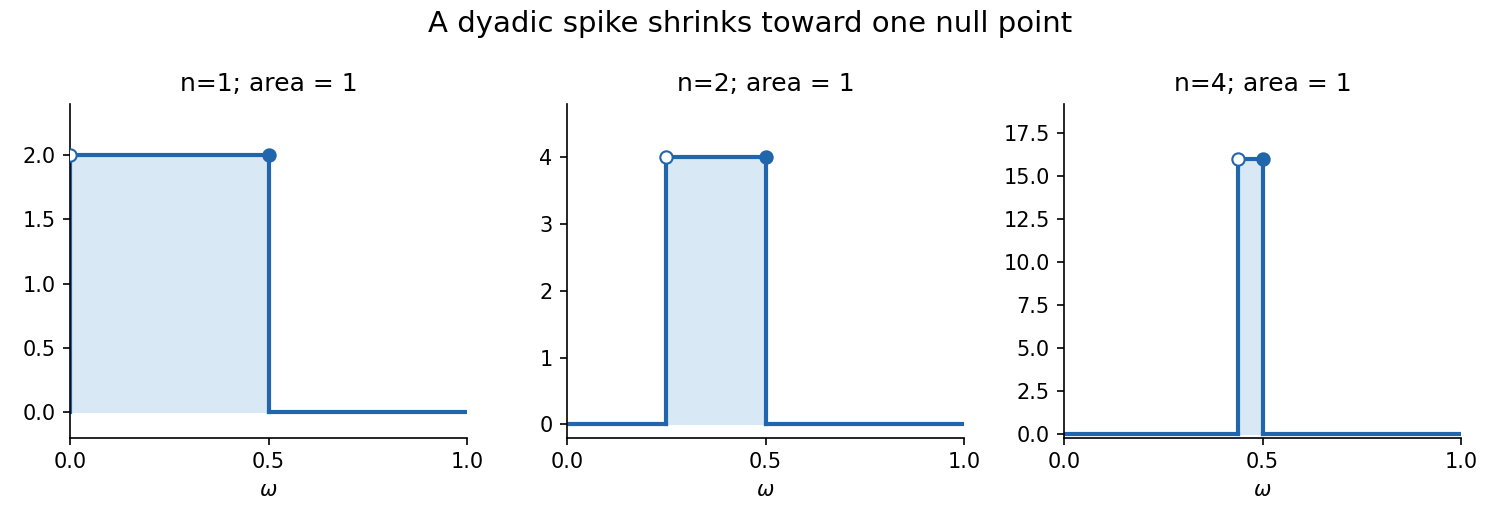
For every , its support is one atom of , so is adapted and integrable with expected value one. At the next dyadic level, splits into two equal-measure children; is zero on its left child and on its right child . Its conditional average on the parent is , and on every other parent it is zero. HenceThus the printed process is a martingale from time one onward. The intended full-index repair is to define and leave all terms unchanged, since then .
If , it eventually lies outside the shrinking intervals, so . At the single null set , the values tend to infinity. ThereforeThe repaired martingale is not uniformly integrable and does not converge in . This is the time-zero correction for a half-point dyadic spike martingale.

A family of sigma-algebras is independent if for every finite collection of distinct indices and sets ,A family of random variables is independent if its generated sigma-algebras are independent. Equivalently, the displayed product identity holds for the events with arbitrary Borel . Pairwise independence alone is weaker and does not suffice for a family.
The pi-systems criterion says that if are pi-systems and for all , , then their generated sigma-algebras are independent. Necessity is immediate. We may add to either pi-system, since it does not alter the generated sigma-algebra or the product identities.
For sufficiency, fix and defineIt contains , is closed under complements by subtraction from , and is closed under countable disjoint unions by countable additivity. Thus it is a lambda-system. It contains , so the pi-lambda theorem gives .
Now fix any and apply the same lambda-system argument to the sets satisfying the identity. The first step shows that this lambda-system contains , so it contains all . Thus the product identity holds on both entire sigma-algebras, proving their independence.
The tail sigma-algebra isFix . independence of the variables and the pi-systems criterion imply independence of from . Hence is independent of every finite-head sigma-algebra .
The increasing union is an algebra, hence a pi-system, and generates . Another pi-lambda argument extends the equality from that union to all of . Since itself belongs to , take :ThereforeThis is Kolmogorov zero-one law; no moment assumptions on the variables are needed.
Let be the event that the sample averages have a limit in the extended real number line. It is measurable: the bounded sequence converges exactly when it is Cauchy, and the Cauchy condition is a countable combination of measurable inequalities. Limits at correspond to extended limits .
For each fixed , remove the first terms and setThe difference tends to zero for every outcome, since the finitely many variables are real-valued. Thus these two sequences have an extended limit simultaneously. Equivalently their arctangents differ by a quantity tending to zero, because arctangent is Lipschitz. The event is therefore expressible using alone. Since this holds for every , .
Kolmogorov's law gives or one. In the latter case the measurable extended variable , redefined on a null set if needed, is the almost sure convergence. In the former there is almost surely no extended-real limit. Hence extended convergence occurs almost surely, or divergence occurs almost surely. The law need not make the value of a possible limit finite.
Articles by others on the same topic
There are currently no matching articles.