Assume a thin cylindrical wall, uniform internal pressure and closed ends carrying the pressure load. The radial stress is small compared with the membrane stresses when .
For an end cap, the outward pressure force is . The wall's axial tensile force is . Equilibrium therefore givesFor a longitudinally split half-cylinder of length , pressure has resultant across the projected rectangular area. Two cut wall sections each carry , soThus hoop stress is twice the closed-end axial stress in this model. An open-ended tube without an external end load does not acquire the same pressure-induced axial membrane stress.
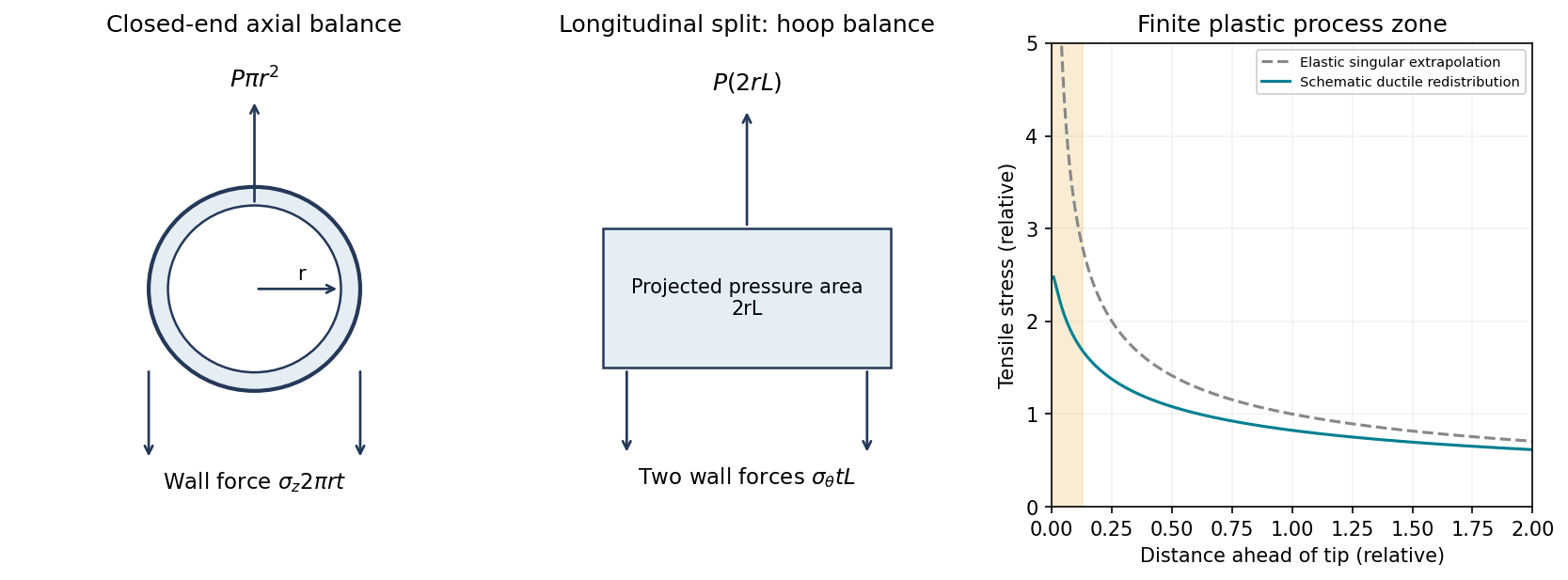
Original thin-pipe force balances and schematic crack-tip stress regularization by plastic deformation; the plastic-zone curve is qualitative
. Details. 
Linear elastic fracture mechanics predicts a near-tip tensile stress varying approximately asA ductile material yields near the tip before that mathematical singularity can be realized. Plastic deformation blunts the crack and redistributes stress over a finite process zone, as shown in the right-hand diagram. Constraint can sustain stresses above the uniaxial yield stress, so the schematic plateau should not be interpreted as a universal exactly- cap.
A useful process-zone scale is with a geometry- and constraint-dependent coefficient. Advancing the crack then requires energy for plastic deformation and other irreversible processes as well as forming new surfaces. Consequently the critical energy release rate is much larger than the reversible surface-energy term of a perfectly brittle idealization:In a small-scale-yielding plane-strain description, with . Large-scale yielding requires an elastic-plastic measure rather than treating a linear-elastic stress-intensity criterion as exact. The increased dissipation and crack-tip blunting explain the larger energy requirement.
Let be a characteristic crack depth and its geometry factor. A simple fast-fracture condition isThe crack should penetrate a wall of thickness before reaching the critical size, so the simplified leak-before-break criterion is , with appropriate geometry and stable-through-wall-crack assumptions.
The conventional material-based maximum thickness uses the yield stress as a conservative limiting operating stress:It ensures that the depth required for penetration is subcritical even at the stated limiting stress. Geometrical factors depend on crack shape and orientation; this is an educational screening estimate rather than a full crack-growth or leak-detection analysis. The handbook's fracture formula uses the same stress-intensity and geometry-factor convention.[ref]
Materials Data Book by Cambridge University Engineering Department. 2011 edition revised2019, printed p.6, Fast Fracture; this confirms the formula convention, not the exact2018NST supplied values
There is an important distinction if the actual pressure and radius are fixed while thickness varies. Substituting at penetration givesThat is a lower, not upper, bound on thickness under the fixed-pressure model. Yield avoidance additionally requires . It would be inconsistent to derive the fixed-pressure expression and call it a maximum. The standard maximum quoted above answers a different, yield-limited material-selection comparison.
For the aluminium alloy, write and for the appropriate data-book properties at the relevant material state and temperature. The yield-limited screening bounds from part(c), with , areFor in and in , the numerical substitutions are and .
A high-strength alloy's large yield stress can require a small allowable leak-before-break thickness even when its minimum pressure thickness is modest. FCC structure generally favors low-temperature plasticity, but does not by itself establish the alloy's fracture toughness, weld performance, corrosion behavior or fatigue resistance.
TODO: exact numerical thickness pending the identified 2018 NST Data Book values and alloy condition. The accessible Engineering2011/revised2019 book is not confirmed as the supplied edition; generic aluminium property ranges are not substituted as if they were the exam's values.
For Ti–6Al–4V, use its own fracture toughness and yield stress inThe same unit-conversion formulas from part(i) apply. A feasible yield-limited screening interval requires , using consistent crack geometry and low-temperature properties.
High specific strength and corrosion resistance can be attractive, but cost, fabrication, joining and toughness must also be assessed. The label HCP is not a sufficient rule that every titanium alloy has the same sharp ductile-to-brittle transition as ferritic steel; actual low-temperature alloy and microstructural data are needed.
TODO: exact numerical thickness pending the 2018 NST Data Book's Ti–6Al–4V property pair. No historical value or material-specific Arctic toughness is invented.
For mild steel, the corresponding bounds areA relatively low yield stress increases the thickness needed to carry pressure, but a favorable toughness-to-yield-strength ratio can give a much larger leak-before-break upper bound. This tradeoff often makes a tough structural steel more attractive than choosing the highest strength alone.
For Arctic service, the ductile-to-brittle transition is crucial. A room-temperature toughness cannot be assumed to persist below the transition, and welding, constraint and loading rate affect the comparison. A suitably qualified low-temperature steel can be practical; the word mild alone does not establish that qualification.
TODO: exact numerical thickness pending the 2018 NST Data Book values. The temperature and state of the tabulated toughness must also be identified before making a numerical service claim.
For high-strength steel, useAt fixed toughness, raising yield stress reduces quadratically but reduces the required pressure thickness only linearly. Thus a higher-strength grade can have a worse leak-before-break screening margin. The relevant screening combination is , since simultaneous satisfaction requiresUse measured low-temperature toughness and appropriate joining/environmental performance; strength alone does not establish suitability. The comparison also has to remain within the thin-wall approximation.
Articles by others on the same topic
There are currently no matching articles.