For two nonparallel vectors , a nontrivial relation would make one a scalar multiple of the other. They are therefore linearly independent. Two independent vectors in a two-dimensional vector space form a basis.
Likewise, three vectors in that are not contained in one plane through the origin cannot obey a nontrivial linear dependence: such a relation would express one as a combination of the other two, or already make that pair dependent. Thus they are independent and form a basis of . The plane condition here is linear coplanarity with the origin, as required for vectors, rather than affine coplanarity of three arbitrary points.
Let , since the original vectors form a basis. The reciprocal basis isTaking the dot product with each gives , using orthogonality of a cross product and cyclic symmetry of the scalar triple product. If , taking its dot product with yields . The three reciprocal vectors are therefore linearly independent and form a basis of .
Equivalently, if has columns and columns , then , so . In particular any vector has coordinates , even when the original basis is not orthonormal.
Provided are linearly independent, their linear combinations fill a two-dimensional direction space. Adding translates it to the plane through . The unit normal and constant areThen for every pair of parameters. Conversely a point satisfying differs from by a vector in , proving that the two descriptions give exactly the same plane.
For the three points, choose , and . Their cross product is , which is nonzero. The plane therefore has equationEach supplied point satisfies it. Its unit normal is , up to an overall sign, and .
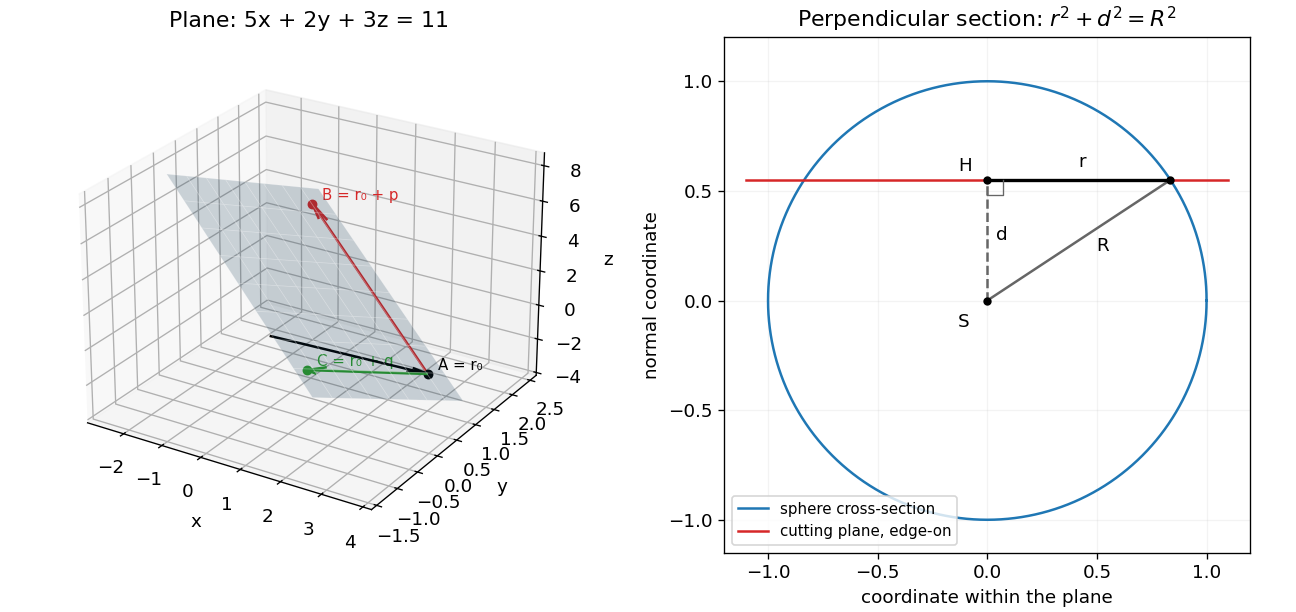

Let be the sphere centre. The circle centre is its perpendicular projection onto the plane:For the specific plane this isFor a point on the section, its displacement from lies in the plane and is perpendicular to . The Pythagorean theorem therefore givesA genuine circle requires . At the section is a single tangent point, and at the plane misses the sphere. A central cut gives a great circle of radius .
Articles by others on the same topic
There are currently no matching articles.