Since , the two square roots are and . The principal square root is , whose real part isIf the notation is meant to include both square-root values, their real parts are and . Stating the principal-branch convention removes that ambiguity.
For , the finite geometric series givesThe exponential prefactor has modulus one. ThusAt an excluded phase every summand is one, which supplies the removable limiting value directly. Here is a positive integer.
From the exponential definition, . ThereforeA cosine of a nonreal argument need not lie between and ; that bound applies to real arguments.
An integrating factor for is a nonzero function , chosen so that . Integrating this total derivative reduces the first-order linear ordinary differential equation to one quadrature.
For the given nonlinear equation, let , so . Multiplication by gives . Using the integrating factor , or recognizing the particular solution , yields . The initial value gives and selects the positive branch:The radicand is strictly positive for every real . This solution never reaches the singular denominator of the original equation, so multiplication by has introduced no forbidden crossing. The negative branch would violate .
Let with and . Then , while taking the complex conjugate gives . Since , every eigenvalue of a Hermitian matrix is real.
If and , thenDistinct eigenvalues therefore force : their eigenvectors are orthogonal in the Hermitian inner product. A degenerate eigenvalue occurs more than once in the spectrum, counted with multiplicity. For a Hermitian matrix, its algebraic multiplicity equals its geometric multiplicity, so degeneracy gives an eigenspace of dimension greater than one; an orthonormal basis can be chosen within it.
A unitary matrix preserves the Hermitian inner product and hence the norm. If with , thenDividing by the positive squared norm givesUnlike the Hermitian case, this constrains eigenvalues to the unit circle, not necessarily the real axis.
Subtracting the second equation from the first gives . With this is , whereas the third equation requires . Consistency therefore requiresAt that value one parameter remains free:Thus the solution is not unique. For any other the two required values of conflict and the linear system has no solution.
For and , the third equation gives . Combining it with gives and , after which the second equation gives . HenceThe coefficient matrix has determinant , proving uniqueness. Direct substitution gives the required right-hand sides , and .
For a unit vector, the radial coordinate is and the spherical coordinates giveThe Pauli matrices therefore giveThe diagonal entries are real and the off-diagonal entries are complex conjugates, so . Its trace is zero and its determinant is , giving eigenvalues and . A convenient orthonormal eigenbasis isThe half-angle identities verify , and . Multiplication of either vector by any unit-modulus phase gives an equivalent normalized eigenvector. At a pole, the azimuth is undefined geometrically, but the remaining phase freedom makes the chosen expressions consistent with the same one-dimensional eigenspaces.
With the Einstein summation convention, the magnetic force has components . Thus its matrix acting on velocity isThe Levi-Civita symbol changes sign on exchanging , so ; the diagonal vanishes and the matrix has zero trace. For nonzero , , exhibiting a nontrivial kernel and proving noninvertibility. If or , is the zero matrix and is again noninvertible.
Equivalently, an odd-dimensional real antisymmetric matrix has , hence zero determinant. The same antisymmetry gives , expressing that the magnetic force does no work.
For , use the Euler differential equation substitution , so , and . The transformed equation isIts characteristic polynomial factors as . The forcing coincides with a homogeneous solution, so the method of undetermined coefficients requires a particular solution . Substitution gives , hence . Transforming back,The conditions at give and , soDifferentiating confirms both initial values and the original equation. The solution interval containing excludes the singular point .
Using the complex forcing method for a real differential equation, , a suitable complex forcing is . Solve and take its imaginary part. Writing reduces the equation toA linear polynomial gives and . ThusFor a direct check, , while . Their sum is the required forcing. Adding gives the full real solution if needed.
Let the columns of the given unitary matrix be , with . Columnwise, for . Multiplication by and unitarity giveThe premise includes an orthonormal eigenbasis. It is not true that an arbitrary matrix admits such a basis; over it exists precisely for a normal matrix. The real symmetric inertia matrix in part (b) does satisfy the required condition.
In the quadratic form, the two equal off-diagonal contributions together supply the mixed term. Comparing coefficients givesFor a nontrivial physical moment of inertia scale take ; then this inertia tensor is positive definite.
The normalized vectors and give eigenvalues and . ThereforeThe columns are orthonormal, so and direct multiplication verifies . Signs of individual eigenvectors are free; the displayed signs also make .
The matrix has the standard rotation matrix form , with . ThusWith , the new first axis points along the original direction and is counterclockwise from the original first axis. Specifying this coordinate convention avoids confusing rotation of the axes with the inverse transformation of component columns.
Substituting and using the diagonalization givesFor and energy level one in the chosen units, its ellipse equation isThe major semiaxis has length along ; the minor semiaxis has length along . The full axis lengths are and . The original-coordinate curve is the same ellipse tilted by , elongated along ; an orthogonal coordinate change preserves lengths and does not change the ellipse itself.
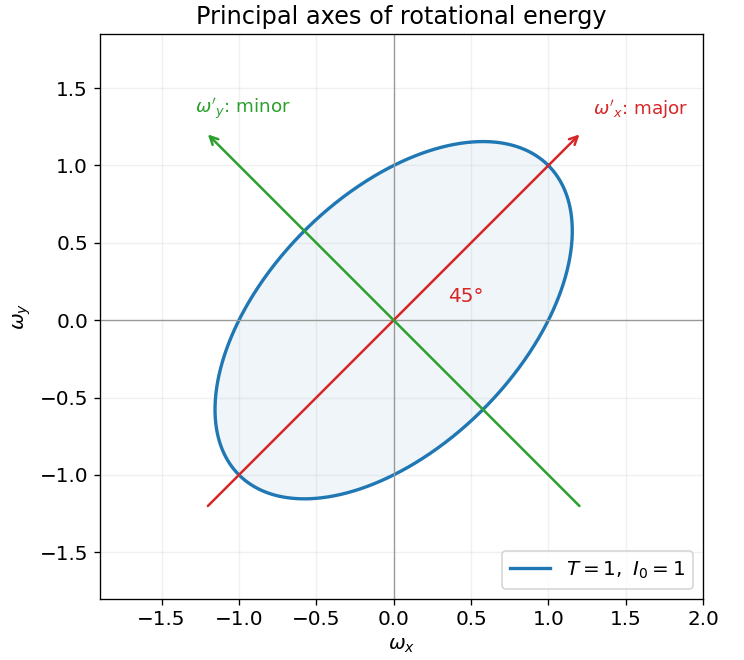
Principal axes of the rotational-energy ellipse
. Original plot at I0 equal to one and energy equal to one, showing the longer axis along the normalized (1,1) eigenvector and the shorter perpendicular axis. Details.
A map between vector spaces over the same field is linear when for every and scalars . Its kernel is . It contains zero because . If , thenThus it is closed under linear combinations and is a vector subspace of . No injectivity or equality of the dimensions of is needed.
Write both cross products with the Levi-Civita symbol. Its contraction identity givesTherefore the vector triple product identity isThe order matters: the cross product is not associative, and exchanging the two nested arrangements changes the expression.
The vector triple product with givesThis is the orthogonal projection onto a plane perpendicular to , so it is a linear map. Its image is the plane through the origin, while its kernel is the normal line . In components,The equation is equivalent to , hence to . Its solution set is precisely the two-dimensional plane , with infinitely many nonzero vectors, not merely the normal line. These are the eigenvectors with eigenvalue one; the normal direction has eigenvalue zero.
For two nonparallel vectors , a nontrivial relation would make one a scalar multiple of the other. They are therefore linearly independent. Two independent vectors in a two-dimensional vector space form a basis.
Likewise, three vectors in that are not contained in one plane through the origin cannot obey a nontrivial linear dependence: such a relation would express one as a combination of the other two, or already make that pair dependent. Thus they are independent and form a basis of . The plane condition here is linear coplanarity with the origin, as required for vectors, rather than affine coplanarity of three arbitrary points.
Let , since the original vectors form a basis. The reciprocal basis isTaking the dot product with each gives , using orthogonality of a cross product and cyclic symmetry of the scalar triple product. If , taking its dot product with yields . The three reciprocal vectors are therefore linearly independent and form a basis of .
Equivalently, if has columns and columns , then , so . In particular any vector has coordinates , even when the original basis is not orthonormal.
Provided are linearly independent, their linear combinations fill a two-dimensional direction space. Adding translates it to the plane through . The unit normal and constant areThen for every pair of parameters. Conversely a point satisfying differs from by a vector in , proving that the two descriptions give exactly the same plane.
For the three points, choose , and . Their cross product is , which is nonzero. The plane therefore has equationEach supplied point satisfies it. Its unit normal is , up to an overall sign, and .
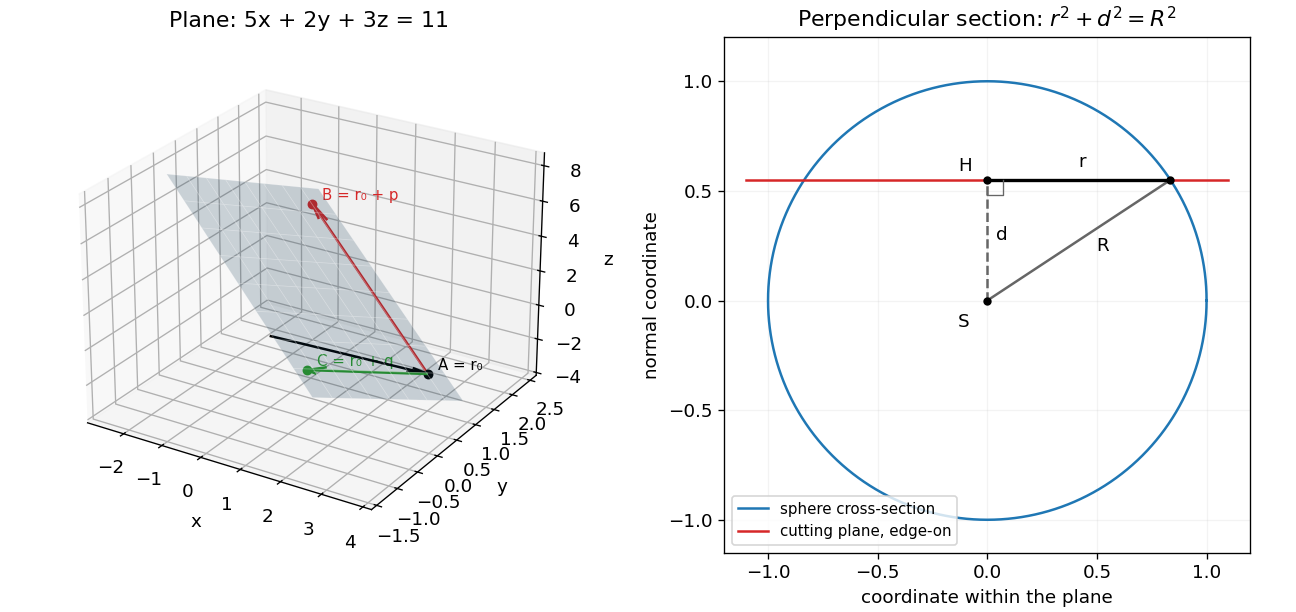

Let be the sphere centre. The circle centre is its perpendicular projection onto the plane:For the specific plane this isFor a point on the section, its displacement from lies in the plane and is perpendicular to . The Pythagorean theorem therefore givesA genuine circle requires . At the section is a single tangent point, and at the plane misses the sphere. A central cut gives a great circle of radius .
Articles by others on the same topic
There are currently no matching articles.