For a purely imaginary candidate , , the imaginary part of the polynomial is . The candidate is not a root, while both make the real part zero. The resulting factorization into quadratic polynomials givesThe roots of a polynomial sum to and have product , as required by Vieta's formulas for a monic quartic with cubic coefficient and constant coefficient .
Expand using De Moivre's theorem, then divide its imaginary and real parts by . With , this givesThe quotient holds where its denominator and are nonzero. At , use the undivided real-part identity: implies . Thus . Since , the smaller positive value applies:This limiting step avoids treating an undefined value of as an ordinary finite number.
A plane through with nonzero normal vector consists of the position vectors satisfying . Thus , with . When is a unit vector, is the signed distance from the origin in the direction ; for an unnormalized normal vector, that distance is . The displacement within the plane is perpendicular to .
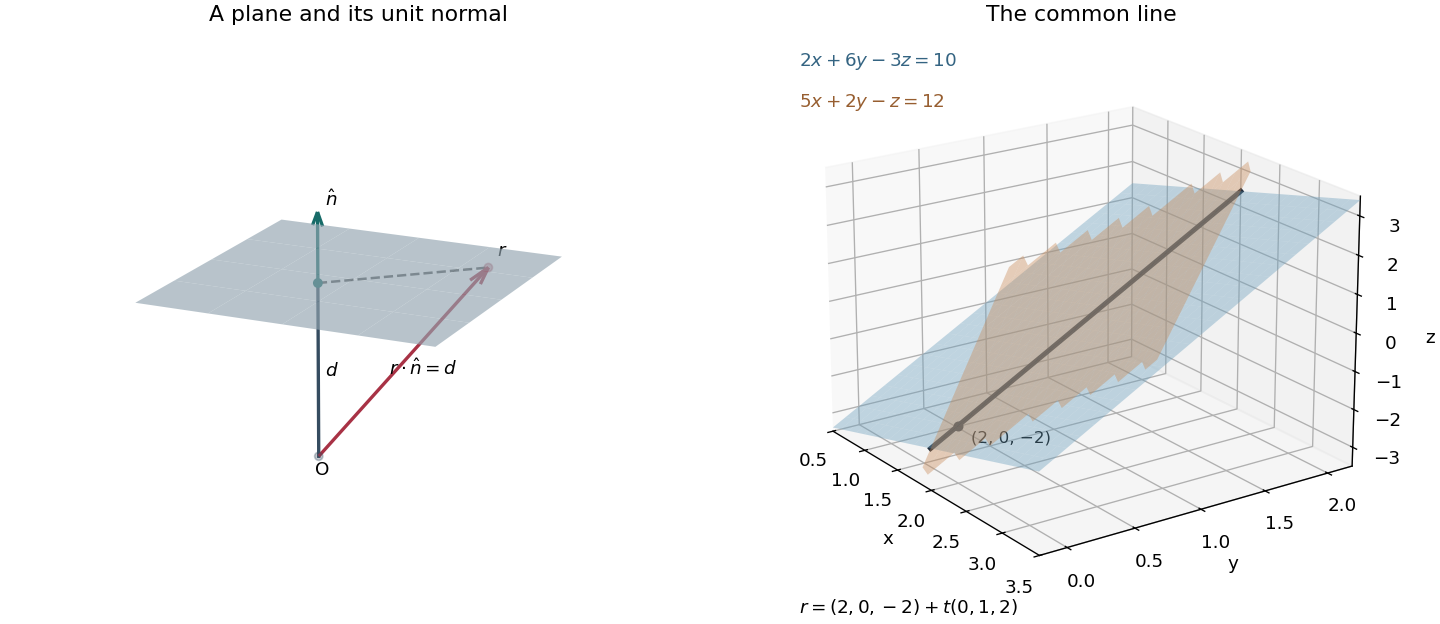
A unit normal vector and signed plane distance, followed by the intersection of two planes as a straight line
. Details. 
The cross product of the two normal vectors is , so their intersection of two planes has direction . Eliminating gives , and substitution then gives . Thus the Cartesian constraints and parametric equation of a straight line areThere is no valid division by a zero component in a symmetric ratio form; retaining explicitly handles that component.
Articles by others on the same topic
There are currently no matching articles.