For a separated solution , the wave equation gives . Choose the separation constant . ThenThese are the oscillatory separated building blocks. Since no endpoint conditions have yet been imposed, the general solution is a superposition over the allowed continuum of , rather than one product with four constants. Equivalently, combining the left- and right-travelling separated components gives the D'Alembert's formulawith arbitrary twice differentiable functions on the relevant characteristic intervals. Indeed, in characteristic coordinates , , the equation becomes , whose general solution is exactly this sum. This also includes zero-frequency and polynomial limits that would be omitted by restricting to one nonzero- sine mode.
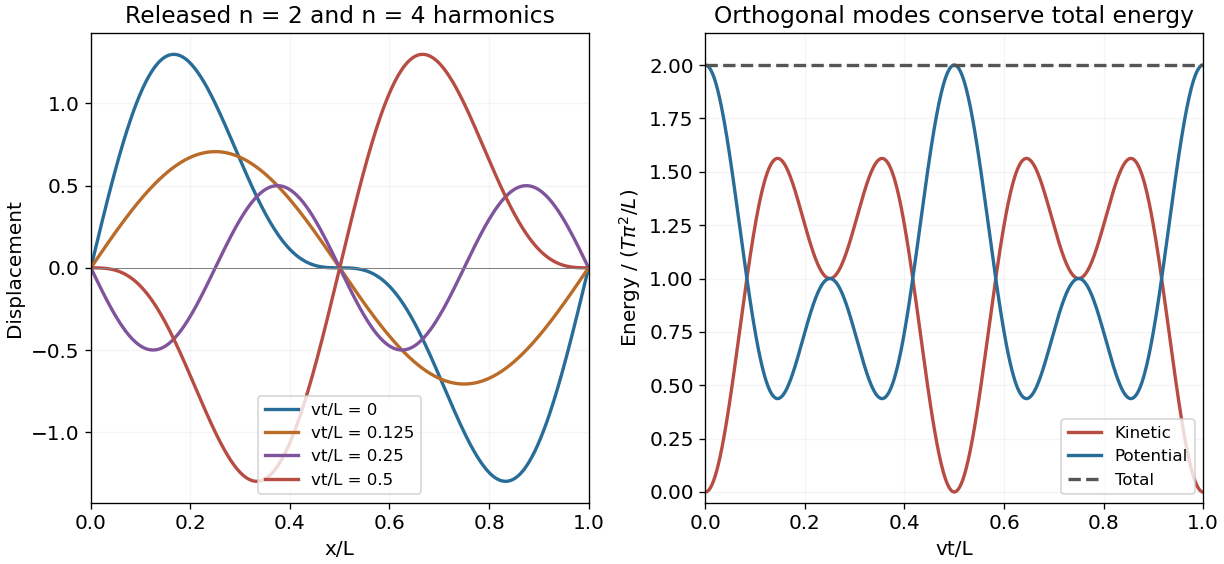
Fixed endpoints select sine normal modes with and . The product identity decomposes the held initial profile into and , with amplitudes and . Zero initial velocity selects cosine time dependence. ThereforeBoth endpoints vanish at every time. At the product-form displacement is recovered and . The implicit leading displacement amplitude is one in the source's chosen length units; including a physical amplitude multiplies the whole solution by .
The total kinetic energy and small-slope elastic potential energy areOrthogonality removes cross terms between the two distinct sine or cosine modes. A mode of amplitude contributes and . For amplitudes and , the prefactors agree. Writing ,Thusindependent of time. This is another instance of equal modal energies for inverse-harmonic string amplitudes. An explicit initial amplitude multiplies every energy by .

Articles by others on the same topic
There are currently no matching articles.