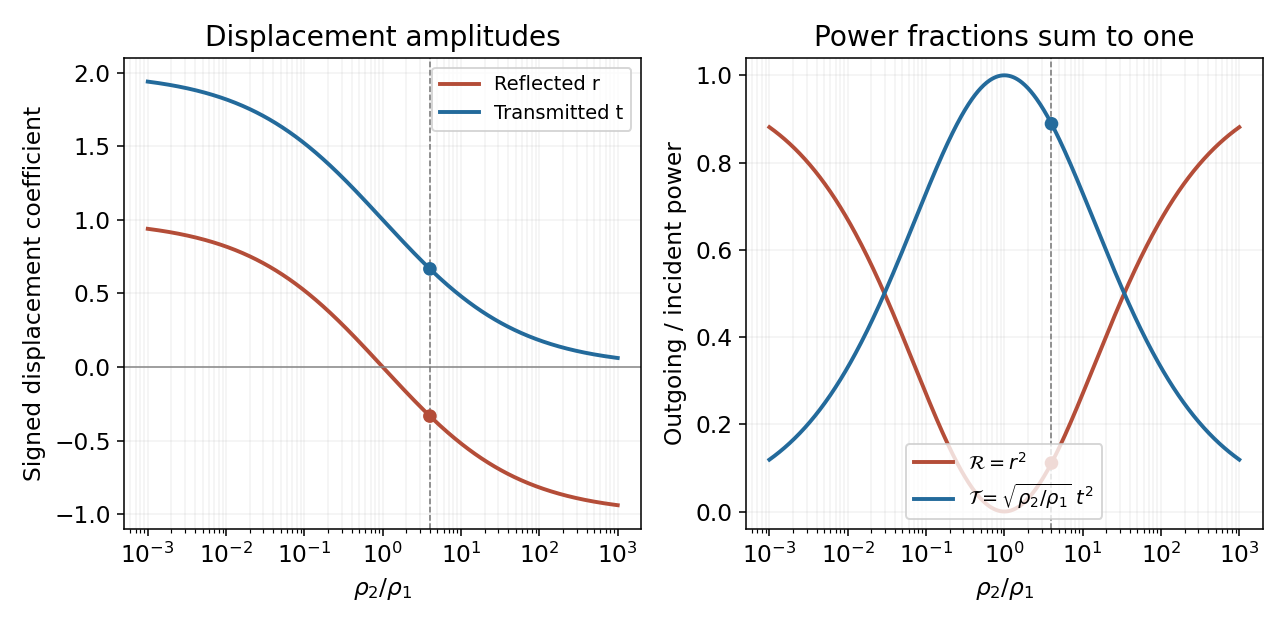
The transmitted and incident waves have the same angular frequency and tension, but the transmitted wavenumber is twice as large. The time-average string-power formula therefore givesThe extra factor is essential. Squaring the displacement transmission coefficient alone would give , which is not the transmitted power fraction in strings with different linear mass densities.
The reflected wave remains on the incident string, so its wavenumber magnitude is still . Its outward power magnitude isThus , verifying energy conservation. With signed positive- fluxes, and the same statement is . The minus sign of the reflected displacement is a phase reversal, whereas the minus sign of its flux records travel in the opposite direction; these are different uses of a sign.

Articles by others on the same topic
There are currently no matching articles.