For an equilibrium string segment of length , the mass is . Under the small-slope approximation, the transverse tension component at an endpoint is . The difference between its two endpoint contributions is .
Newton's second law in the transverse direction gives . Cancelling the segment length producesThis wave equation assumes a uniform string, small slopes, negligible gravity and negligible bending stiffness. Longitudinal changes in tension and the difference between actual and equilibrium segment length contribute only beyond the linear approximation used here.
The instantaneous energy flux towards positive is the rate at which the string on the left does work on the string on the right. To first order its transverse force is , soFor a right-travelling sinusoidal wave , and . ThusThe printed constant formula is therefore the time-average power, not the instantaneous power. The latter oscillates between zero and twice its average. A left-travelling wave carries negative signed flux through the same positively oriented section; its transported power magnitude has the same average formula with positive .
Place the massless junction at , with common tension on both sides. Using a common time factor , write the left-hand wave as and the right-hand wave as . A stationary junction does not change the frequency, while .
displacement continuity requires . Transverse force balance on a massless junction requires equal tension-weighted slopes, giving . Hence the signed displacement coefficients areHere , so and . The negative reflected coefficient signifies inversion. If “reflection and transmission coefficients” instead denotes power fractions, their values are and , as derived separately below; power and displacement coefficients must not be conflated.
The transmitted and incident waves have the same angular frequency and tension, but the transmitted wavenumber is twice as large. The time-average string-power formula therefore givesThe extra factor is essential. Squaring the displacement transmission coefficient alone would give , which is not the transmitted power fraction in strings with different linear mass densities.
The reflected wave remains on the incident string, so its wavenumber magnitude is still . Its outward power magnitude isThus , verifying energy conservation. With signed positive- fluxes, and the same statement is . The minus sign of the reflected displacement is a phase reversal, whereas the minus sign of its flux records travel in the opposite direction; these are different uses of a sign.
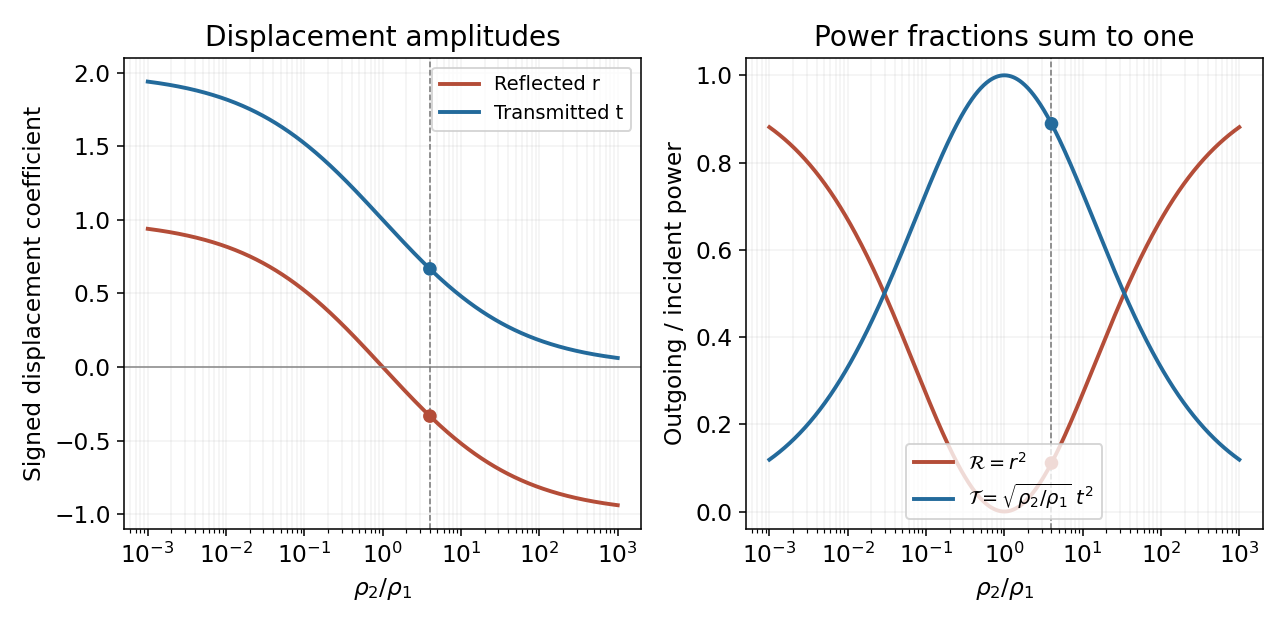

For equal linear mass densities and common tension, . The junction relations then giveThere is no mechanical-impedance discontinuity, so no reflected wave is needed to satisfy displacement and force continuity. The transmitted displacement is in phase with the incident wave and has the same amplitude; all incident power crosses the junction.
If , then and the wave meets a much larger string impedance. The displacement and power coefficients approachThe junction behaves approximately as a fixed end. The reflected displacement reverses sign, corresponding to a phase shift of ; the small transmitted displacement is not inverted. For a large but finite density ratio, and the transmitted power fraction is about , tending to zero rather than vanishing identically at every finite ratio.
If , then and the junction behaves approximately as a free end for the incident string. The limits areThe reflected displacement is not inverted, and at the junction it adds in phase to the incident displacement, producing nearly twice its amplitude. The transmitted displacement is also in phase. A transmission amplitude near two does not create power: the lighter string has much smaller impedance, and . These are limiting statements for positive densities, not an ordinary propagating-wave model for an exactly massless second string.
Articles by others on the same topic
There are currently no matching articles.