For a uniform string, let . A separated mode obeys , . Fixed ends require , soThe first three normal modes have one, two and three half-waves respectively. Their interior nodes of a standing wave are at for .
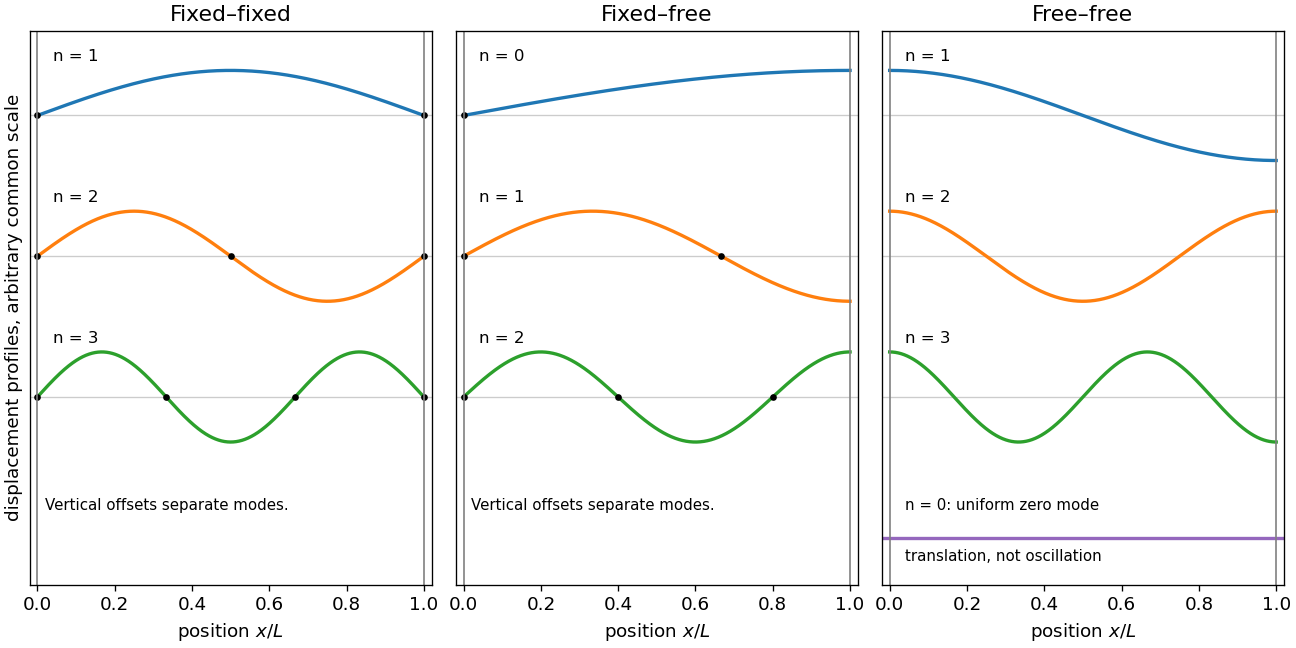

A free end has zero transverse force, hence , rather than zero displacement. With , write . The remaining condition is , givingThe first three shapes have one, three and five quarter-waves. Each has a node of a standing wave at the fixed end and an antinode at the free end; the mode frequencies are in the ratio .
Free ends give , so the oscillatory normal modes areThere is also the zero mode , with uniform displacement : a free string can translate without a restoring force. It is not a positive-frequency oscillation. The first three oscillatory shapes are , and , with an antinode at each end. The figure includes the uniform mode too, so that the zero-frequency limit is explicit.
Articles by others on the same topic
There are currently no matching articles.