For two equal-amplitude waves with the same frequency and wavenumber, choose their phases so thatThe spatial amplitude and temporal oscillation separate. Positions with are fixed nodes of a standing wave, while positions with are antinodes. Different initial phases merely shift this pattern in space and time.
A travelling wave has a phase profile that moves at its phase velocity; a standing wave has stationary nodes and each point oscillates with its fixed local amplitude. The two counterpropagating waves carry equal opposite time-averaged energy flux, so their superposition has zero net time-averaged energy transport. Instantaneous energy can still move within the standing pattern.
For a uniform string, let . A separated mode obeys , . Fixed ends require , soThe first three normal modes have one, two and three half-waves respectively. Their interior nodes of a standing wave are at for .
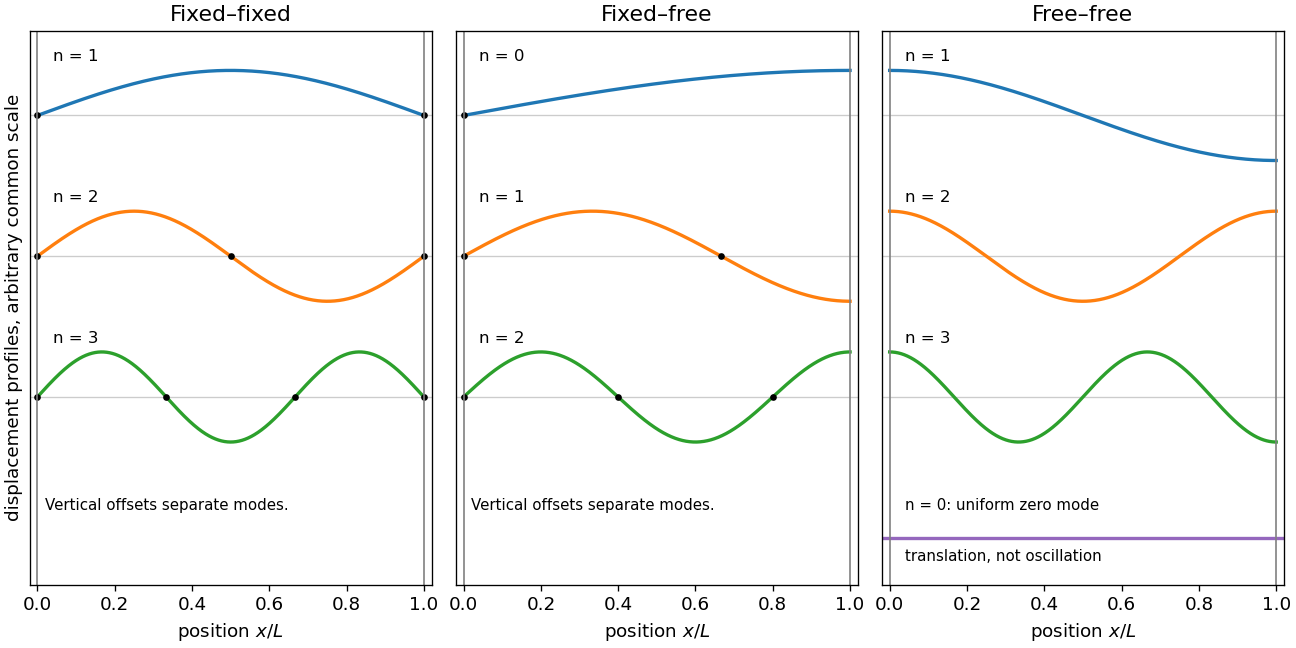
A free end has zero transverse force, hence , rather than zero displacement. With , write . The remaining condition is , givingThe first three shapes have one, three and five quarter-waves. Each has a node of a standing wave at the fixed end and an antinode at the free end; the mode frequencies are in the ratio .
Free ends give , so the oscillatory normal modes areThere is also the zero mode , with uniform displacement : a free string can translate without a restoring force. It is not a positive-frequency oscillation. The first three oscillatory shapes are , and , with an antinode at each end. The figure includes the uniform mode too, so that the zero-frequency limit is explicit.
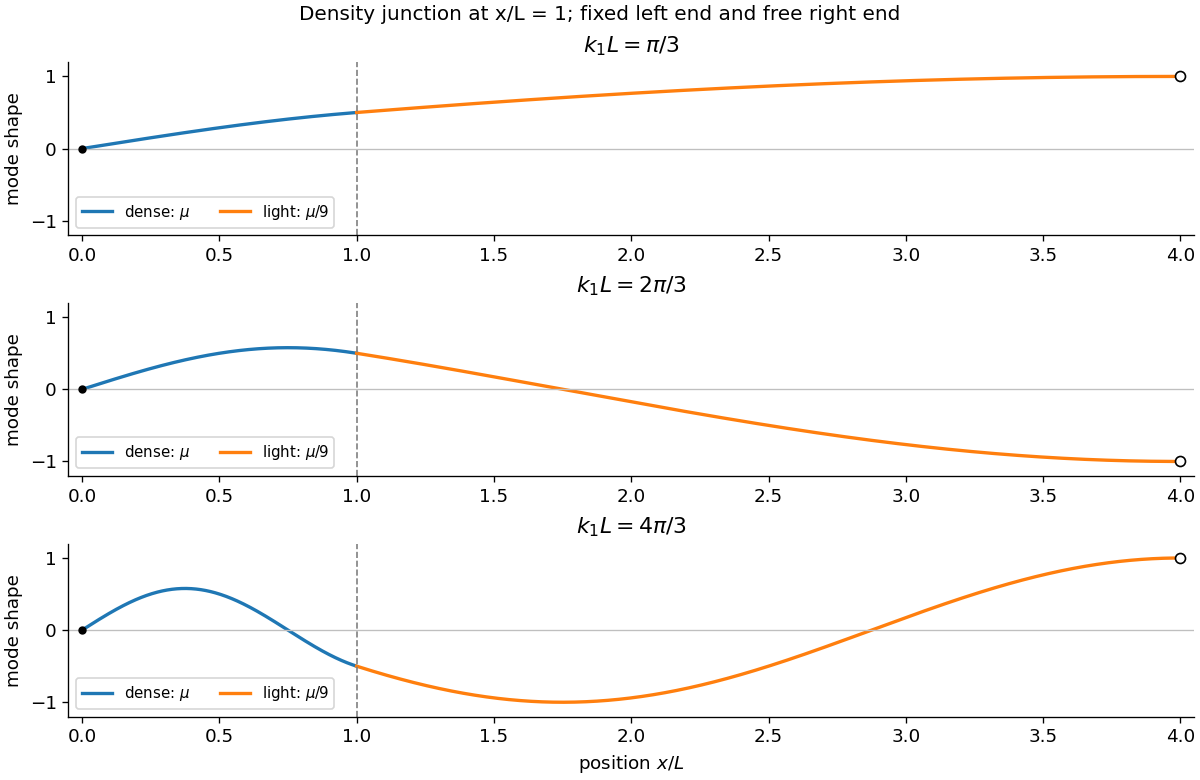
At common tension, the lighter segment has three times the wave speed, so its wavenumber at the same frequency is . The fixed left end and free right end selectLet . Since , continuity of displacement and of transverse force at the junction givesEqual tension makes the second condition continuity of slope. A nontrivial pair of amplitudes requires the coefficient determinant to vanish:For positive frequency, , soNeither nor gives a nonzero mode, as direct substitution into the two matching equations confirms. The positive roots are or for . The first modes in the figure show the changing wavelength across the junction while retaining continuous displacement and slope. The zero-frequency limit must be solved separately; the fixed and free boundary conditions allow only the trivial static solution.


Articles by others on the same topic
There are currently no matching articles.