After the first encounter, the reflected pulse travels backwards through the heavy string with amplitude and width . The transmitted pulse has amplitude and speed . Its temporal duration is unchanged at the stationary junction, so its spatial width doubles to . Both pulses retain the original displacement sign.
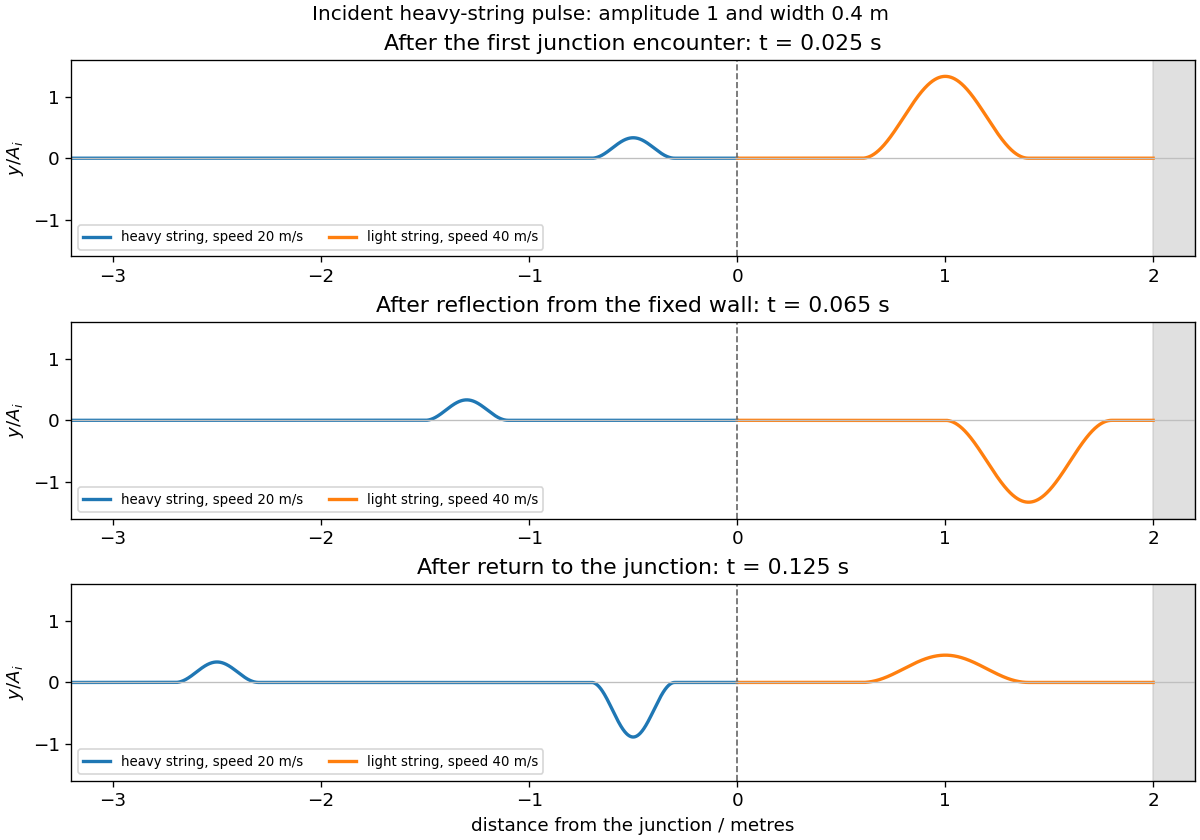

Reflection at a fixed end has displacement coefficient . The light-string pulse therefore returns from the wall with amplitude and width . It is inverted and travels left at . Taking the first junction encounter as time zero, its centre reaches the wall after and returns to the junction after ; a finite pulse takes its own duration to complete each encounter.
At the return encounter, transmission from light to heavy multiplies the amplitude by , giving a backward heavy-string pulse of amplitude . Its speed halves, so its width returns to . Reflection within the light segment multiplies the incoming amplitude by , giving a right-going pulse of amplitude and width . The earlier reflected pulse is already farther along the heavy string.
Articles by others on the same topic
There are currently no matching articles.