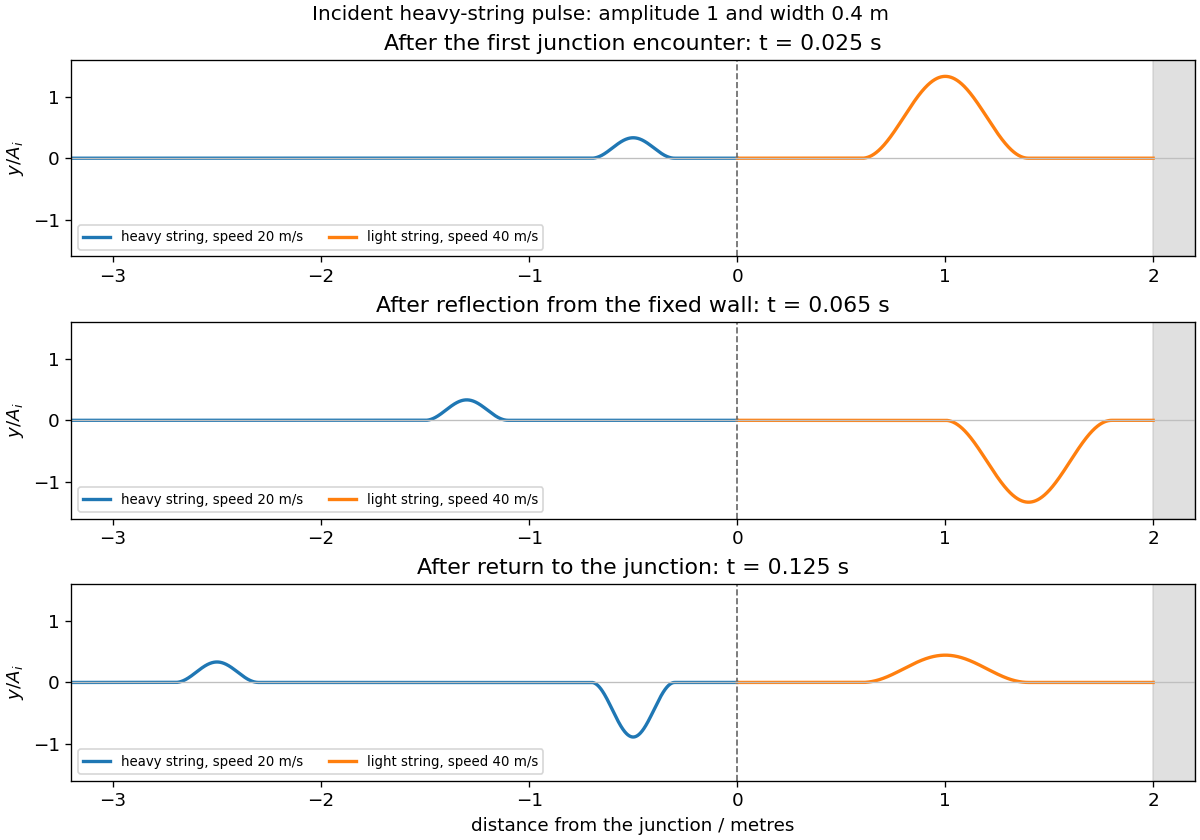
After the first encounter, the reflected pulse travels backwards through the heavy string with amplitude and width . The transmitted pulse has amplitude and speed . Its temporal duration is unchanged at the stationary junction, so its spatial width doubles to . Both pulses retain the original displacement sign.

Articles by others on the same topic
There are currently no matching articles.