For a short length , the kinetic energy is . For small slope, its increase in length is , so its elastic potential energy is . For a travelling wave , and . Using givesWriting a pulse as yields . Thus energy is proportional to amplitude squared for a fixed shape and width. Width must also be retained when comparing pulses on different strings.
At fixed frequency , so the displacement reflection and transmission coefficients areThe heavy-string speed is and the light-string speed is . ThereforeA displacement amplitude greater than the incident amplitude does not mean energy is created: the transmitted pulse also has a different width and propagates in a different medium.
After the first encounter, the reflected pulse travels backwards through the heavy string with amplitude and width . The transmitted pulse has amplitude and speed . Its temporal duration is unchanged at the stationary junction, so its spatial width doubles to . Both pulses retain the original displacement sign.
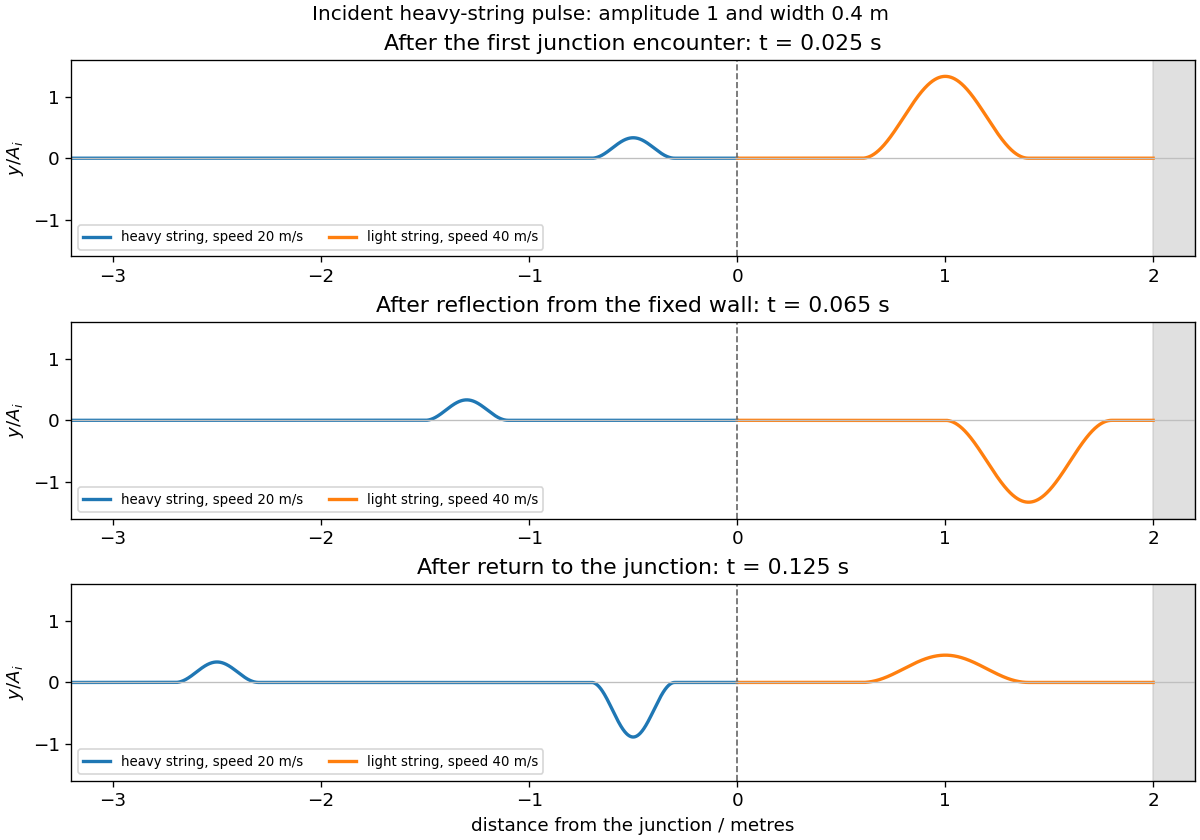

Reflection at a fixed end has displacement coefficient . The light-string pulse therefore returns from the wall with amplitude and width . It is inverted and travels left at . Taking the first junction encounter as time zero, its centre reaches the wall after and returns to the junction after ; a finite pulse takes its own duration to complete each encounter.
At the return encounter, transmission from light to heavy multiplies the amplitude by , giving a backward heavy-string pulse of amplitude . Its speed halves, so its width returns to . Reflection within the light segment multiplies the incoming amplitude by , giving a right-going pulse of amplitude and width . The earlier reflected pulse is already farther along the heavy string.
The sketches show these as separate pulses in the short-pulse regime . For longer pulses the corresponding components overlap and must be superposed rather than interpreted as isolated visible humps.
Each light-string round trip combines wall reflection with junction reflection , multiplying the remaining pulse amplitude by . The initial directly reflected heavy-string pulse has amplitude . The subsequent outgoing heavy pulses have amplitudesThey all have width in the same heavy medium. For nonoverlapping pulses their energy fractions therefore sum toThe first transmission leaves energy fraction in the light segment; each return encounter leaves only of the previous stored energy there, so this residual tends to zero.
For reflection from a finite string segment with a fixed far end, if pulses overlap, squared amplitudes cannot simply be added because of interference. The same result follows frequency by frequency: with round-trip phase , , the total amplitude coefficient isFor real frequencies , so and . Thus the ideal lossless fixed-ended segment returns all incident finite-pulse energy even when individual echoes overlap; their relative phases must be retained.
Articles by others on the same topic
There are currently no matching articles.