At steady state the interior free-substrate balance gives . Substituting this into the interior free-carrier balance gives . ThereforeFor positive inward throughput there are more free carriers facing inward: release of transported substrate must be followed by outward return of empty carriers at net rate .
The relation means . Put and substitute the preceding expression for :The first term is the equilibrium binding contribution from the outward free-carrier pool; the additional terms account for the maintained current and the excess inward-facing free carriers. This is a steady throughput relation, not a detailed-balance assumption.
The exterior free-substrate equation gives at steady state. Thus , andThe sign of the current term is opposite to the interior relation because substrate is supplied to the exterior and removed from the interior. Nonnegative occupancies are selected by the complete steady transport solution and compatible substrate totals.
The loaded-carrier balance gives . Substitute the preceding two complex concentrations and collect the current terms:Next carrier conservation givesEliminate between these relations and set . Simplification yieldsHere must be the total carrier protein, as in the conservation equation. Calling it total substrate in the final line of the scan is a typographical inconsistency; total substrate is the different invariant .
For carrier-turnover saturation of passive transport at fixed , write , and . Then , soThe flux is outward when the substrate gradient is reversed and inward when . Saturation occurs because there is a finite carrier population and finite binding-release/conformational turnover: arbitrarily abundant exterior substrate cannot make carriers cycle arbitrarily quickly. This is passive facilitated transport, so no maintained flux remains when the two free concentrations agree. Varying at fixed compares reservoir-controlled steady states or systems with different total substrate; it is not a trajectory preserving one fixed .
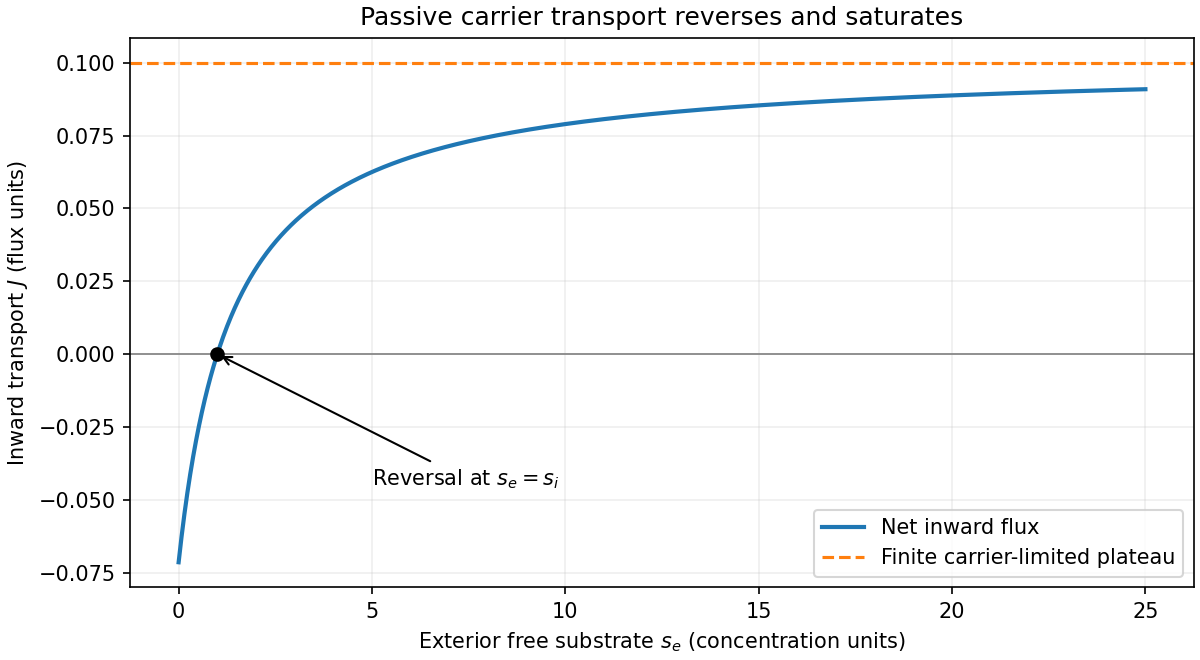
Carrier-mediated transport: reversal and saturation at fixed interior concentration
. Details. 
Articles by others on the same topic
There are currently no matching articles.