For a statistically homogeneous matter distribution, the cosmological two-point correlation function of the mean-zero density contrast isSpatial homogeneity removes dependence on , and isotropy reduces the separation argument to its magnitude. For discrete galaxies, the galaxy two-point correlation function equivalently specifies the excess pair probability at distinct positions:Consequently the mean density of other galaxies, conditioned on a galaxy at the origin, is . The self-pair at zero separation is excluded from this definition; its Dirac delta contribution is the galaxy power spectrum shot noise of the unsmoothed number-density field.
With the specified Fourier transform convention, the inverse is . Inserting both inverse transforms into the cosmological two-point correlation function and applying the given Dirac delta covariance yieldsFor an isotropic matter power spectrum, align the polar axis with . The angular integral is . Hence the isotropic cosmological correlation-power-spectrum relation isThe angular kernel is the order-zero Spherical Bessel function . At , replace it by its limit one, giving the unsmoothed variance when the integral converges. The argument assumes an ordinary integrable spectrum, or an explicitly specified distributional Fourier transform interpretation otherwise.
The galaxy-conditioned neighbour count is the integral of the conditional number density , rather than of alone. For a power law with ,With the specified , , and , the factors of cancel andA uniformly chosen point in space is not conditioned to lie on a galaxy. Its expected value is simply the mean number density times the volume:The difference is the clustering excess. The first count means other galaxies; including the chosen central galaxy adds one. Although the assumed galaxy two-point correlation function diverges at , its contribution is integrable here because is constant.
Apply the isotropic cosmological correlation-power-spectrum relation and put , . The band-limited linear density correlation isTwo integrations by parts give the primitive . Evaluating both endpoints yieldsThe apparent singularity at the origin is removable. Either the Taylor series or the original integral givesIn fact . The sharp spectral cutoff produces oscillations and negative correlations at some nonzero separations, even though the matter power spectrum is everywhere nonnegative. A covariance function need not be pointwise nonnegative; its required positivity is that of the covariance quadratic form.
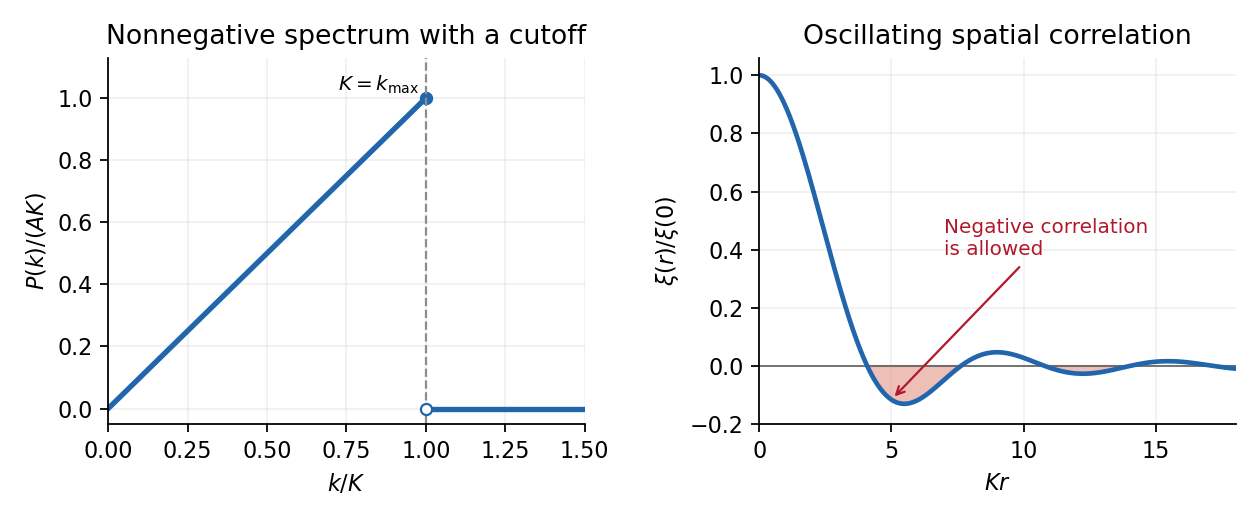
An abrupt cutoff in a nonnegative density power spectrum produces an oscillating correlation function
. Details. 
Consider a logarithmic band of wavenumbers around , where is a comoving scale. The dimensionless cosmological power spectrum of the density contrast is . For this scales as , so the rms density amplitude in such a band scales as .
The cosmological Poisson equation gives , with a dimensionful peculiar gravitational potential. Its spectrum and its potential fluctuations per logarithmic wavenumber are thereforeindependent of . Equivalently, is independent of because . This is the scale-local meaning of the Harrison-Zeldovich spectrum. An uncut spectrum has a divergent total potential variance; equal amplitude per logarithmic band does not imply a finite unsmoothed variance over all scales. For wavelengths beyond the Hubble radius, the statement is formulated using the corresponding conserved primordial curvature mode and its adiabatic matter-era potential, rather than treating the subhorizon Poisson approximation as universally valid.
On angular scales larger than roughly a degree, the Sachs-Wolfe effect relates the last-scattering potential to the observed Cosmic microwave background anisotropy: for adiabatic modes in matter domination. Thus the observed large-angle amplitude constrains . Scale-invariant potential bands produce a Sachs-Wolfe plateau, approximately constant, rather than constant . Its amplitude and any tilt test the normalization and spectral shape. Cosmic variance, Integrated Sachs-Wolfe effect and assumptions about adiabatic initial conditions limit this inference; the density spectrum's late-time transfer must also be included when comparing it with galaxy clustering.
Articles by others on the same topic
There are currently no matching articles.