For a radial null geodesic in the FRW metric, define . Two successive wave crests emitted and received at the same comoving positions obeySubtracting and keeping the first order in the wave periods gives . Thus the cosmological time dilation and the cosmological redshift have the same factor:Here the emitter and observer are comoving; an additional peculiar velocity would supply a separate kinematic redshift. The derivation uses the null geodesic propagation of the crests rather than interpreting a finite cosmological distance as an ordinary Doppler effect.
The luminosity distance is defined by , where is the bolometric luminosity and the received radiative flux. In the FRW metric a sphere through the observer around a comoving source has area . The cosmological redshift reduces each photon's energy by , and cosmological time dilation reduces their arrival rate by another such factor. HenceThe positive radial lookback integral is . The printed time limits are reversed; also the factor is required unless units are adopted. The areal coordinate and the radial comoving distance agree only when .
For an Einstein-de Sitter universe, the Friedmann equation gives . Using the redshift-time relation in the radial null geodesic integral yieldsThus the Einstein-de Sitter luminosity-distance relation isIts small-redshift expansion recovers Hubble's law.
A Type Ia supernova can be standardized as a standard candle by correcting its peak brightness using the light curve shape and colour index. Its host spectrum gives the redshift; the corrected apparent magnitude and calibrated absolute magnitude give the distance modulusThe resulting Hubble diagram measures the shape of the luminosity distance as a function of redshift. A spatially flat matter-and-vacuum model, for example, predictsNonzero cosmological spatial curvature changes both the expansion rate and the conversion from radial to transverse comoving distance. Comparing the observed Hubble diagram with these predictions constrains the matter density parameter, cosmological constant and cosmological spatial curvature; a single low-redshift observation cannot separate them. The nearby sample calibrates the common intercept, while distant Type Ia supernovae supply the redshift-dependent shape. Relative faintness at a specified redshift means a greater inferred luminosity distance.
Type Ia supernova cosmology requires correction for interstellar extinction, possible evolution of the standardized luminosity, and selection bias. The absolute magnitude–Hubble constant degeneracy means that an uncalibrated sample constrains the shape rather than independently determining .
Use the luminosity convention in the supplied flux relation: , where is the total spectral luminosity. For a general spectrum , the cosmological spectral flux-density relation givesIn a spatially flat universe, a shell subtending the solid angle contains sources, because is their comoving number density. The cosmological spectral background intensity per unit solid angle is consequentlyThis is the cosmological background intensity from comoving emissivity specialized to identical, nonevolving sources in an Einstein-de Sitter universe. For the integrand reduces to , or directly . The finite comoving particle horizon therefore givesFor , instead,The emitted frequency grows with redshift, and the rising spectral luminosity now defeats the redshift dimming. The Einstein-de Sitter spectral-background convergence criterion is ; equality produces a logarithmic divergence. This divergence describes the unbounded power-law, eternal-population model. A finite formation epoch, a high-frequency spectral break or absorption changes that model and can make its background finite.
The term is Hubble friction in the equation for the density contrast. During expansion, , it damps the peculiar motion producing density growth. It therefore slows gravitational instability relative to the otherwise identical static model; it does not necessarily stop growth.
Multiplying by shows the mechanism without confusing it with microscopic dissipative friction:When the self-gravity term is negligible, the expansion-weighted derivative of a passive density perturbation is conserved, so . Expansion also reduces and hence weakens the source on the right. A contracting background has and reverses the sign of this effect.
For constant and constant , Hubble friction vanishes. Put . The constant-coefficient ordinary differential equation is , so its characteristic polynomial has the real roots of a polynomial :These are the pressureless special case of the Static-universe Jeans modes. A positive growing-mode coefficient gives exponential gravitational instability, with time scale . For initial data and , the equivalent answer is . This solves the stated perturbation model; a globally static dust-only FRW metric would require additional background support.
In an Einstein-de Sitter universe, and . The Friedmann equation givesThis is an Euler differential equation. Substitution of gives , namely . The Einstein-de Sitter density-growth modes are thereforeThe linear growth factor for the growing mode is proportional to , rather than an exponential in cosmic time. These expressions apply while the density contrast is small enough for linear cosmological density perturbations.
After the decay products dominate the background, radiation domination gives . Neglecting curvature and vacuum terms, the Friedmann equation implies , so andThe displayed form uses a cosmic-time origin with . After a late transition the extrapolated radiation-era origin need not be the original Big Bang; this time shift does not change the growth law.
For the remaining pressureless matter, neglect its self-gravity to leading order in . Its density contrast obeys . Using the conserved expansion-weighted derivative of a passive density perturbation givesThus logarithmic growth of matter perturbations during radiation domination replaces the static exponential growth and the matter-era growth. The expansion persists while its dominant radiation component supplies little sustained clustering in this pressureless test-component approximation. The residual matter can eventually become important again because ; the approximation is for the radiation-dominated interval. The equation is not a pressureless growth equation for the relativistic decay products themselves, whose pressure and, when a fluid description applies, radiation acoustic oscillations must be retained.
For a statistically homogeneous matter distribution, the cosmological two-point correlation function of the mean-zero density contrast isSpatial homogeneity removes dependence on , and isotropy reduces the separation argument to its magnitude. For discrete galaxies, the galaxy two-point correlation function equivalently specifies the excess pair probability at distinct positions:Consequently the mean density of other galaxies, conditioned on a galaxy at the origin, is . The self-pair at zero separation is excluded from this definition; its Dirac delta contribution is the galaxy power spectrum shot noise of the unsmoothed number-density field.
With the specified Fourier transform convention, the inverse is . Inserting both inverse transforms into the cosmological two-point correlation function and applying the given Dirac delta covariance yieldsFor an isotropic matter power spectrum, align the polar axis with . The angular integral is . Hence the isotropic cosmological correlation-power-spectrum relation isThe angular kernel is the order-zero Spherical Bessel function . At , replace it by its limit one, giving the unsmoothed variance when the integral converges. The argument assumes an ordinary integrable spectrum, or an explicitly specified distributional Fourier transform interpretation otherwise.
The galaxy-conditioned neighbour count is the integral of the conditional number density , rather than of alone. For a power law with ,With the specified , , and , the factors of cancel andA uniformly chosen point in space is not conditioned to lie on a galaxy. Its expected value is simply the mean number density times the volume:The difference is the clustering excess. The first count means other galaxies; including the chosen central galaxy adds one. Although the assumed galaxy two-point correlation function diverges at , its contribution is integrable here because is constant.
Apply the isotropic cosmological correlation-power-spectrum relation and put , . The band-limited linear density correlation isTwo integrations by parts give the primitive . Evaluating both endpoints yieldsThe apparent singularity at the origin is removable. Either the Taylor series or the original integral givesIn fact . The sharp spectral cutoff produces oscillations and negative correlations at some nonzero separations, even though the matter power spectrum is everywhere nonnegative. A covariance function need not be pointwise nonnegative; its required positivity is that of the covariance quadratic form.
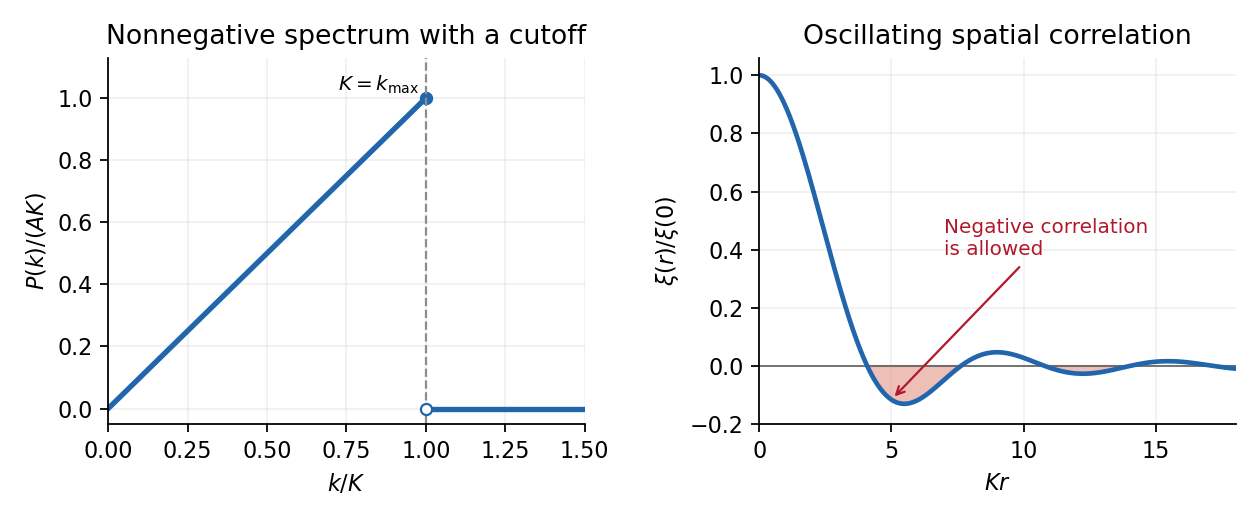
An abrupt cutoff in a nonnegative density power spectrum produces an oscillating correlation function
. Details. 
Consider a logarithmic band of wavenumbers around , where is a comoving scale. The dimensionless cosmological power spectrum of the density contrast is . For this scales as , so the rms density amplitude in such a band scales as .
The cosmological Poisson equation gives , with a dimensionful peculiar gravitational potential. Its spectrum and its potential fluctuations per logarithmic wavenumber are thereforeindependent of . Equivalently, is independent of because . This is the scale-local meaning of the Harrison-Zeldovich spectrum. An uncut spectrum has a divergent total potential variance; equal amplitude per logarithmic band does not imply a finite unsmoothed variance over all scales. For wavelengths beyond the Hubble radius, the statement is formulated using the corresponding conserved primordial curvature mode and its adiabatic matter-era potential, rather than treating the subhorizon Poisson approximation as universally valid.
On angular scales larger than roughly a degree, the Sachs-Wolfe effect relates the last-scattering potential to the observed Cosmic microwave background anisotropy: for adiabatic modes in matter domination. Thus the observed large-angle amplitude constrains . Scale-invariant potential bands produce a Sachs-Wolfe plateau, approximately constant, rather than constant . Its amplitude and any tilt test the normalization and spectral shape. Cosmic variance, Integrated Sachs-Wolfe effect and assumptions about adiabatic initial conditions limit this inference; the density spectrum's late-time transfer must also be included when comparing it with galaxy clustering.
For approximately circular motion in a spherically dominated Newtonian gravitational field, . If most gravitating mass followed the concentrated luminous galaxies, then beyond their main light distribution the enclosed mass would nearly saturate, giving a declining Keplerian galaxy rotation curve, .
Instead, extended galaxy rotation curves commonly remain roughly flat. The spherical mass profile for a flat rotation curve then requiresThe inferred mass continues growing where the luminous contribution is small, so the mass-to-light ratio increases outward. Under the assumed gravitational dynamics this is evidence for an extended dark matter halo. Measurements of neutral-gas motion can probe radii beyond the bright stellar disk. A realistic disk contribution must be computed using its flattened geometry; the spherical formula describes a halo-dominated region and does not turn every disk rotation curve into a spherical mass profile.
The three probes constrain the same deep gravitational potential by different observations. A large member-galaxy velocity dispersion requires a large binding mass. Applying the virial theorem, with a gravitational scale radius and approximately isotropic orbits, gives a cluster velocity-dispersion mass estimate of order , with a profile-dependent numerical coefficient. The inferred mass-to-light ratio is much larger than the stellar value. Membership, orbital anisotropy and equilibrium assumptions affect the precision.
The hot intracluster medium radiates through thermal bremsstrahlung and line emission. Its X-ray spectrum measures temperature, while its surface brightness constrains gas density. Confining this gas requires a potential with characteristic . Combining resolved profiles through the cluster hydrostatic mass estimator gives the total mass, not just the gas mass. The detected gas contributes substantial baryonic mass but does not normally account for the full gravitating mass. Nonthermal pressure or a merging cluster can invalidate a purely thermal hydrostatic equilibrium estimate.
Finally, gravitational lensing measures mass through light deflection. Strong gravitational lensing supplies multiple images and arcs; weak gravitational lensing measures coherent background-image distortion over larger radii. The lensing convergence is projected surface mass density divided by the critical surface density, irrespective of whether the material emits light. Cluster gravitational-lensing mass estimates agree broadly with the high masses implied by galaxy motions and hot gas, while having different equilibrium assumptions. Together these observations support a dominant nonluminous component in galaxy clusters, after accounting for their stars and observed gas.
Use conservation of energy for an isolated spherical perturbation of fixed mass , with negligible initial random motion and no significant surface-pressure term. For a homologous density profile its Newtonian gravitational potential energy is , with the same positive structure coefficient at both stages; a uniform sphere has .
At spherical-collapse turnaround, coherent radial motion momentarily vanishes, so . In the final virialized state, the virial theorem gives , hence . ThereforeThis is the virial radius from turnaround energy in the spherical-collapse model. It is an idealized virial-radius estimate rather than the radius of the formal pressureless point collapse. If the profile coefficient changes, the same argument instead gives . Significant energy loss, mass loss or boundary work also changes the result.
Let be the gas density and the total gravitating mass. For a spherically symmetric gas in hydrostatic equilibrium, radial force balance isUsing the ideal gas law , with constant mean molecular weight , differentiate the product rather than setting constant:Substitution and cancellation of give the cluster hydrostatic mass estimatorHere is the Boltzmann constant, denoted in the question. The prefactor has units of mass; a pressure decreasing outward makes the bracket negative and the inferred mass positive. For an isothermal gas with , this reduces to . The density in the logarithmic derivative is the gas density, not the total density. A varying or nonthermal pressure would require the corresponding extra terms.
Measure the cluster's baryonic mass, dominated by its intracluster medium with a smaller stellar contribution, and divide it by an independently inferred total mass. If this cluster baryon fraction is representative of the cosmic baryon fraction, then . Thus the cluster baryon-fraction estimate of matter density isBig Bang nucleosynthesis constrains the baryon-to-photon ratio and hence through primordial light-element abundances. A specified converts this to ; the cluster mass and gas-mass estimates also have distance-dependent factors, which must be used consistently. This method estimates the total nonrelativistic matter density, including baryonic and dark matter. It does not add radiation or vacuum energy to that inferred ; in a matter-dominated interpretation the question's is this matter parameter.
Primordial deuterium as a baryon-density indicator works because increasing baryon density makes the destruction of deuterium into heavier nuclei more efficient during Big Bang nucleosynthesis. Smaller inferred primordial D/H therefore implies larger , with the other nucleosynthesis assumptions fixed. For a fixed measured cluster baryon fraction, a smaller primordial deuterium abundance raises the inferred matter density. A low abundance caused instead by stellar processing is not a lower primordial abundance; depletion, gas ejection and the representativeness of clusters must also be assessed before identifying the cluster fraction with the cosmic one.
Articles by others on the same topic
There are currently no matching articles.