The perturbations are density contrasts, and , evaluated in the common comoving synchronous gauge. For nonrelativistic cold dark matter of fixed particle mass, , hence . Thermal photons have photon number density and energy density . A small local temperature perturbation therefore givesFor adiabatic initial conditions, the ratio is unperturbed, so . Combining these equations provesEquivalently , with and . The relation applies before causal pressure gradients can separate the two species on superhorizon scales; it need not remain true after cosmological horizon crossing.
In deep matter domination, the scale factor is , so . Neglect radiation in the gravity source, including its backreaction, to obtainFor a power the Euler-Cauchy equation becomes . Its two independent matter-era growing and decaying density modes give the full approximate solutionThere is no -dependent pressure term for cold dark matter. Thus this leading equation is valid both outside and inside the horizon in the stated comoving synchronous gauge, as long as the perturbations remain linear and the omitted radiation gravity is negligible. A different time slicing would give a different density variable.
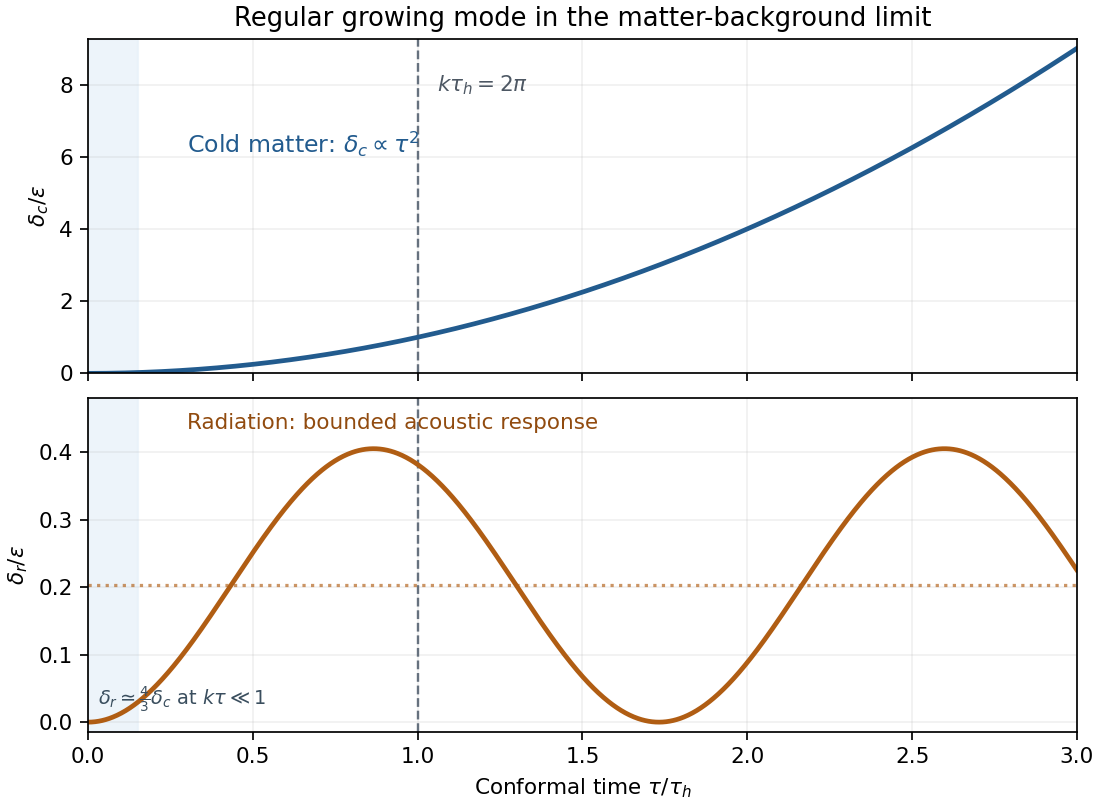
For , put , and . The remaining radiation equation is a forced harmonic oscillator:The matter-era forced radiation response can be written exactly within the matter-background approximation asThe last term is a Green's function particular solution; changing its lower limit only changes the two oscillatory constants. For the decaying source, a slowly varying particular solution obeys , since a second time derivative is smaller than by order . Consequently the subhorizon asymptotic form isFor a pure growing mode, the constant offset and acoustic terms are an exact solution of this reduced radiation equation. In particular, the late radiation contrast does not follow the ever-growing .
Before crossing, a regular growing adiabatic cosmological perturbation has both contrasts proportional to , with to leading order. Afterwards cold dark matter keeps this quadratic growth, whereas radiation undergoes subhorizon radiation acoustic oscillations about a constant forced offset. To make the requested sketch concrete, one regular leading matter-era solution on both sides isIts small- expansion gives , and its oscillation frequency is the radiation sound frequency. The sketch plots amplitudes in units of ; can be chosen small enough that the whole plotted interval remains linear. The line at uses the wavelength-to-particle-horizon convention in the question, rather than asserting that the smooth transition occurs at a sharp surface.

In deep radiation domination, and . Neglect against the radiation gravity source, so the supplied CDM density equation in a matter-radiation universe becomesOn superhorizon scales omit the pressure-gradient term. Under adiabatic initial conditions, then givesThe Euler-Cauchy equation characteristic polynomial is , soThese are the general growing and decaying adiabatic solutions in this approximation. A regular primordial growing mode discards the divergent solution. Although its conformal-time growth is again quadratic, now , rather than in matter domination.
If “general” is taken without imposing adiabaticity, both independent relative-entropy integration constants must also be retained. The gradient-free radiation equation givesSubstitution into the matter equation producesThis is the general solution of the leading supplied coupled system, described by the superhorizon radiation-era entropy integration constants. Setting both and to zero recovers the adiabatic result. Regularity and the full initial Einstein field equations constraints can further restrict which of these leading solutions represents a prescribed physical initial mode.
On scales well inside the horizon, radiation pressure drives oscillations at frequency approximately . Their amplitude is bounded at leading order, and their gravitational forcing of a slowly varying matter contrast can be averaged away. With this approximation, as well as negligible matter self-gravity,hence the logarithmic CDM growth after radiation-era horizon entry isThis is the Mészáros effect. It does not mean that itself vanishes. For a rapidly oscillating source , the matter equation has a particular responseIts leading second derivative reproduces ; the remaining terms are smaller by powers of . Thus the suppressed cold-matter forcing by rapid radiation oscillations is only order and does not change the secular logarithm. Radiation forcing near horizon entry determines and cannot be averaged away there. Neither this smoothing approximation nor the neglect of matter gravity remains uniformly valid near equality.
Articles by others on the same topic
There are currently no matching articles.