Use units , and let be the areal radial coordinate of the FRW metric, rather than the radial comoving distance when . On a constant-cosmic time slice the spatial metric tensor isThe determinant of the spatial metric tensor supplies the factor . Integrating over the solid angle gives . An incoming radial null geodesic obeysConsequently the proper shell volume sampled by an emission-time interval of positive width is . Multiplying by the proper number density proves the source counts on an FLRW past light cone:Here is evaluated on the observer's past light cone, not along a fixed source worldline. The curvature factor cancels between the spatial volume and the radial light speed; it has not been set to one.
An isotropic source's bolometric luminosity is distributed over a wavefront of physical area . Each photon loses an energy factor through cosmological redshift, and successive photons arrive with a further rate factor through cosmological time dilation. Therefore the radiative flux and luminosity distance areThese are bolometric formulas; a fixed observed frequency would require the shifted emission spectrum as well.
Normalize the scale factor by . Summing the radiative flux over the source counts on an FLRW past light cone makes the transverse shell-area factors cancel:Thus is power per effective detector area, summed over the whole sky; an all-sky detector of effective area receives . The corresponding intensity per solid angle is . Restoring the speed of light multiplies these flux integrals by .
Spatially uniform by itself does not specify its time evolution. For a persistent population comoving with the expansion, with neither creation nor destruction, the cosmological continuity equation for source number is . Its conserved comoving number density is , so the cosmological bolometric background from conserved sources becomes . For the Einstein-de Sitter universe,The last equality uses . The early-time improper integral converges despite the diverging physical source density. If instead the proper number density were maintained at a constant value by continuous source creation, the same geometry would give . For a completely unspecified source history the general integral above is the determined answer; constancy of individual luminosity alone does not imply number conservation.
Use the same conserved-source interpretation, comoving number density and normalization as in the preceding part. DefineThe open matter-dominated Friedmann solution then has , and . The present parameter satisfiesThe cosmological bolometric background from conserved sources is thereforeSince , the open dust bolometric background integral isThis leaves the answer in the requested parameter form and makes no use of a radial-distance approximation. For arbitrary proper number density instead, the same calculation gives
For the conserved population, compare models with the same present . As , and . The leading term in the square bracket is ; the terms linear in and vanish after multiplication by . HenceThis is also immediate in the Milne model, for which and . If one compares at fixed cosmic age instead, the results are and , so the empty open model gives of the flat-model flux. Specifying what is held fixed is necessary because the two expansion histories have different ages at the same Hubble constant.
Use natural units with and the unreduced Planck mass . In a radiation-dominated universe, the effective number of relativistic energy degrees of freedom givesThe ratio of weak conversion rate to expansion rate is proportional to , so it decreases as the universe cools. Cosmological weak freeze-out occurs approximately at , givingFor , and this estimate is . Equivalently is only a mild multiplicative correction. The rate itself was given only to order of magnitude, so this is a decoupling scale, not a precise prediction for the weak freeze-out abundance.
Both neutrons and protons are nonrelativistic at this temperature. The nonrelativistic Maxwell--Boltzmann number density follows by the Gaussian momentum integral:Their equal spin degeneracies are . Chemical equilibrium of the weak reaction gives ; with negligible lepton asymmetry, . Taking the ratio and setting the nearly equal nucleon masses equal only in the prefactor gives the neutron-proton chemical equilibrium resultThe common baryon normalization cancels. Keeping the exact mass prefactor changes this by only order . Thus the printed simple exponential is the usual nonrelativistic equal-mass-prefactor approximation. Using with the rough decoupling scale above gives a ratio of order one half; the rate's omitted numerical factors and gradual freeze-out must be included before using a more accurate neutron abundance.
Use , so counts deuterium nuclei per baryon, not baryons bound into deuterium. For the radiative capture reaction, chemical equilibrium and the zero photon chemical potential give . Dividing the three nonrelativistic Maxwell--Boltzmann number densities removes all chemical potentials:Here and . The binding convention in this PDF is a negative mass defect, . The positive nuclear binding energy is , so the abundance is enhanced by , not by .
Since , insert the baryon-to-photon ratio and the photon number density . This givesAt equal nucleon mass in the prefactors, , the deuterium equilibrium abundance simplifies toThe dimensionless prefactor is about . These expressions describe thermal equilibrium; residual primordial deuterium after nuclear reactions cease must instead be obtained from the reaction kinetics.
At a fixed temperature, the deuterium equilibrium abundance contains an explicit factor through . Two nucleons have to encounter each other to make one bound nucleus. Their capture rate per volume is proportional to , whereas nuclear photodisintegration competes through the very numerous thermal photons. The small baryon-to-photon ratio therefore delays stable deuterium formation until , producing the deuterium bottleneck. Changing the cosmological baryon density changes both its release time and the subsequent efficiency of nuclear burning. The residual primordial deuterium abundance is particularly sensitive to these rates: on the usual nucleosynthesis branch, increasing burns more deuterium into heavier nuclei and lowers the remaining D/H. The positive dependence of the instantaneous equilibrium expression and the negative dependence of the final relic D/H are different statements.
By contrast, once nuclear reactions are efficient, nearly every surviving neutron ends in helium-4. Two neutrons make each helium-4 nucleus, so andThis primordial helium mass fraction is mainly neutron limited: is set by weak conversion, cosmological weak freeze-out and free-neutron decay after freeze-out, rather than by the absolute baryon density. There is a weaker dependence because a higher releases the deuterium bottleneck earlier and allows fewer neutrons to decay. Thus is comparatively insensitive, not exactly independent, of . At such exceptionally small baryon densities that nuclei never form efficiently, the neutron-limited approximation would fail.
Normalize the scale factor to , use , and define the instantaneous critical density by . Separately conserved pressureless matter and radiation in cosmology obey the cosmological continuity equation,The present cosmological density parameters areThe cosmological constant has equivalent energy density . Substituting into the Friedmann equation yieldsAt the present epoch this gives , or curvature contribution . Dividing each component by provesSpatial curvature is not included in the total physical-density parameter . In particular, positive vacuum density does not have the radiation or matter scaling.
For , use the instantaneous cosmological density parameterInsert the Friedmann equation from the preceding part and multiply numerator and denominator by :This holds on an expanding or contracting branch with ; in a recollapsing model the density parameter diverges at turnaround.
During radiation domination, while curvature is small, . During matter domination the corresponding behavior is . Thus the exactly flat solution is unstable against relative curvature during decelerating expansion: a small departure grows rather than being dynamically driven to zero. The flatness problem is that a universe with modest present curvature must have had an extremely tiny initial curvature-to-density ratio at an early radiation epoch. The fact that every such solution tends to when extrapolated to does not supply a mechanism selecting that small departure at a specified finite initial epoch. An early period of cosmic inflation can instead shrink the comoving Hubble radius and suppress .
Write and . With matter and radiation absent, the Friedmann equation isChoose the expanding branch and put its coordinate origin at . Separating variables,so the open slicing of de Sitter spacetime isFor the equivalent normalized form isIt has and , as required. In terms of a prescribed present Hubble parameter,At early times resembles the Milne universe, while at late times it grows exponentially. The empty model still has vacuum energy density; the vanishing of at the open-patch origin is not a curvature singularity of de Sitter spacetime.
The perturbations are density contrasts, and , evaluated in the common comoving synchronous gauge. For nonrelativistic cold dark matter of fixed particle mass, , hence . Thermal photons have photon number density and energy density . A small local temperature perturbation therefore givesFor adiabatic initial conditions, the ratio is unperturbed, so . Combining these equations provesEquivalently , with and . The relation applies before causal pressure gradients can separate the two species on superhorizon scales; it need not remain true after cosmological horizon crossing.
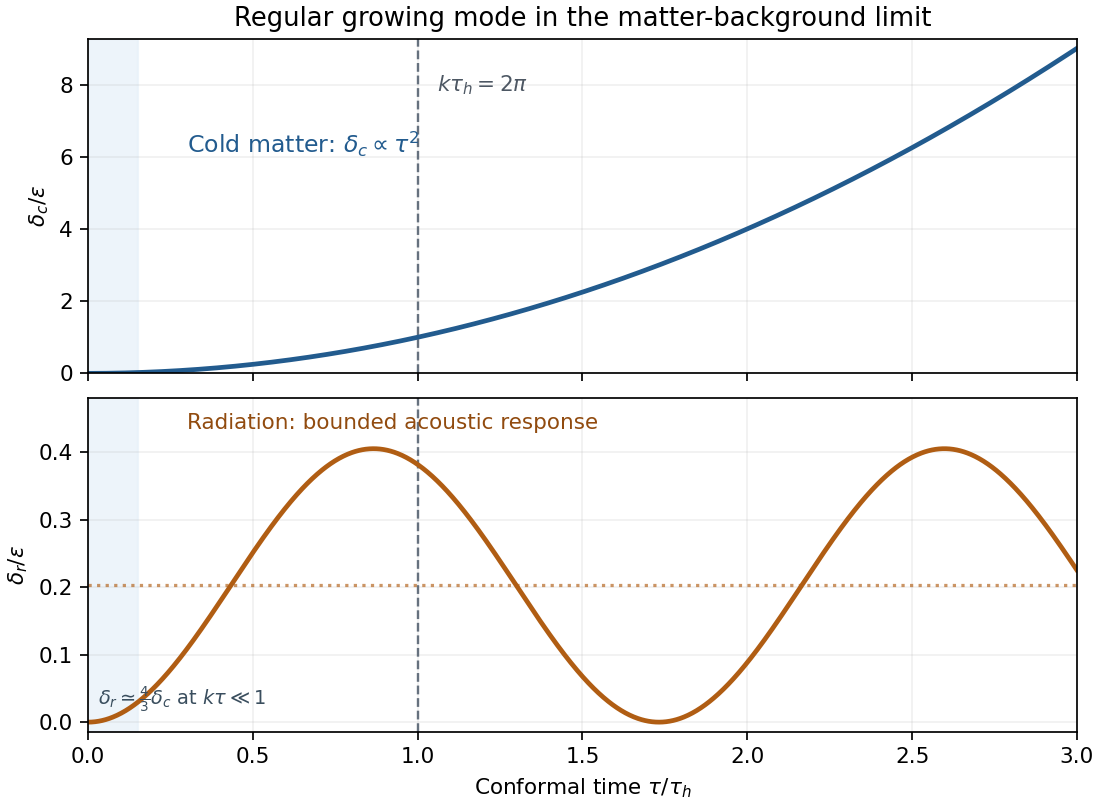
In deep matter domination, the scale factor is , so . Neglect radiation in the gravity source, including its backreaction, to obtainFor a power the Euler-Cauchy equation becomes . Its two independent matter-era growing and decaying density modes give the full approximate solutionThere is no -dependent pressure term for cold dark matter. Thus this leading equation is valid both outside and inside the horizon in the stated comoving synchronous gauge, as long as the perturbations remain linear and the omitted radiation gravity is negligible. A different time slicing would give a different density variable.
For , put , and . The remaining radiation equation is a forced harmonic oscillator:The matter-era forced radiation response can be written exactly within the matter-background approximation asThe last term is a Green's function particular solution; changing its lower limit only changes the two oscillatory constants. For the decaying source, a slowly varying particular solution obeys , since a second time derivative is smaller than by order . Consequently the subhorizon asymptotic form isFor a pure growing mode, the constant offset and acoustic terms are an exact solution of this reduced radiation equation. In particular, the late radiation contrast does not follow the ever-growing .
Before crossing, a regular growing adiabatic cosmological perturbation has both contrasts proportional to , with to leading order. Afterwards cold dark matter keeps this quadratic growth, whereas radiation undergoes subhorizon radiation acoustic oscillations about a constant forced offset. To make the requested sketch concrete, one regular leading matter-era solution on both sides isIts small- expansion gives , and its oscillation frequency is the radiation sound frequency. The sketch plots amplitudes in units of ; can be chosen small enough that the whole plotted interval remains linear. The line at uses the wavelength-to-particle-horizon convention in the question, rather than asserting that the smooth transition occurs at a sharp surface.

In deep radiation domination, and . Neglect against the radiation gravity source, so the supplied CDM density equation in a matter-radiation universe becomesOn superhorizon scales omit the pressure-gradient term. Under adiabatic initial conditions, then givesThe Euler-Cauchy equation characteristic polynomial is , soThese are the general growing and decaying adiabatic solutions in this approximation. A regular primordial growing mode discards the divergent solution. Although its conformal-time growth is again quadratic, now , rather than in matter domination.
If “general” is taken without imposing adiabaticity, both independent relative-entropy integration constants must also be retained. The gradient-free radiation equation givesSubstitution into the matter equation producesThis is the general solution of the leading supplied coupled system, described by the superhorizon radiation-era entropy integration constants. Setting both and to zero recovers the adiabatic result. Regularity and the full initial Einstein field equations constraints can further restrict which of these leading solutions represents a prescribed physical initial mode.
On scales well inside the horizon, radiation pressure drives oscillations at frequency approximately . Their amplitude is bounded at leading order, and their gravitational forcing of a slowly varying matter contrast can be averaged away. With this approximation, as well as negligible matter self-gravity,hence the logarithmic CDM growth after radiation-era horizon entry isThis is the Mészáros effect. It does not mean that itself vanishes. For a rapidly oscillating source , the matter equation has a particular responseIts leading second derivative reproduces ; the remaining terms are smaller by powers of . Thus the suppressed cold-matter forcing by rapid radiation oscillations is only order and does not change the secular logarithm. Radiation forcing near horizon entry determines and cannot be averaged away there. Neither this smoothing approximation nor the neglect of matter gravity remains uniformly valid near equality.
For two neighboring comoving points separated along the zeroth-order direction by coordinate distance , the synchronous gauge spatial metric gives the cosmological proper distanceDifferentiate with respect to cosmic time at fixed coordinate separation. To first order,A photon crosses this neighboring interval in when , so its local relative recession velocity isAt each infinitesimal step, the local Doppler effect gives . ThereforeThe first term integrates to the homogeneous cosmological redshift, . Subtracting it isolates the metric contribution to the fractional frequency shift. A shifted blackbody radiation spectrum has its temperature shifted by the same fraction as its photon frequencies, givingThe dot denotes a partial time derivative at fixed comoving position, evaluated along the zeroth-order null geodesic. It is not the total derivative of along the ray, so the integral cannot in general be replaced by a difference of at the endpoints. Deflection of the ray or its direction multiplies an already first-order metric perturbation and is second order here. This is the metric part of the Sachs-Wolfe effect in the negative-spatial-perturbation convention; an intrinsic emission temperature fluctuation or an emitter velocity would add separate boundary terms. The time derivative is present in the original PDF, although missing from the converted TeX's displayed integral.
Let and retain the negative-spatial-perturbation convention of the preceding part. Since , the isotropic pieces of the supplied Fourier mode contraction cancel:For , the factor in the line-of-sight integral cancels the derivative's factor two. ThusAn antiderivative convenient even at isIt follows directly, or by two integrations by parts, thatThe source sign and both endpoint coefficients are fixed by the metric convention; no division by is needed.
To interpret the large-angle Cosmic microwave background anisotropy, restore the observer-centered propagation phase , which can equivalently be absorbed into the definition of each Fourier mode amplitude. Put . One mode contributesThe first term is a local angular monopole plus a dipole, so it is removed when discussing observed angular multipoles . For modes outside the horizon at decoupling, , the higher-multipole emission signal is dominated byIts transfer amplitude has no leading positive power of : the two explicit powers in have canceled in the integral. Projection onto the sky supplies Spherical Bessel functions , with modes of order contributing to each angular scale. This is the large-angle Sachs-Wolfe effect; the emission velocity-like correction is relatively of order . For wavelengths much larger than the entire observed region, , removing the monopole and dipole leaves a signal starting at order , rather than a finite observable anisotropy from a spatially uniform mode.
The stochastic scale dependence of is not specified by the deterministic metric solution. If one additionally assumes a scale-invariant primordial spectrum, , thenfor , giving the familiar large-angle Sachs-Wolfe plateau, , for the measured multipoles. A tilted primordial spectrum changes that trend. The full numerical temperature transfer also includes intrinsic last-scattering and Doppler terms, omitted from the stipulated metric-only integral.
Articles by others on the same topic
There are currently no matching articles.