Use units and the Minkowski metric . The canonical momentum of the real scalar field is . Canonical quantization replaces the classical fields by operator-valued distributions and imposes the equal-time canonical commutation relationsThese relations are imposed on an initial slice, with smeared fields understood. In the Heisenberg picture, simultaneous unitary time evolution of both operators preserves their commutators. Since the momentum is , the requested equal-time commutator is .
The Legendre transform in mechanics, applied pointwise, gives the canonical Hamiltonian density of a real scalar field. ThusTo obtain its dynamics rather than assume them, use the Heisenberg equation of motion . The momentum-square term gives . The field-square term gives , while differentiating the Dirac delta function in the gradient term and integrating by parts gives . ConsequentlyBoundary terms vanish for suitably decaying smeared fields. This is the Klein-Gordon equation as an operator identity.
A spatial Fourier transform reduces the Klein-Gordon equation to , where . Its two frequency branches and the Hermitian adjoint condition giveThe invariant-normalized scalar mode extraction can be written particularly simply asSubstituting the mode expansion of a free field proves these inversion formulas: the opposite-frequency coefficient is proportional to and vanishes after spatial Fourier inversion. Alternatively they are the corresponding Klein-Gordon inner products. Taking their commutators using the equal-time fields gives in the mixed case. In the two equal-type cases the delta function enforces , multiplying . ThereforeConversely these mode commutators reproduce : the two frequency contributions each supply half the spatial Dirac delta function.
For the covariant oscillator Hamiltonian of a real scalar field, insert the mode expansion of a free field into . Spatial integration sets the two momenta equal in the mixed terms and opposite in the two-creator or two-annihilator terms. The latter have coefficient . The mixed terms giveThe constant is the divergent zero-point energy; a finite box and a momentum cutoff make its meaning explicit. Normal ordering sets the free vacuum energy to zero and leaves all commutators unchanged. Directly applying the mode commutators to the mixed expression yieldsChoose the Fock vacuum by . Each creation operator adds a boson of energy and four-momentum , while each annihilation operator removes one. Products of commuting creation operators give bosonic statistics from commuting creation operators and unrestricted occupation numbers. The real scalar field has one spin-zero species, identical to its antiparticle. Its one-particle states obey , precisely the relativistic normalization of a one-particle state.
For the Feynman propagator, put and contract the two fields in the Fock vacuum. Only survives, giving the Wightman functionThe stipulated time-ordered product convention is . In a contour integral over , the Feynman i-epsilon prescription places the positive-energy pole just below the real axis and the negative-energy pole just above it. For close below, clockwise, obtaining ; for close above, obtaining . Changing in the second contribution therefore provesActing with multiplies the integrand by . The remaining factor tends to as a distribution, so Fourier inversion givesThe sign also follows from the derivative jump of a free scalar time-ordered two-point function: the first time derivative of jumps by , so that of jumps by .
For the complex scalar field, the canonical momenta are and . Split . The interaction picture is obtained from the Schrödinger picture by and , choosing a common time origin. The fields therefore obey the free Klein-Gordon equation, while the states evolve through . The canonical quantization of a complex scalar field givesThe adjoint expansion contains and . Particle and antiparticle modes are independent; their nonzero commutators areAll cross-species commutators, and all pairs of creation operators or of annihilation operators, vanish. These formulas reproduce and the remaining vanishing equal-time commutators.
There are no derivative interactions, so the interaction Hamiltonian is . Differentiating the interaction picture state gives . Its time-evolution operator satisfiesIteration gives ordered integration regions . Each is of the full region with a time-ordered product, yielding the Dyson seriesWith the usual asymptotic scattering prescription, taking and provesTime ordering is essential because different interaction Hamiltonians need not commute.
At first order, use the connected tree scattering amplitude, equivalently the normal-ordered quartic vertex with the vacuum and one-particle mass contributions removed. This qualification matters if the local product is interpreted literally without normal ordering: single-vertex tadpole diagrams and vacuum diagrams are not the requested connected two-particle amplitude. The complex scalar quartic contact vertex is obtained fromIn a fully connected matrix element, an incoming particle and outgoing antiparticle attach to the two factors; an outgoing particle and incoming antiparticle attach to the two factors. Each pair has two assignments, giving . The external relativistic normalization of a one-particle state cancels each mode measure: for example and . Consequently the connected integrand is , andThus the invariant connected amplitude isThe Dirac delta function expresses four-momentum conservation.
For the identity contribution, commute through and independently through ; all terms leaving a creation operator against the left Fock vacuum or an annihilation operator against the right Fock vacuum vanish. HenceThere is no exchange term between the two distinct particle and antiparticle species.
Use the Minkowski metric and Feynman slash notation . The Pauli matrices satisfy . In the Dirac representation of the gamma matrices, direct block multiplication givesandThus the spatial anticommutators are , proving the Clifford relationsSince partial derivatives commute, their symmetric product selects the symmetric part of the gamma matrices. Multiplying the Dirac equation by givesHence every spinor component satisfies the Klein-Gordon equation with the same mass.
For parity, let and . The chain rule gives and . Combining these signs with provesThis establishes parity symmetry in quantum field theory for the free Dirac equation, rather than merely asserting its covariance.
A positive-energy plane wave solves . Write . The two block equations areThe second gives . In the first, and make the remaining coefficient zero. There are two independent two-component choices , soFor a massive Dirac spinor, choose as the two rest-frame spin states along a fixed axis, for example . The label distinguishes these canonical spin states after boosting; it is not automatically a helicity label.
Now and for the same fixed . ThereforeThe parity action on canonical massive spin states leaves the canonical spin label unchanged while reversing the momentum. Spin is an axial vector under parity; its orientation is unchanged. Consequently helicity, the projection of spin along momentum, reverses. If had instead been chosen to denote helicity, the transformed label would have the opposite sign.
The Dirac adjoint is , with . ThusThe chirality matrix has in this representation, so and it anticommutes with every . In particular . The parity transformation of a Dirac bilinear therefore yieldsThe first bilinear is a scalar under parity, whereas the second is a pseudoscalar.
For the requested gamma matrix trace identities, use the cyclic property of the trace. Conjugation of a product of gamma matrices by multiplies it by , but leaves its trace unchanged. All odd products therefore have zero trace. Taking the trace of the Clifford algebra relation and using gives . For four factors, move the first gamma matrix successively past the next three using the anticommutators. If , this givesThus . Contracting with the relevant four-vectors proves all four answers:
The original PDF contains three algebraic misprints in this question. The second internal four-momentum must consistently be , since it is defined by . Its Dirac propagator denominator is , including after contracting the first photon; the printed plus sign is incorrect. Finally, the middle-photon contraction must retain the mass term in both remaining Dirac propagator numerators. The following calculation keeps the electron mass and proves the corrected identities.
Write , and introduceHere is the matrix part of the Dirac propagator, with the overall factors of kept in the common amplitude convention. The Clifford algebra proves . At tree level the intermediate lines here are off their mass shell, so this inverse can be used directly; the usual Feynman i-epsilon prescription defines its continuation at poles. With , the consistently routed tensor isThe external Dirac equations are and .
For the photon at the electron end, and hence . Multiplication by removes that internal line, givingFor the middle photon, . Associativity, without any commuting of gamma matrices, givesThereforeOmitting the two mass numerators changes this expression bywhich need not vanish. For a concrete counterexample take , , and outgoing photon momenta , , . All external momenta are on shell and conserve four-momentum. Choose the upper two-spinor for and the lower two-spinor for , with the other blocks fixed by the Dirac equations. For and , the correct middle contraction divided by is , whereas the expression with the mass numerators omitted is . Thus the printed middle identity is not valid for a massive electron.
At the positron end, . The adjoint Dirac equation gives , so the remaining requested contraction isThe opposite signs at the two ends are precisely what makes the Ward identity work.
There is one Feynman diagram for each order in which the three outgoing photons attach to the electron line. Their orders, encountered from the incoming electron to the incoming Positron, are , , , , and .
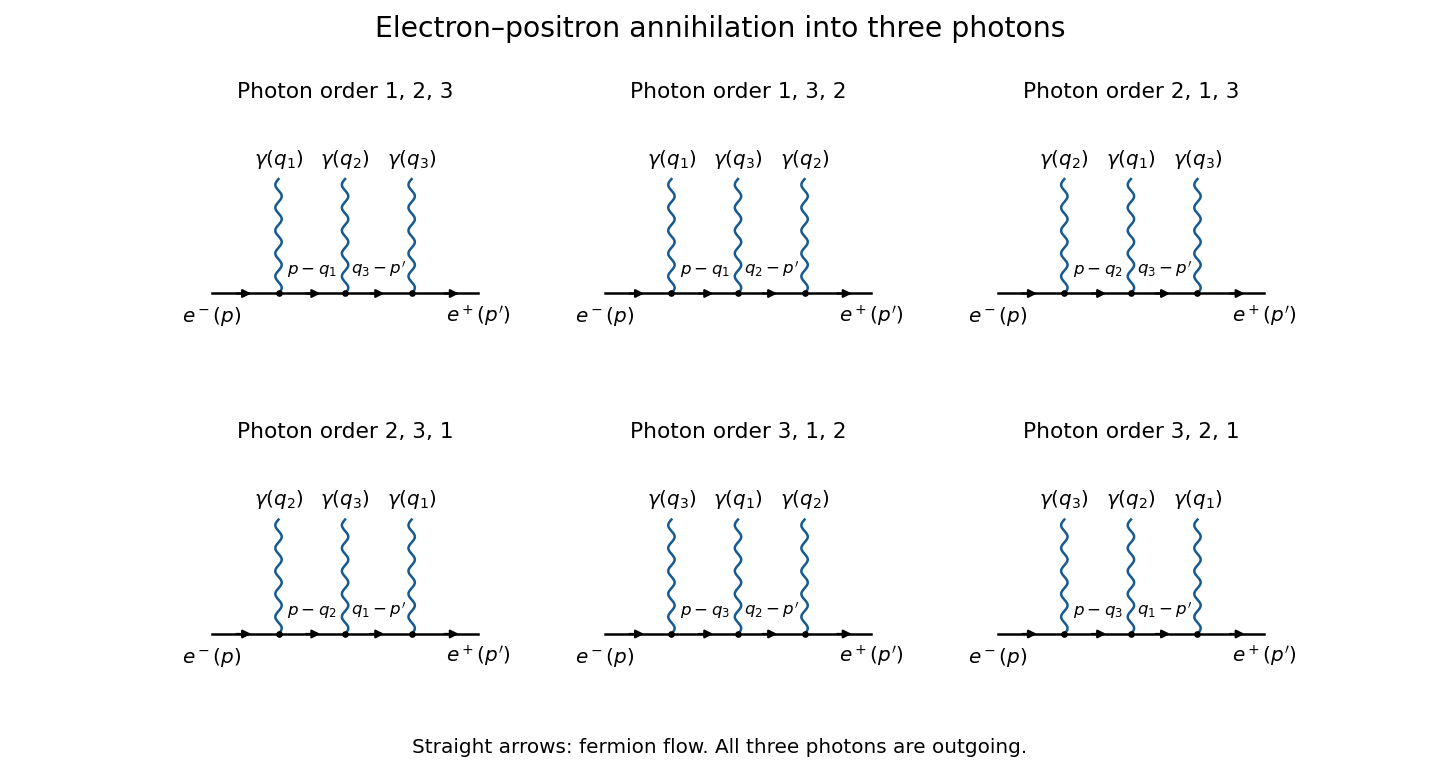
The six tree diagrams for electron-positron annihilation into three photons, ordered along fermion flow
. Details. 
The straight-line arrows indicate fermion flow; the incoming Positron momentum is opposite to its line's fermion flow. Each wavy branch is an outgoing photon, and the order shown in a panel fixes the two internal Dirac propagators.
To prove the full three-photon fermion Ward identity, replace the photon polarization vector of one fixed photon by its four-momentum . Fix the order of the other two photons and write , . There are exactly three positions for photon relative to that order. By the three contractions just derived, their contributions, divided by , areFour-momentum conservation identifies the shared internal momenta in these expressions. The three terms cancel exactly. Repeating for the other order covers all six Feynman diagrams, and provesIndividual Feynman diagrams generally fail this test; their complete sum is essential. By linearity in each photon polarization vector, the result also proves . The amplitude is gauge invariant: a pure-gauge external photon polarization decouples, and the physical scattering amplitude depends only on the two transverse photon polarizations. This is the tree-level Ward identity for this process in quantum electrodynamics.
Articles by others on the same topic
There are currently no matching articles.