The standard CW complex structure on Complex projective space has one cell in each dimension and no other cells. Its cellular chain complex therefore has zero differentials: each boundary has an odd-dimensional target group, which is zero. The product of the usual two-cell structures on and likewise has exactly one cell in dimensions . Thus cellular homology gives, for both spaces,The cohomology rings detect more than these additive groups. Let be the hyperplane class. The cohomology ring of complex projective space isFor the normalization, a hyperplane is Poincare dual to ; intersecting three generic hyperplanes gives one point with positive complex orientation, so . Together with the computed additive groups this makes generators in their respective degrees.
Let and be the pullbacks of the orientation classes of and . The Künneth theorem and naturality of the cup product givewhere generates degree six. In particular, every degree-two class on the product has square zero, whereas . Any graded ring isomorphism would send to , contradicting this product relation. A homotopy equivalence induces an isomorphism of cohomology rings, so the spaces have isomorphic integral homology but are not homotopy equivalent.
For a continuous map , use the classes from part (a). Since , there is an integer with . Naturality of the cup product and yieldWith the product orientation on the source and the complex orientation on the target, the mapping degree is defined by . Evaluation on the fundamental class givesThus the induced group homomorphism on is zero. This is a cup-power obstruction to nonzero degree, rather than a consequence of the additive homology groups alone.
A simply connected manifold is connected and orientable: its orientation character is a group homomorphism , and this group is trivial. Choose an orientation. The Hurewicz theorem in degree one gives . The universal coefficient theorem for cohomology then gives andbecause the possible term is zero.
The homology groups are finitely generated for a closed manifold. The displayed dual group is therefore free abelian. Poincare duality identifies with , so itself has no torsion. Since the second Betti number is one, both groups are isomorphic to . This torsion argument is essential: rank one by itself would not rule out finite summands.
Let generate . The integral intersection formis unimodular. Indeed, cap product with is the Poincare duality isomorphism to , and the preceding universal-coefficient identification makes evaluation the full integral dual. Composing these isomorphisms identifies the pairing with an isomorphism . In rank one its matrix must therefore be or . Consequently , so generates .
All products in degrees above four vanish. Hence the assignment of the degree-two generator giveswhich is the cohomology ring of complex projective space for . If the intersection form is negative, this ring isomorphism reverses the chosen top orientation generator; preserving that additional orientation is not part of the requested ring isomorphism.
Use integral singular homology. The singular chain group is the free abelian group on continuous maps , and its boundary operator isFor , deleting vertex and then vertex has sign , while deleting and then the shifted vertex has sign . Both yield the same codimension-two face. Pairing these terms proves . The inclusion identifies with the subgroup spanned by those simplices having image in , so it is injective and preserved by .
The relative chain complex is with induced boundary . Thus there is a degreewise short exact sequence of chain complexesInclusion and quotient take homological cycles to homological cycles and boundaries to boundaries, hence define the group homomorphisms and on homology. We construct and prove exactness of the resulting sequence directly, rather than invoke an unproved algebraic lemma:ending in .
For the relative homology connecting homomorphism, lift a relative cycle to . Since , the chain belongs to ; it is a homological cycle because . DefineChanging the lift by changes the boundary by , hence does not change its homology class. More generally, if a different relative cycle represents the same relative homology class, lifts satisfy for some and . Then . This proves independence both of the lift and of the homology representative. Lifting a sum by the sum of lifts proves additivity, so is a well-defined group homomorphism.
At , an element in the image of is represented by for some , so its image in is zero. Conversely, if a homological cycle in has , then for a -chain . Its quotient is a relative cycle and . ThusFor completeness, the other terms are exact by the same elementary chain argument. At , clearly . If a homological cycle in has zero relative class, then for a quotient chain . Lifting gives , and . Hence , proving . At , absolute homological cycles have zero connecting image. Conversely, if , then for some ; the chain is an absolute homological cycle and maps to . Therefore . In degree zero every quotient chain lifts to an absolute homological cycle, because the differential to degree is zero, so is surjective. These proofs establish the whole long exact sequence in relative homology and all the algebraic facts used in its construction.
Here closed oriented surfaces are connected, as in the usual single-genus convention. Let have nonzero mapping degree . Work over , so multiplication by is invertible and cannot vanish.
The Poincare duality pairing on is nondegenerate. Thus for every there is with . Naturality of the cup product and evaluation on the fundamental class giveIn particular , so is injective. The cohomology ring of a closed oriented surface has . Comparing dimensions now givesThis proves genus monotonicity under nonzero-degree surface maps by rational cohomology injectivity of a nonzero-degree map, without requiring to be a covering map or a smooth map.
A vector field on the sphere means a tangent vector field. For with , suppose were continuous and nowhere zero. Normalize it to . Tangency means , and both vectors have norm one. Thereforehas squared norm . It defines a homotopy through self-maps of the sphere from the identity to the antipodal map.
The identity has mapping degree . The antipodal map on has degree : it is the boundary restriction of on the oriented -ball, and this linear map changes orientation by . For its degree is . Homotopy invariance of mapping degree would force , a contradiction. Thus every continuous tangent field on an even-dimensional sphere vanishes somewhere. For the tangent spaces are zero, so the conclusion holds directly. This proves the Hairy ball theorem using degree, rather than assuming it.
Identify the ambient Euclidean space with and let be multiplication by . Equivalently, in real coordinates,This linear map preserves the norm and satisfies . On the unit sphere defineIt is continuous, tangent because it lies in , and has norm one everywhere. It is therefore a nowhere-zero section of the tangent bundle, including when and the sphere is . This supplies a nonvanishing tangent field on an odd-dimensional sphere explicitly.
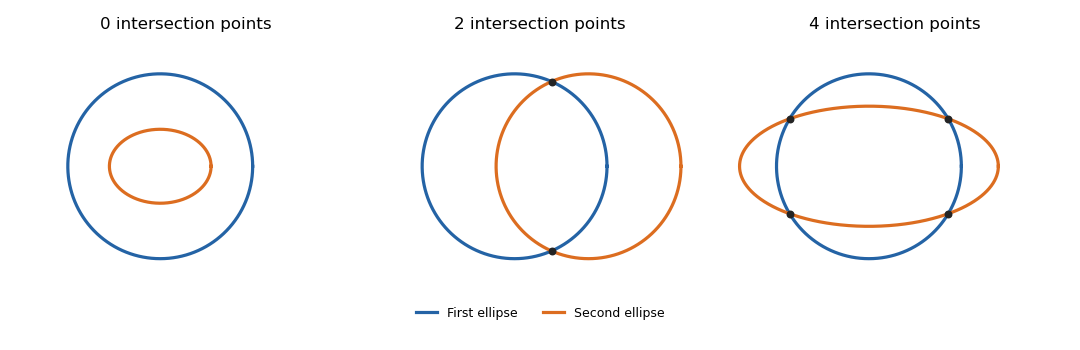
An ellipse here is a nondegenerate ellipse, hence a smooth embedded circle. Write the first ellipse aswhere is invertible. Write the second as , wherefor a positive-definite symmetric matrix . Its gradient is nonzero on the ellipse. Let . At an intersection, transversality says the tangent vector is not tangent to , soEvery intersection is thus a simple zero of , and changes sign there. The intersection set is finite: it is closed and compact, and transversality makes each of its points isolated. Start at a parameter with and traverse one full period. Returning to the same sign requires an even number of sign changes. Therefore the number of intersection points is even, including zero when the ellipses are disjoint.
For the upper bound, substituting the parametrization into the quadratic gives the trigonometric polynomialIt is not identically zero: otherwise the first ellipse would lie on the second, and its tangent would be tangent to the second everywhere, violating transversality. Put . Multiplying by turns this function into the polynomialIt is nonzero and has degree at most four, so it has at most four distinct roots. Distinct points on the first ellipse correspond to distinct parameters modulo and hence distinct points on the unit circle. ThusBoth the parity and the upper bound follow without using an algebraic intersection theorem. The four-point bound is attained by a unit circle and a concentric ellipse whose semiaxes lie on opposite sides of one.

Articles by others on the same topic
There are currently no matching articles.