For a straight-line solution , substitution into the differential equation gives . Thus , and the two possible slopes areThese straight lines solve the differential equation on either side of the origin. At the origin itself the right-hand side is undefined.
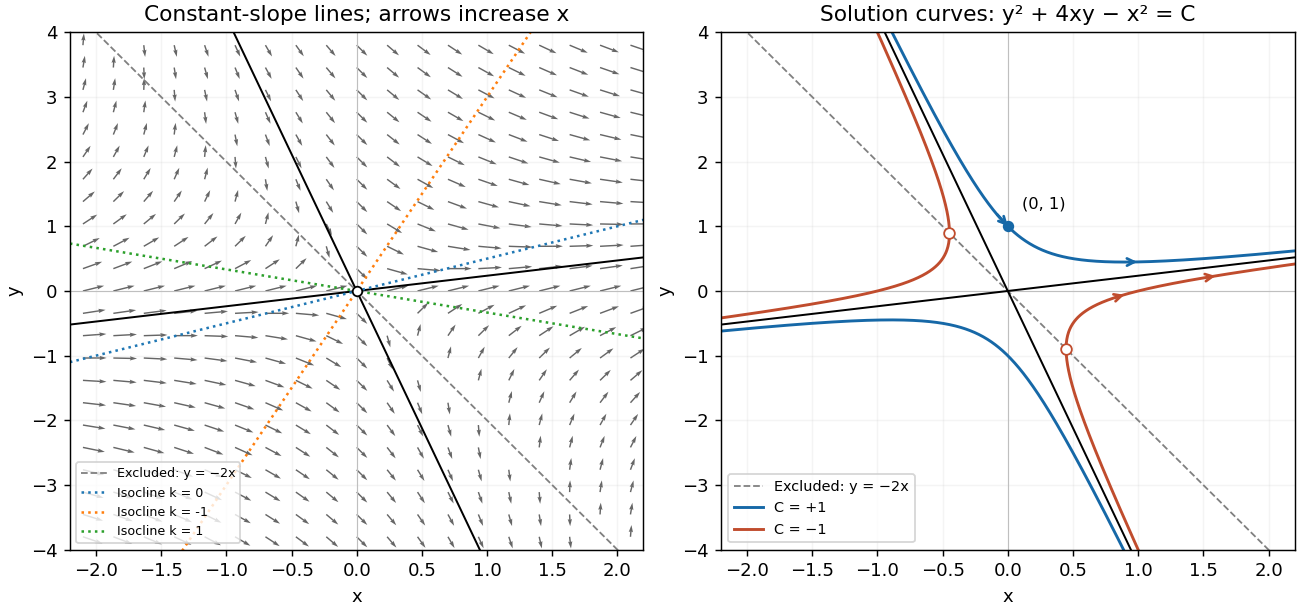
An isocline of slope has equation . For it is the straight line ; for it is , excluding the origin. In particular, is the zero-slope isocline. The line is excluded from the domain of the differential equation; slopes tend to infinity on approaching it. Draw the flow vectors proportional to , with positive horizontal component. This specifies orientation by increasing , rather than by an auxiliary time variable.
To integrate, put where . ThenThe left-hand integral is , so the nonconstant- solutions have the first integralThe constant- solutions omitted by separation are exactly the two straight lines already found, corresponding to . Alternatively, differentiating this first integral gives , which recovers the original differential equation wherever and also verifies continuation through when .
The first integral describes hyperbolas with the two straight-line solutions as asymptotes. For , the upper branch crosses the vertical axis at and exists for every real . For , each branch is confined to and reaches a vertical tangent on the excluded line ; the corresponding classical solution intervals exclude those endpoints. These give the two distinct types of curves requested in the sketch.
The initial condition selects and the upper branch, henceHere , so this really is a global solution of the initial value problem, and agrees with the right-hand side.

Articles by others on the same topic
There are currently no matching articles.