Split the vector into its normal and tangential orthogonal projections:A reflection in the plane negates the first component and preserves the second. Thus , giving the Householder reflectionSince and ,The columns of a matrix representation of a linear map are the coordinates of the images of the ordered basis vectors. Consequently, in the orthonormal basis ,Equivalently, with the orthogonal matrix , the change of basis formula is .
Write , , . If , every and the claimed inequality is immediate. Otherwise the sum of squaresholds for every real . Choosing gives , and hence the Cauchy-Schwarz inequality in its stronger absolute-value form:In particular , as requested. For unit vectors, , so this same argument givesThe absolute value is essential for opposite-pointing vectors; it follows from the squared inequality without a sign assumption on their dot product.
For a nonempty set , a real number is its supremum if every satisfies and every upper bound of satisfies . Equivalently, is an upper bound and, for every , some has . The least upper bound axiom states that every nonempty set of real numbers bounded above has a real supremum.
Suppose is nondecreasing and bounded above. Apply the least upper bound axiom to , obtaining . For any , cannot be an upper bound, so there is with . For every , monotonicity givesso . This is precisely the definition of a convergent sequence. If is nonincreasing and bounded below, apply the proved case to ; its limit is the negative of the infimum of the original terms. Thus the bounded monotone sequence theorem follows directly from the axiom:
For the first derivative, , which is the stated formula at . If the formula holds at , differentiating multiplies its coefficient by . The factorial coefficients satisfyThe sign changes, proving by mathematical induction that
Apply the given Taylor formula with integral remainder at . Its polynomial part is , where is the first terms of the requested series, sinceTo justify passage to the infinite series, for ,Therefore the integral remainder obeysThe last inequality follows from , a direct binomial theorem bound. Hence , and
Let be the augmented matrix of the linear system. Consistency means that is in the column space of , equivalently . For a consistent system, choosing one solution gives every solution as . The rank-nullity theorem therefore gives the complete classification:
- Unique: , equivalently .
- Infinitely many: .
- None: .
For the given equations, subtracting the first from the second and the second from the third givesIf , then and the first equation gives . If , the first reduced equation is , so the system is inconsistent. ThusThese conclusions can also be checked from , but the row differences exhibit the inconsistency directly.
Using the Levi-Civita symbol and Einstein summation convention, the scalar triple product isInterchange the dummy indices . Antisymmetry gives , since . Over the real numbers this proves
The normal vector to the first plane and the specified positive direction give . Then and , soNext . A vector perpendicular to both and is a scalar multiple of their cross product; the required length gives the two possibilities and . The original PDF specifies approach to the x-axis. From the original squared distance to that axis is . The two candidate endpoint squared distances are and . Hence .
Adding the given yields . By the proved scalar triple product identity, , so the only vector of the specified length for is the zero vector. Finally set . The last point is , and its plane condition becomes . Thus and .
All waypoints, in the given distance units, areTherefore the final location is . The converted TeX omits two vector instructions and changes the axis; the computation above follows the original PDF.
Put and retain the domain restriction . Then , so the continued fraction simplifies toThe other denominators are nonzero automatically because . Writing , the real-part condition becomesMultiplying by and rearranging gives . Thus the first geometric locus in the complex plane is the circleIts center is and radius is ; it does not contain the excluded point on its circumference.
The principal complex logarithm has imaginary part equal to the complex argument, so its equation gives the open rayIf one interprets the logarithm as multivalued, requiring a value with imaginary part gives the same ray. Expanding in the other equation gives , hence . Its solution is the union of the entire imaginary axis and the horizontal line .
These latter loci bound a right triangle with verticesThe bounded open region is , . Its closure is the closed triangle. Although the logarithm is undefined at , the imaginary-axis locus includes that vertex. The earlier circle is a separate locus and is not a side of this triangle.
The right angle is at , so the circumcenter is the midpoint of hypotenuse :Thus its circumcircle has the complex equationTo find the incircle, let its radius be . Tangency to and puts its center at . The distance from that point to is . Requiring this distance to be givesThereforeThis tangent circle is indeed the largest contained circle. For any contained disk of radius , its center has distances from the three side lines. Splitting the triangle into triangles with that center as vertex gives area , where is its semiperimeter. Here and , so . Our circle attains this upper bound, proving maximality rather than just tangency.
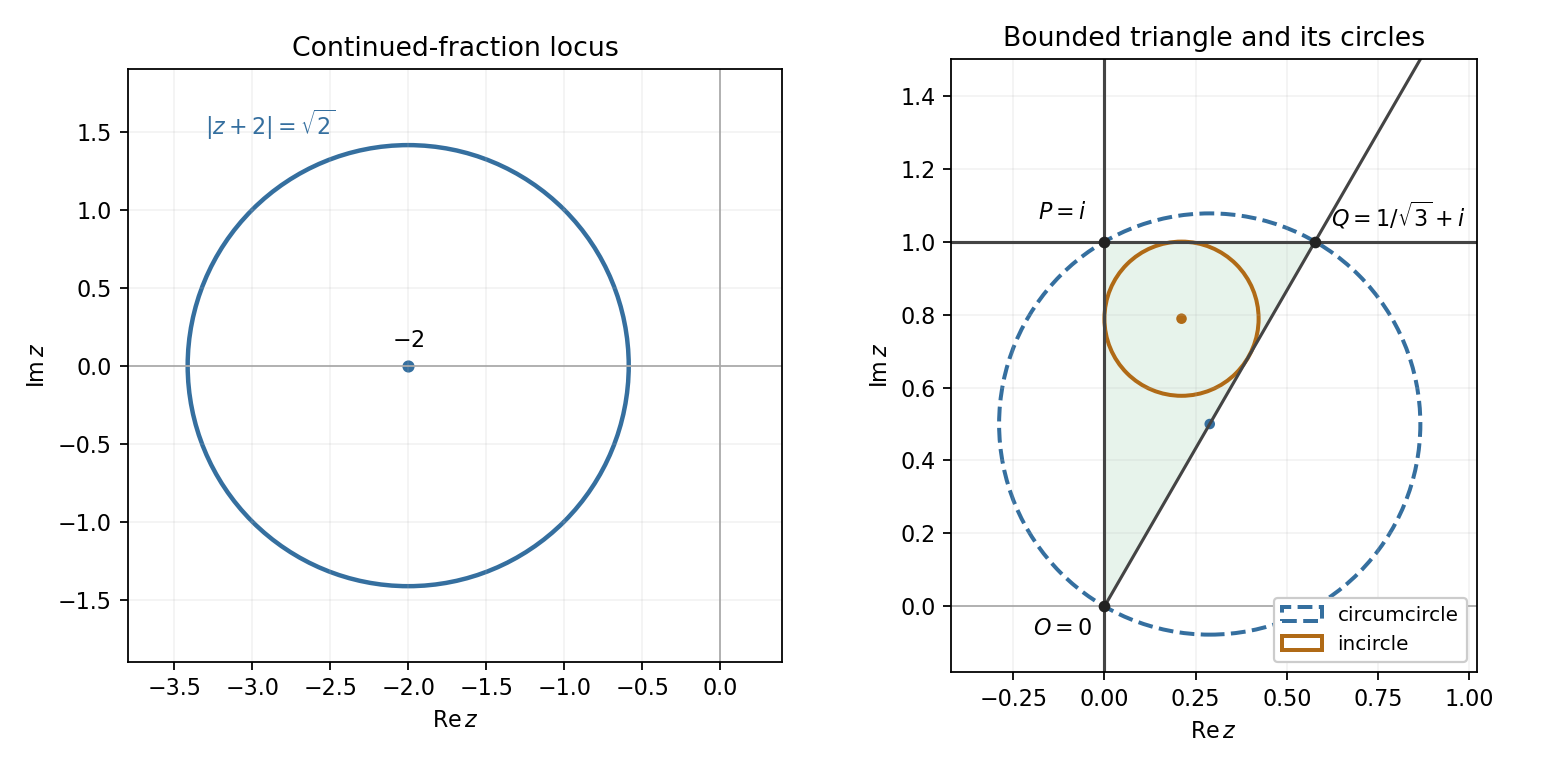
Complex loci and the bounded triangle with its circumcircle and incircle
. Details. Yes. Suppose . Taking its dot product with eliminates the last two terms and givesThe nonzero scalar triple product forces . Cyclically using and forces as well. This is the definition of linear independence. Equivalently the three-column matrix has nonzero determinant.
No. For every , takein . These form a minimally dependent vector family: the full family is dependent because .
If the omitted vector is , the remaining coordinate vectors are independent. If the omitted vector is , a relation among the retained vectors has an coordinate coming only from , so its coefficient must be zero; the coefficients of all retained coordinate vectors must then be zero. Thus every -element subfamily is linearly independent, as required for a counterexample. When , the empty subfamily is independent while the one-vector family consisting of the zero vector is not, so the answer remains negative.
A direct construction, valid for every , isThe first coordinates give , andThe first two norms are one. For the third,Thus the required Gram matrix is . The column matrix is upper triangular and has determinantso these vectors are linearly independent. This is an explicit instance of unit vectors with a common inner product; at it reduces to the standard orthonormal basis.
Rolle's theorem states that if a real function is continuous on , differentiable on , with and , then some satisfies .
For the two-function assertion, defineThis function has the required continuity and differentiability and satisfies . Rolle's theorem therefore gives withThis proves the Cauchy mean value theorem even when either endpoint increment vanishes; no division was used.
Now impose the stated zero endpoint values and nonvanishing assumptions near . For each , applying the proved identity on gives some such thatAs , every possible also tends to . Explicitly, for any , choose a right neighborhood of where . If lies in it, so does , and therefore . This proves the endpoint zero-over-zero form of L'Hôpital's rule:No continuity of either derivative is required, only their ratio limit and the given nonvanishing conditions.
For the final limit, near zero , so the real logarithm is well defined. First apply the proved rule to on the right: its derivative ratio is . Next apply it to ; the derivative ratio isThe original quotient is even, so the left limit equals the right limit. Consequently
Use integration by parts on , for :Both boundary terms are zero. Therefore the Wallis integrals satisfyStarting with and , repeated application givesThese formulas also hold at by empty products.
For , , so when . Integrating the strict inequalities proves . In particular . For , the recurrence and giveThusAt the same displayed bounds are , also true directly from .
The squeeze theorem now gives . Substituting the evaluated integrals showsand henceThis is twice the finite-product form of the Wallis product; the proof used only the integral recurrence and strict comparison of its integrands.
For the additive function, setting both arguments to zero gives , and then . Continuity at the given point impliesFor any real , , so is continuous at every point. This proves the continuity part of additive function continuous at one point is linear.
Let . Repeated addition and negation give for every integer . For integers and positive ,so for every rational number . Given any real , choose rational . Continuity and density of the rational numbers giveConversely each real multiple of satisfies the Cauchy functional equation.
For the multiplicative equation, assume first that is not identically zero and choose with . Then forces . Nextmakes every value nonzero, andmakes every value positive. Thus is a continuous real additive function, since . The proved classification gives for a real constant . This solves the continuous exponential functional equation:Both types satisfy the equation and continuity, and every nonzero solution is everywhere strictly positive.
Rearranging the assumed positive-term ratio inequality givesInduction therefore yields for every . In particularThe positive partial sums of the first series are nondecreasing and bounded above, so the bounded monotone sequence theorem proves that they converge. This is the ratio comparison test, and establishes convergence of .
Extend the sequence by . Cancelling factorials in consecutive normalized central binomial coefficients givesThe given logarithmic inequality therefore impliesOn , , so summing its integrals gives . Exponentiating yields the explicit boundAlso every consecutive ratio is less than one, so is strictly decreasing, a fact needed for the alternating endpoint.
At the terms are . Their decay to zero alone is insufficient for convergence. In factbecause the difference has numerator . Since , induction gives . The comparison harmonic series diverges, so
At the terms are . Part (ii) gives positive decreasing magnitudes tending to zero, so the alternating series test applies. To see the convergence directly, let . Thenwhile , obtained by grouping . Thus the even partial sums have a finite limit. The odd partial sums differ from them by , so the whole sequence of partial sums has the same limit. Absolute convergence would require convergence of , already disproved. Hence
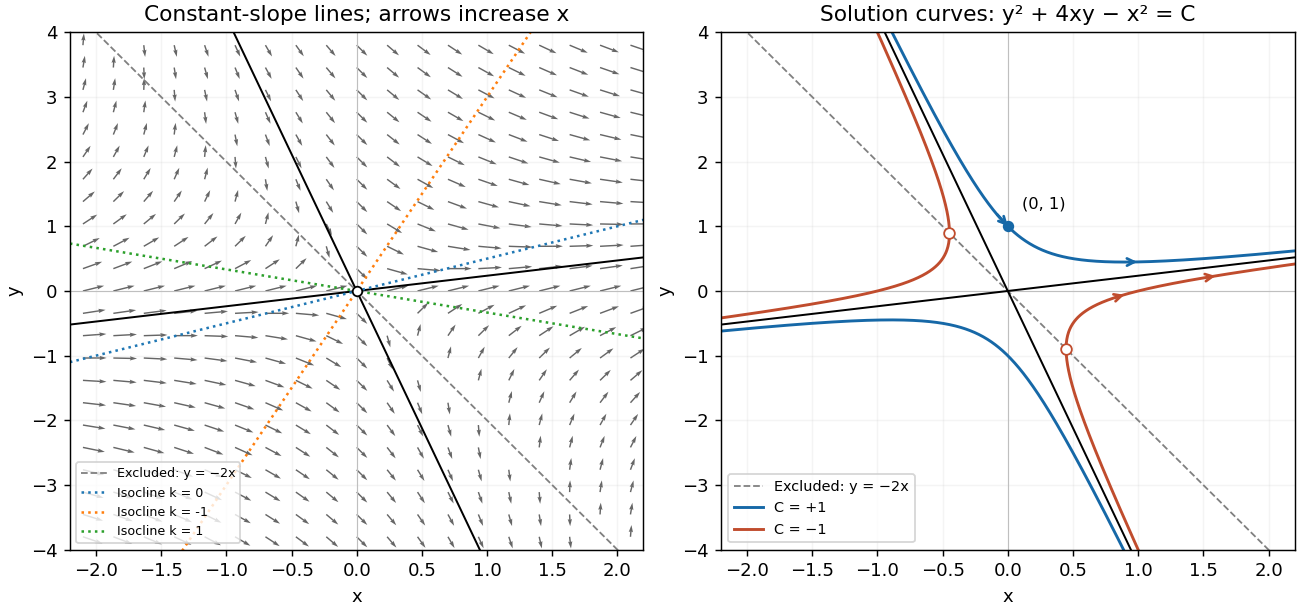
For a straight-line solution , substitution into the differential equation gives . Thus , and the two possible slopes areThese straight lines solve the differential equation on either side of the origin. At the origin itself the right-hand side is undefined.
An isocline of slope has equation . For it is the straight line ; for it is , excluding the origin. In particular, is the zero-slope isocline. The line is excluded from the domain of the differential equation; slopes tend to infinity on approaching it. Draw the flow vectors proportional to , with positive horizontal component. This specifies orientation by increasing , rather than by an auxiliary time variable.
To integrate, put where . ThenThe left-hand integral is , so the nonconstant- solutions have the first integralThe constant- solutions omitted by separation are exactly the two straight lines already found, corresponding to . Alternatively, differentiating this first integral gives , which recovers the original differential equation wherever and also verifies continuation through when .
The first integral describes hyperbolas with the two straight-line solutions as asymptotes. For , the upper branch crosses the vertical axis at and exists for every real . For , each branch is confined to and reaches a vertical tangent on the excluded line ; the corresponding classical solution intervals exclude those endpoints. These give the two distinct types of curves requested in the sketch.
The initial condition selects and the upper branch, henceHere , so this really is a global solution of the initial value problem, and agrees with the right-hand side.


Write . Direct differentiation givesThe homogeneous linear differential equation therefore has . A linearly independent pair of solutions isTheir Wronskian is , which never vanishes; the argument also includes .
For the inhomogeneous linear differential equation, the same substitution gives . Since implies , and then implies , integration gives . Thus the required solution of the initial value problem is
For random variables with finite second moments, their covariance isThe Cauchy-Schwarz inequality ensures the product is integrable under this hypothesis. More generally the definition works whenever the displayed expectations exist. Assertions about arbitrary random variables below are understood on this domain: without suitable moments a covariance need not be defined at all.
Linearity of expectation gives . Expand the centered product and use linearity of expectation again:Thus the assertion is true whenever the covariances are defined. Neither independence nor identical distributions are required.
The covariance is symmetric, because multiplication of real random variables is commutative. Expanding with the bilinearity just proved givesIdentical probability distributions imply equal second moments and equal means, hence equal variances. Therefore the assertion is true, withThe cancellation shows exactly why no assumption of independence is needed.
A probability density function must integrate to one. ThereforeThe first two moments areConsequently the mean and variance are
The origin is an ordinary point, since the coefficients of the second-order linear differential equation are polynomials. Seek a power series . Matching the coefficients of and gives . Matching the coefficient of givesThus the four residue classes of indices modulo four evolve separately. The initial conditions for the first solution give , , and henceThe second set of initial conditions gives , , andAn empty product equals one. In either power series, the ratio of successive nonzero terms tends to zero for every fixed : the coefficient ratio is of order , while the power increases by four. The ratio test therefore proves convergence for every , and termwise differentiation verifies the differential equation. These normalized solutions are linearly independent.
For their Wronskian , differentiating and substituting the differential equation givesThus the Abel identity yieldsOn the interval containing zero where has no zero,Since , integration proves the requested reduction of order formula:This is a local formula around the origin, as requested. The power series define both solutions globally; an ordinary integral through a zero of is not intended. Reduction of order across a zero of the known solution instead uses continuation of the actual solution.
Substitute the linear recurrence relation for each of and in the discrete Wronskian:Iterating givesNo division was used, so vanishing cause no exception.
For constant coefficients, seek a solution . The characteristic equation of a linear recurrence is . Choose with . Its roots are and , since . For the two resulting solutions,It is independent of , exactly as the product identity predicts when .
When the roots are distinct and the discrete Wronskian is nonzero. At or , the two displayed solutions coincide and ; the identity still holds. If an independent pair is wanted at these endpoints, take and , where or respectively. Direct substitution verifies both, and their discrete Wronskian is .
Introduce the velocity variable . The second-order differential equation becomes the autonomous planar systemA critical point of a dynamical system is a point where both components of the vector field vanish: here and . It is a stationary solution in the phase plane. The Jacobian matrix at each such point gives the local linear stability of a planar equilibrium. For the equations below, a conserved energy also determines the nonlinear phase portrait; this is important because purely imaginary eigenvalues alone do not generally prove that an equilibrium is a center equilibrium.
Here the autonomous planar system is , . Its equilibrium points areThe Jacobian matrix isFor even , the eigenvalues are , so these points are unstable saddle equilibria. Writing , their local unstable and stable directions are and respectively. For odd , the eigenvalues are .
To classify the latter points nonlinearly, differentiate the first integralAt this energy has a strict local minimum. Its nearby level sets are closed curves, proving that the odd- points are stable center equilibria, with no attraction to the center. The phase portrait consists of closed oscillatory orbits for , heteroclinic orbits at joining consecutive saddle equilibria, and open rotating orbits for . The separating curves haveAbove the horizontal axis , so flow is rightward; below it flow is leftward. The closed orbits are clockwise, and these same signs orient every separating and rotating orbit.
For both parameters the autonomous planar system is , . It has the conserved energyIndeed . At any equilibrium point the eigenvalues satisfy
For , the quadratic is strictly positive, so the only equilibrium point is , with eigenvalues . Since has the sign of , has a unique strict minimum at zero and tends to infinity in both directions. All positive energy levels are closed curves surrounding this stable center equilibrium. They are clockwise: rightward when and leftward when .
For , factor . The three equilibrium points and their classifications areThe two center equilibria are stable but not asymptotically stable; the saddle equilibrium is unstable. At the saddle equilibrium the local unstable and stable directions are and .
The potential values are , , and . Consequently there are closed loops around the left center for , closed loops in both wells for , and a figure-eight pair of homoclinic orbits at . At the right center is a stationary point while the left well still has a closed orbit. For , each closed curve encircles both centers and the saddle.
The two homoclinic orbits satisfy . Their outer turning points can be located exactly fromEvery nonstationary energy curve is oriented to the right in the upper half-plane and to the left in the lower half-plane. The sketches show the closed curves, the separating orbits, the stable and unstable saddle directions and the direction of flow.
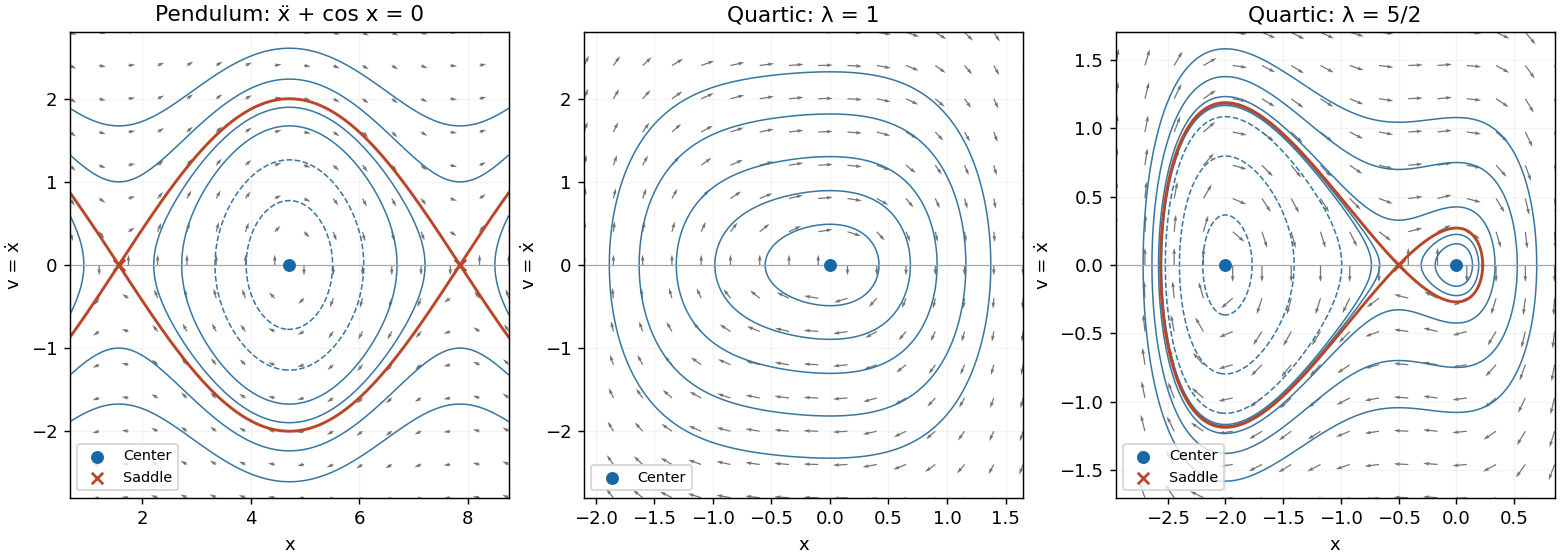
Clockwise phase flows, alternating pendulum saddles and centers, and the one-well and two-well quartic potentials
. Details. 
Write the linear differential equation as , withIts characteristic polynomial is . Thus a choice of eigenvalues and eigenvectors isThe distinct eigenvalues give two linearly independent solutions, and the general complex solution isReal solutions have . Equivalently,They spiral counterclockwise towards the origin, which is a stable spiral.
In a forced linear differential equation, resonance in a differential equation occurs when exponential forcing excites a mode with the same exponent as its eigenvalue, producing a polynomial factor such as multiplying that exponential. Merely matching an exponent is not enough: its projection onto that mode must be nonzero. Here still decays in absolute magnitude because the real part of is negative; resonance refers to this extra factor, not necessarily to unbounded growth.
For each forcing vector, resolve it in the eigenvector basis:If is the coefficient of the th eigenvector, its scalar equation is . Multiplying by and integrating shows that the contribution is , whereas a contribution is . Therefore the exact conditions for no resonant response areUnder these conditions one particular solution iswhich contains no factor of . For a real forcing, and , and the two boxed conditions are conjugate to each other.
The probability generating function isFor independent random variables, the bounded factors and have factorizing expectation, soThis includes complex in the indicated disk by absolute convergence.
For the dice construction, encode the labels of an ordinary die by . Its probability generating function is . A useful factorization into polynomial factors isUse redistribution of polynomial factors for dice to defineBoth polynomials have nonnegative integer coefficients, no constant term, and coefficient sum six. They therefore describe fair six-sided dice with strictly positive face labelsWhen these dice are thrown with independent outcomes, the sum has probability generating function . Equality of coefficients proves equality of every sum probability, including all totals from two to twelve, with zero probability outside that range. Both dice are nonstandard, completing the construction.
For events with , the conditional probability isUse the sample space , where the first coordinate is the chosen coin and the other coordinates record which of its two physically distinguished faces lands upwards on each toss. There are equally likely elementary outcomes. Label the double-headed coin by one. For that coin both face indices mean heads; for each other coin only face index one means heads. In particular, strings of observed heads and tails are not equally likely outcomes.
Let be the event that the first three tosses show heads. With coin one all sixteen face-index strings are permitted. For each ordinary coin the first three indices must be one and the fourth is free, giving two strings. Thus . Of these outcomes, sixteen from the double-headed coin and one from each ordinary coin also have a fourth head. HenceEquivalently, Bayes' theorem gives conditional probability of having selected the double-headed coin after ; the fourth-head probability is then . The tosses are independent conditional on the selected coin, while mixing over the same coin explains their unconditional dependence.
Take as the rate of the exponential distribution. By independence, the joint probability density of the original pair is on . Put , . The inverse change of variables isIts Jacobian determinant isUsing the absolute value in the change of variables formula, the transformed joint probability density isand zero otherwise. The support is the entire positive quadrant, and the factors are separately normalized:Integrating out either variable therefore yields these factors as the marginal densities. Factorization of the joint probability density proves independence, withThe sum has a shape-two gamma distribution, and the ratio has a beta-prime distribution with parameters one and one, independent of . Its cumulative distribution function is for .
Because the events are pairwise disjoint events, their count can only be zero or one. The event that the count is zero is the complement of an event of their union. Finite additivity therefore gives
Now use for the fixed number of independently located ships. Normalize the radius to one and write their positions as unit vectors . A point on the sphere is reached by ship precisely when , so each ship reaches an open hemisphere. Coverage fails exactly when there is a unit vector with for every . Equivalently, all ship positions lie in some closed hemisphere.
With probability one no pair of ship vectors is antipodal and no three are linearly dependent: the exceptional choices lie on sets of zero surface area. For such a configuration, containment in a closed hemisphere implies containment in an open hemisphere. To see this, choose its inward normal , so . At most two vectors lie on its boundary. If there are two, their sum has positive dot product with each, since they are not antipodal; if there is one, use that vector itself. Perturb slightly in this direction. The boundary dot products become positive while all already positive dot products remain positive. Thus the strict and non-strict containment conditions have the same probability here.
Condition on the unoriented axes . Choose representatives by any fixed sign convention. By uniform sampling and independence, the actual positions are with independent fair signs . Conditional on these axes, each of the sign choices has probability .
The great circles partition the sphere into open regions. In each region the sign vector is constant. No sign vector labels two different regions: its strict inequalities define a convex cone, and normalized line segments within that cone connect any two points of its spherical section. The regions of a general-position great-circle arrangement therefore yield exactly realized sign vectors.
The chosen positions lie in an open hemisphere if and only if some has for every , that is, for every . Failure of coverage thus corresponds exactly to one of the realized sign choices. These choices are mutually exclusive events, each of conditional probability , so the first part applies:The result is independent of the axes. Averaging gives the coverage of a sphere by random open hemispheres:For this is zero; for it is . If no ship lands, coverage has probability zero separately. The counting uses equiprobable orientation signs, not an assumption that the spherical regions have equal area.
For a subgroup of a finite group , Lagrange's theorem states . Thus a subgroup's order, and in particular the order of a group element, divides .
For , if every element had order one or two, the order of a finite group of exponent two would make a power of two, a contradiction. Hence an element has order five or ten. In the latter case is the cyclic group . Otherwise choose of order five. Its cyclic subgroup has index two and is therefore a normal subgroup.
In the noncyclic case an element outside has order two: its order divides ten, it cannot have order ten, and an element of order five has trivial image in the order-two quotient group . Every element of is then or . Conjugation by restricts to an automorphism of , say . Since , , so or modulo five.
For , the generators commute and has order ten, yielding the cyclic case. For , these are the relations of the dihedral group of the pentagon. The classification of groups of order ten is therefore exactly and , where the subscript on denotes its order. They are not isomorphic because one is Abelian and the other is not.
The Möbius group consists of maps with , acting on the Riemann sphere . Proportional matrices represent the same map. Thus it is , equivalently after normalizing the determinant. A zero denominator gives the image , while maps to when and stays at infinity when .
Fixing both zero and infinity forces , leaving with . Composition multiplies the parameters, giving a bijective group homomorphism from the multiplicative group of nonzero complex numbers to this pointwise stabilizer.
For the other pair, take , which sends zero to zero and one to infinity. Conjugate the scaling subgroup by this Möbius transformation:Every map fixing zero and one arises this way. Composition again multiplies , proving both subgroups are isomorphic to . This is the Möbius pointwise stabilizer of two points; conjugation changes the selected fixed points without changing its group structure.
Use the Levi-Civita symbol and sum over repeated indices. The contraction of two Levi-Civita symbols and the product rule giveReading the four terms as divergence and directional derivatives proves the curl of a cross product identity
The contraction of two Levi-Civita symbols gives . Similarly . Add the two directional-derivative terms to cancel the last terms, leavingThe product rule has therefore proved the gradient of a dot product identity
For a regular space curve parametrized by arc length , its curvature is , where is the unit tangent. Differentiating the given parametrization givesThe curve approaches the origin as ; the origin is a limiting endpoint. Its arc length measured from that endpoint is , soThis is a logarithmic conical helix. Its unit tangent and derivative areConsequently,The infinitely many turns near the limiting origin have finite total arc length, while the curvature diverges there.
Use for the dihedral group of order twelve and write each element uniquely as or , . The classification of subgroups of a dihedral group organizes the complete list: rotational subgroups are cyclic, and a subgroup containing a reflection is generated by its rotational part and one reflection. The individual lists and quotients follow below.
The involutions in an even dihedral group are the half-turn and the six reflections . Thus the seven order-two subgroups areThe half-turn is central, so only is normal. Indeed , a different reflection; an order-two subgroup has only one nonidentity element, so each reflection subgroup fails the normal subgroup condition.
The remaining proper subgroups areTheir orders are respectively one, three, six, four and six. The order-four groups are Klein four-groups; the last two are dihedral groups of order six, isomorphic to .
For completeness, if contains a reflection, write with . Any other reflection differs from a chosen by an element of this rotational subgroup, so with specified modulo . The choices give respectively the whole group, the two order-six groups, the three order-four groups and the six reflection groups already listed. This proves there are no omitted subgroups.
Thus there are eight remaining proper subgroups. The printed count nine includes one too many; nine would be correct if the whole group were included with these remaining subgroups. Altogether has sixteen subgroups, fifteen proper.
The proper normal subgroups and their quotient groups are as follows. Here the trivial subgroup is included as a proper subgroup.
- gives .
- gives : the rotation has order three and the reflection inverts it.
- gives : the two generators now have order two and commute.
- gives .
- or gives .
The rotational subgroups are preserved by reflection conjugation, and the last three order-six subgroups are normal by index two. The three order-four groups are not normal, since conjugation by changes the reflection exponent by two, which is nonzero modulo three. Part solution excluded the reflection subgroups. These observations, together with the complete subgroup list, prove the normal-subgroup list is exhaustive.
The rotation has order six. The possible cycle types in the alternating group are the identity, a three-cycle, and a product of two disjoint transpositions; their orders are one, three and two. Since a group isomorphism preserves the order of a group element, is not isomorphic to .
Articles were limited to the first 100 out of 153 total.
Articles by others on the same topic
There are currently no matching articles.