Use a mostly-plus target metric tensor and the standard open-string mode expansion convention . The integer string oscillator level is , whose eigenvalues are nonnegative integers. Then , so the string mass-shell condition givesThe ground state is a tachyon, and the level-one state is massless. The physical string state conditions in old covariant string quantization areOnly the positive-mode Virasoro constraints annihilate a ket; their negative-mode partners annihilate the corresponding bra. Imposing both signs on every ket would contradict the nonzero Virasoro central extension.
The central charge comes from normal ordering the quadratic oscillator expressions. Classically their Poisson brackets have no central term. Quantum mechanically, moving annihilation operators through creation operators produces double contractions. From the oscillator commutator one obtains , which gives the noncentral part .
The coefficient is fixed by the free-boson Virasoro central term. On a formal zero-momentum vacuum, for ,The two contraction pairings giveHere ; the time coordinate contributes one, just as each spatial coordinate does. Comparing with the Virasoro algebra provesThis counts covariant target coordinates. It is distinct from the physical transverse polarizations. Including the central charge of reparameterization ghosts gives ; cancellation of the worldsheet Weyl anomaly gives the usual critical dimension of the bosonic string .
A general level-one state isThe zero-mode constraint requires . Since , the remaining nontrivial positive-mode constraint is ; all with act trivially at this level. Thus the polarization vector is transverse to a nonzero null momentum.
There is also a null string state . It is physical when and orthogonal to every physical polarization. The null-state quotient of a string therefore identifiesChoose . Transversality sets , and the null-state identification removes this common component. The remaining spatial components have positive norm. Hence the physical level-one states form a massless vector with polarizations, or 24 at the critical dimension. The removed component is gauge redundancy. States violating the constraints, including independent timelike negative-norm polarizations, are unphysical; physical null states are removed by the quotient rather than counted as additional particles.
The string sigma model in a spacetime metric is the Polyakov actionTake conformal gauge , and choose spatial period for the closed string. Substitution of the plane-wave metric givesThe stipulated light-cone gauge in string theory sets and . Its longitudinal term is a total time derivative. The transverse string sigma model in an isotropic plane wave is thereforeThe resulting Euler-Lagrange equations are the massive wave equationsThese conventions fix the mass term directly from . More generally would replace by , with for this spatial period.
Use the real orthonormal Fourier basisFor the plane-wave string mode frequencies, let and . The complete real mode expansion for nonzero frequencies isEvery term obeys the wave equation and is periodic. Orthonormality and completeness let its coefficients match arbitrary appropriate initial position and velocity data. For , replace the zero-mode bracket by ; the zero mode becomes a free particle rather than an oscillator.
The canonical momentum density is . The transverse Hamiltonian isWrite and . Since and , substitution gives the plane-wave string mode HamiltonianThis is a collection of independent harmonic oscillators. The last equality follows by substituting the sine-and-cosine time dependence; each oscillator energy is constant.
For canonical quantization of each nonzero-frequency mode, putThen . Opposite travelling-wave oscillator combinations give the equivalent formFor , the formal zero-point energy is . At , replace the zero-mode occupation term by . The zero-point expression is divergent and needs a regulator or a specified normal ordering convention; no mass-independent intercept has been assumed.
The remaining Virasoro constraints determine the longitudinal coordinate:Periodicity of imposes , the closed-string level matching condition. Labelling the travelling oscillators by their opposite worldsheet momenta gives . The light-cone energy equals , consistent with the positive mass term in the Hamiltonian.
This is the classical reduction in the specified background. As a full quantum background with constant dilaton and no Kalb–Ramond field, this metric has and fails the lowest-order sigma-model beta function equation when ; additional background fields would be required for quantum Weyl invariance.
Use Euclidean worldsheet conventions with . Including a target metric, a Kalb–Ramond field and the dilaton givesThe imaginary coefficient of the antisymmetric term comes from Euclidean continuation; the Lorentzian action has the corresponding real coupling. For constant , the Gauss-Bonnet theorem gives , with Euler characteristic on a connected closed oriented surface. Thus dilaton Euler-characteristic weighting givesAdding one handle multiplies a contribution by , identifying as the string coupling. With canonically normalized external closed-string states, vertices add , giving the string genus expansion .
Before gauge fixing, the Polyakov path integral for inserted string vertex operators is schematicallyThe quotient removes descriptions related by worldsheet diffeomorphisms and Weyl transformations. Gauge fixing has a nontrivial Jacobian, the Faddeev-Popov determinant. Anticommuting vector ghosts and symmetric trace-free antighosts exponentiate this determinant as a local worldsheet ghost action. These worldsheet ghost fields implement the gauge quotient; they are not additional spacetime particles. Their zero modes must be treated separately rather than included in an invertible determinant.
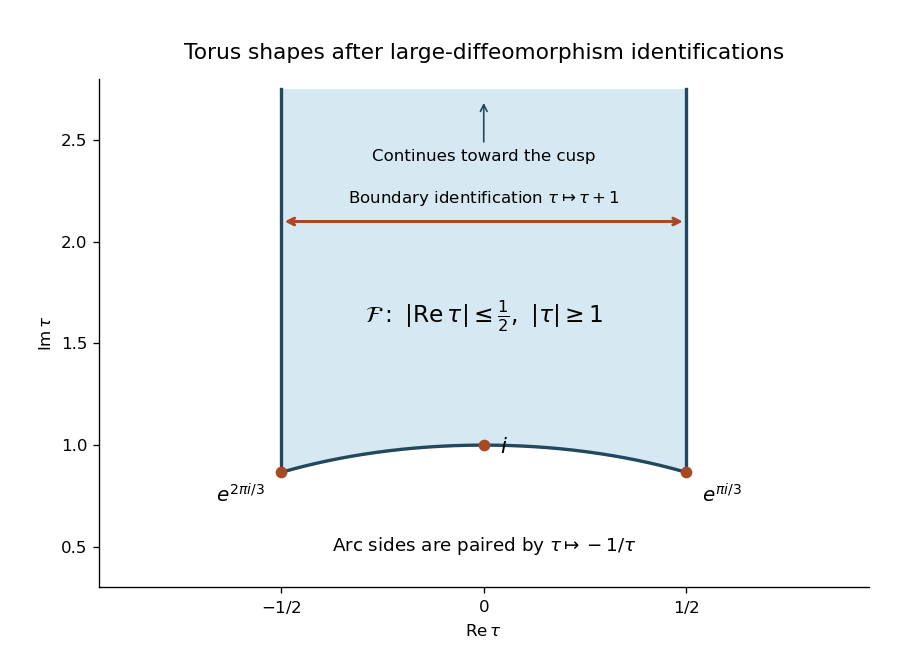
Three kinds of geometry enter the scattering calculation. The worldsheet moduli describe genuinely different conformal shapes that remain after local gauge fixing. Each such shape must be integrated over. The mapping class group consists of orientation-preserving diffeomorphisms modulo those continuously deformable to the identity; it identifies different markings of the same conformal surface, so only one representative of each class is counted. The worldsheet conformal Killing group is the continuous residual conformal symmetry of a chosen surface. It moves insertion positions without changing the geometry and must be divided out, usually by fixing enough vertex positions.
For a torus, write , with . Its shape modulus is , its mapping class group acts through the modular group, and its connected worldsheet conformal Killing group acts by translations. Thus the shape integral runs over the standard fundamental domain of the modular group, while one insertion position can be fixed by translation. On the sphere, three positions can instead be fixed by Möbius transformations; for genus at least two the continuous conformal Killing group is trivial.

Now use the half-normalized worldsheet diffeomorphism ghost operator in the question. A vector field can preserve the representative metric after a compensating Weyl transformation precisely when . The trace of the metric variation sets , leaving the Conformal Killing equationThe kernel of this operator gives the infinitesimal worldsheet conformal Killing group.
For a surviving infinitesimal worldsheet modulus, choose its metric variation orthogonal to all gauge variations. Orthogonality to Weyl transformations requires . On the closed surface, the formal adjoint of the worldsheet conformal Killing operator follows by integration by parts:Orthogonality to every diffeomorphism variation is therefore the adjoint-kernel condition, givingIn a local conformal coordinate these imply and its conjugate: the moduli variations are represented by holomorphic quadratic differentials. Multiplying the definition of by two changes its adjoint by two but changes neither kernel.
For four tachyon vertex operators on the torus, there is one complex shape modulus, four complex insertion positions and one complex translation to remove. The worldsheet integration count after conformal gauge fixing is thereforeFix the fourth insertion at . A schematic gauge-fixed expression isHere the antighost pair supplies the modulus measure, and the ghost pair at the fixed vertex absorbs the translation zero modes. The three unfixed positions and are the four complex integrations. The punctured Riemann surface moduli dimension gives the same result, . Target-spacetime zero-mode integrals producing momentum conservation are separate from this requested count of worldsheet integrations.
Articles by others on the same topic
There are currently no matching articles.