Consider the complex field before taking its real part. Put and . Both components are perpendicular to , so the solenoidal magnetic-field constraint holds. The time-dependent phase obeysbecause and . Moreover , and magnetic stretching is . Thus the changing basis exactly supplies the shear-stretching term. Finally,and acts as . Equating coefficients verifies
Take and first . Remove magnetic diffusion by writing , , whereThen , , and . Equivalently, rescaling time by and replacing by gives the pair used in the question. Its growing WKB approximation isThe complex relative phase follows directly from ; the printed is sufficient for magnitudes but omits that phase.
The phase-averaged magnetic energy is , hence for a nonzero growing-mode componentAt , , so its leading exponential isThe positive quadratic term permits strong amplification before the negative cubic diffusion term dominates. The leading maximum occurs near . Put and . A well-separated late-time growing interval requiresThe first ensures ; the second ensures the WKB condition at the peak, since . For fixed nonzero both follow by taking sufficiently small positive . The peak's leading exponent is , whereas the eventual exponent tends to minus infinity. This is mean-field shearing-wave transient amplification, not sustained dynamo action.
Growth from the initial instant is possible explicitly: choose with . The initial logarithmic energy derivative is when . Growth is not asserted for every initial polarization, for example an identically zero field. If , the amplitudes simply diffuse and the energy is proportional to ; shear can still give algebraic transient amplification of an in-plane field for small diffusivity, but a purely vertical field only decays. Positive diffusivity is essential to the final decay.
Start from the constant-coefficient mean-field dynamo equationHere may include turbulent as well as microscopic diffusion. Use a local Cartesian model, neglect meridional circulation and curvature, and assume independence of . Represent the poloidal magnetic field by a vector potential along and the toroidal magnetic field by its component:The shear contributes . The poloidal part of gives , while the toroidal part of is . ThereforeRetaining one common transverse dependence changes to , producing the two requested equations. The first coupling is the alpha effect regenerating poloidal field from toroidal field; the shear is differential-rotation winding in an Alpha-Omega dynamo. Retaining the alpha contribution in the second equation also allows alpha-squared dynamo feedback, rather than making the pure Parker shear-dominated approximation.
Include temporal dependence and put . The two Fourier amplitudes obeyConsequently the dispersion relation and its branches areFor and , the branch with positive real square root is the potentially unstable one. At marginal stability set ; comparing real and imaginary parts givesEliminating produces the alpha-squared Omega dynamo thresholdEither sign of is allowed; it changes the wave's propagation sign. Larger increases the real part of the growing branch through zero.
To minimize the threshold differentiate with respect to . The sign of this derivative is the sign ofIts derivative is strictly positive for , so there is at most one interior minimum. Its value at zero changes sign atFor , and the minimum is , with . For stronger shear, the minimizing positive wavenumber is the unique rootAn explicit form follows by setting and . The cubic becomes , with real solutionThe negative wavenumber has the same threshold. In the strong-shear limit .
The threshold curve is even in and behaves as at large . Below the shear threshold it increases monotonically away from its central minimum. Above the threshold, zero is a local maximum flanked by the two nonzero minima. At equality the central minimum has vanishing quadratic curvature but remains a minimum. These two cases are sketched from the derived formula below. If , the zero-wavenumber uniform/gauge mode is degenerate and the positive-wavenumber threshold tends to zero as ; the nonzero- minimum formula must not be used as a nondegenerate onset criterion there.
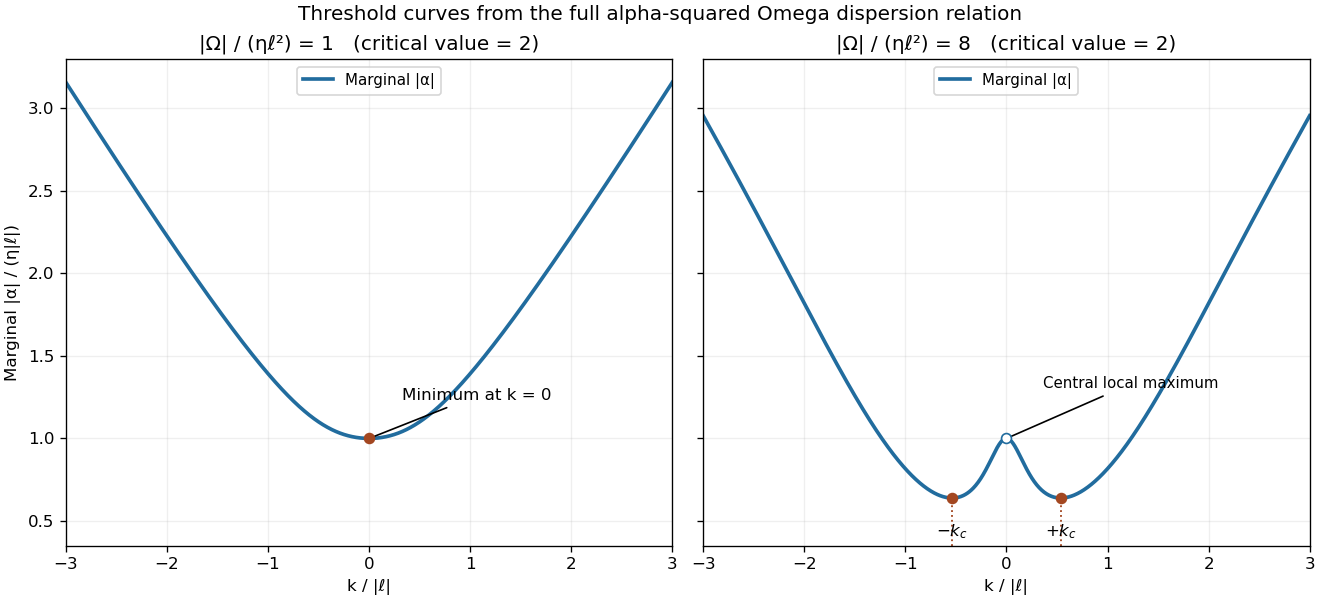
Marginal alpha-squared Omega dynamo thresholds below and above the critical shear, with the minimizing wavenumbers
. Details. 
Interpret the two-dimensional dependence as independence of , allowing the velocity to have a vertical component . Write and . The resistive induction equation, with a gauge fixing the potential's zero mean, givesThe first is a homogeneous advection-diffusion equation. Multiply it by , average over the periodic box and use integration by parts. Advection contributes zero because ; there are no surface terms. ThusMultiplying by makes its derivative nonpositive. With the initial norm convention , this provesThe Poincaré inequality uses the zero-mean assumption; a spatially constant flux potential would otherwise have no gradient. Zero mean remains preserved by this incompressible periodic equation.
Multiplying the vertical induction equation by and averaging eliminates advection and givesIntegrate the derivatives of by parts. Mixed derivatives of cancel, leavingThe pointwise cross-product bound and the Cauchy-Schwarz inequality bound its absolute value by , where . HenceFor and , completing the square givesApply part (i) and integrate, obtaining the periodic two-coordinate anti-dynamo energy boundThe printed bound has only one power of diffusivity and is false as written. Both powers above are needed: one comes from maximizing against diffusion and the other from integrating the decay time of .
For an explicit counterexample in a nondimensional -periodic box, take , , , . All means vanish and the velocity is solenoidal. The exact solution isIndeed and this mode's Laplacian is . Here , , and at ,For this is , exceeding the printed . The corrected bound is valid and finite.
Keep part of the diffusion rather than maximizing all of it. The elementary square inequality givesWriting and , part (ii), the Poincaré inequality and part (i) implyMultiply by and integrate from zero:Thus stretching by a vertical velocity can transiently generate vertical magnetic energy, but cannot maintain it in this zero-mean periodic, -independent setting. For a strictly planar velocity, and the passive vertical component decays directly. The stated conclusion depends on positive magnetic diffusivity and the spectral gap supplied by zero mean.
In the rapidly rotating magnetohydrodynamics of a conducting core, the magnetostrophic balance neglects inertia and, initially, viscosity:Take a spherical or suitable axisymmetric impenetrable container, with gravity/buoyancy having no azimuthal component and no applied mechanical torque. Small Rossby number is the slow-motion assumption. It does not imply that an arbitrary magnetic field is compatible with the balance.
Use cylindrical coordinates and integrate the azimuthal momentum equation over the fluid portion of a cylinder. The pressure term integrates to zero because it is a periodic derivative. The Coriolis contribution is proportional to the radial flux . By incompressibility and impermeability it is zero: closing the cylinder with the container's caps and applying the divergence theorem produces no net flux. There is no azimuthal buoyancy term. ConsequentlyThis is Taylor's condition. Equivalently define the torque per radial thickness by ; it must vanish. In a shell, cylinders split by the inner boundary require the corresponding connected-region conditions. These compatibility conditions concern rotating-fluid torque, distinct from force-free magnetic relaxation in a plasma. Their primary origin is Taylor's rotating-fluid analysis.
A magnetostrophic Taylor state allows construction of the flow's ageostrophic part. Taking the curl givesIntegrate along rotation-axis lines and impose impermeability, then use incompressibility and periodicity to reconstruct a particular solution . In a sphere the boundary geometry supplies the independent endpoint conditions; a cylinder with parallel planar end normals has additional degeneracies. The homogeneous momentum equation admits any differential cylindrical rotation . Its Coriolis force is a radial pressure gradient, so momentum balance alone cannot determine .
The additional equation is dynamic preservation of the constraint. LetThis is the first variation of the cylindrical Lorentz torque. The resistive induction equation supplies . Define and . Then the geostrophic flow preserving the Taylor constraint solvesFor a given field this is linear in ; it prescribes the cylindrical rotation needed to keep the field on the Taylor-state manifold. The magnetic boundary conditions must also be imposed on . Boundary terms cannot generally be discarded for insulating exteriors; their role in a correct construction is described in Hardy and collaborators' primary analysis.
For example, when magnetic surface torque vanishes, as for compatible conditions, the Maxwell stress tensor givesCylindrical rotation induces component changes and . Their product variation integrates to , since the azimuthal derivative integrates to zero. Thus the geostrophic part of the preservation equation reduces toRegularity and compatible boundary conditions fix the nontrivial integration freedom; total angular momentum fixes the solid-body rotation null mode. If vanishes on an entire cylinder, the magnetic coupling coefficient degenerates and generic uniqueness must not be asserted. The simplified expression is conditional on the surface-torque assumption, rather than a general replacement for the boundary-compatible operator equation.
With small positive viscosity the momentum equation adds . Its cylinder integral becomes the viscous regularization of the Taylor constraintMagnetic torque need no longer vanish exactly; it can be transmitted by viscous stress. Bulk viscosity is order at fixed velocity. For ordinary no-slip rotating boundaries, thin Ekman layers have thickness of order and shear stress of order , larger than the bulk order- correction. Boundary pumping and this friction help select the otherwise undetermined geostrophic flow. In the inviscid interior only impermeability is imposed; no-slip matching is supplied by the thin layer, so simply imposing all viscous boundary conditions on the zero-viscosity equations is incorrect.
For bounded velocities, the viscous torque tends to zero as , recovering the leading Taylor condition. A prescribed order-one uncompensated magnetic torque would instead require a velocity growing like under Ekman friction, or under bulk friction alone. Such growth eventually invalidates the assumed small Rossby number: the limit is singular, not a regular guarantee that every imposed magnetic field has an inviscid solution. With stress-free boundaries the leading no-slip friction is absent, and bulk stresses, magnetic boundary conditions and angular-momentum normalization require their own treatment. Retaining inertia permits torque-driven torsional motion rather than an exact magnetostrophic constraint. Thus zero viscosity gives a magnetic compatibility condition and an induction-based selection of cylindrical rotation, while small viscosity replaces it by a torque balance whose bounded solutions approach compatible Taylor states.
Articles by others on the same topic
There are currently no matching articles.