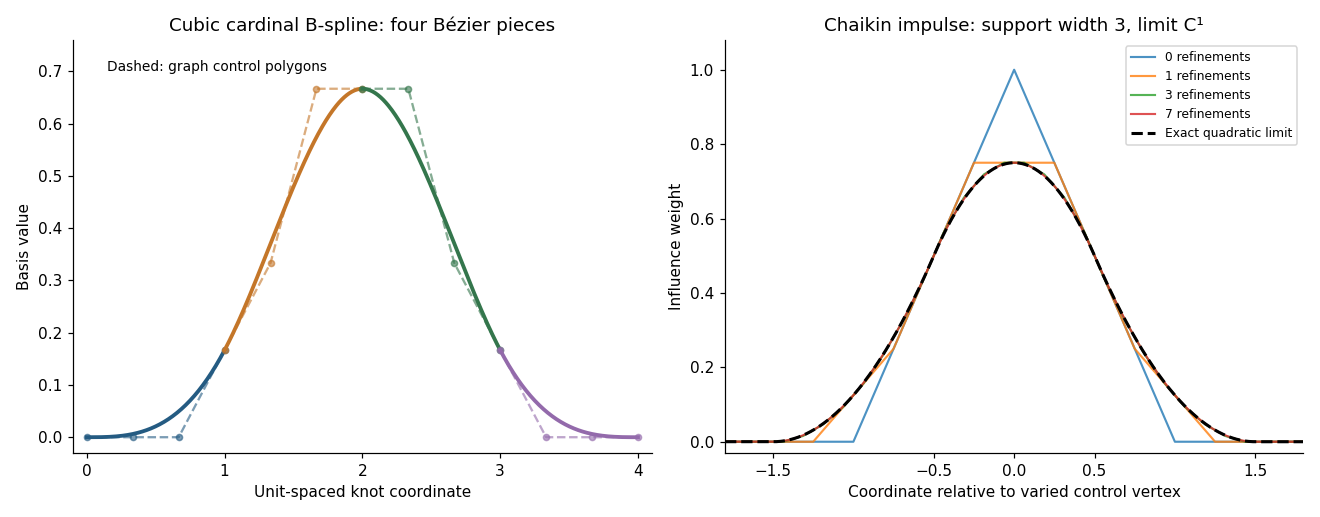
The rule is linear in the ordinates and translation invariant on the uniform grid, so write . Find its Chaikin basis function by setting and every other ordinate to zero. The central local piece just derived has and gives for . On the next interval, the interpolating quadratic through values at abscissae is . Adding its limiting offset gives . Reflection gives the left interval, and locality gives zero outside. ThusThis is a centered quadratic cardinal B-spline. It is nonnegative, and its integer translates form a partition of unity because refinement preserves constant data. Its support has width three, and its first derivative agrees at the half-integer knots while its second generally jumps, consistent with the earlier calculations.

Articles by others on the same topic
There are currently no matching articles.