Multivariate analysis of variance extends analysis of variance to vector responses. For example, a treatment may affect several correlated physiological measurements jointly. Separate univariate tests do not use the correlation geometry and require adjustment if they are interpreted as one multiple-testing procedure. A joint test asks whether group mean vectors differ in any direction.
In a one-way model, take independent , , , with a common positive-definite covariance. Put , and let and be group and overall sample means. The within-group and between-group scatter matrices areExpanding around each group mean makes the cross terms vanish, giving total scatter . To test , use the Wilks lambda statisticwhere solve the generalized eigenvalue problem and is nonsingular. Under the alternative, maximize the normal likelihood at the group means and covariance ; under the null, use the overall mean and covariance . Their likelihood ratio is , so small rejects equal means. Under the null, orthogonal projections of the Gaussian data give independent and , supplying its null calibration. Here is nonsingular almost surely when . Merely having more total observations than responses is not enough if group fitting consumes too many statistical degrees of freedom.
The test is invariant under a nonsingular linear change of response coordinates: both determinants acquire the same factor . The directions associated with large identify mean separation relative to residual variability. With one response it becomes the ordinary ANOVA F-test. With two groups, writing and , the version using Hotelling's T-squared statistic iswith . This formula demonstrates explicitly how the covariance weights a group difference.
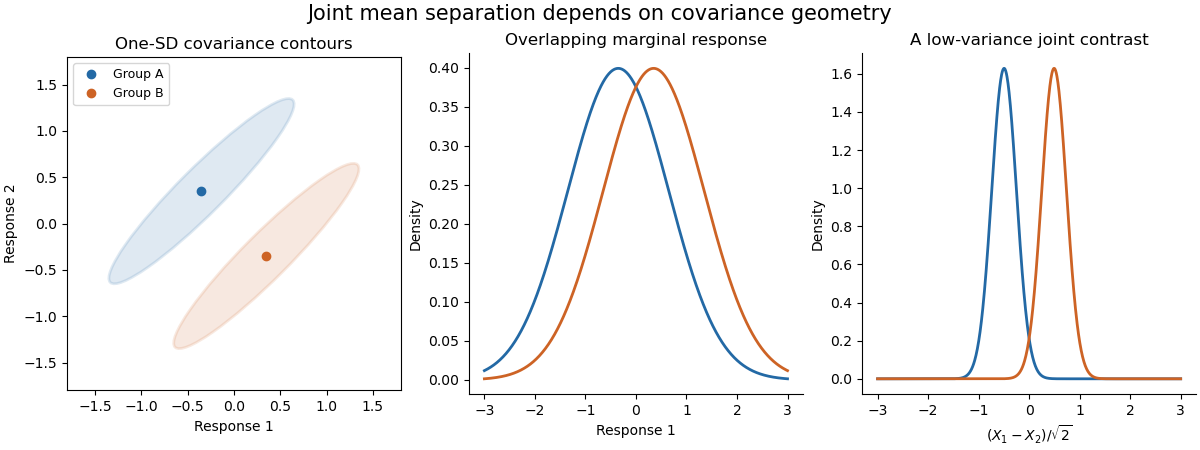

The sketch shows hypothetical groups with strongly positively correlated responses and mean separation along their low-variance contrast. Marginal comparisons can look weak even when the joint comparison is informative. The ellipses represent individual-response covariance, not confidence regions for the means. Independence of observations, approximate multivariate normality and common covariance are substantive assumptions; outliers and unequal covariance can invalidate the usual calibration. Follow-up contrasts can identify the affected responses or groups, with appropriate multiplicity control. MANOVA uses shared covariance to test a multivariate mean difference, rather than testing unrelated coordinates in isolation.
Articles by others on the same topic
There are currently no matching articles.