Let be the local flow of a vector field . The Lie derivative of a differential form is . We prove Cartan's magic formulaBoth sides are degree-zero derivations of an algebra on the exterior algebra of differential forms. They agree on a function , since . They also agree on : pullback commutes with the exterior derivative, so , while . Locally every differential form is a sum of products of functions and coordinate differentials, proving the identity in every degree.
For a compactly supported Hamiltonian vector field , take the convention . Since , Cartan's magic formula gives , so its complete flow of a vector field consists of symplectomorphisms. Given and , a bump function lets us choose a compactly supported with , and hence . Choose such fields for a basis of . Their successive small-time flows give a map with invertible derivative at the origin. The inverse function theorem makes the orbit of open. Every orbit is open; because is connected, there is only one orbit. Thus the compactly supported symplectomorphisms act transitively on points, by Hamiltonian transitivity on a connected symplectic manifold.
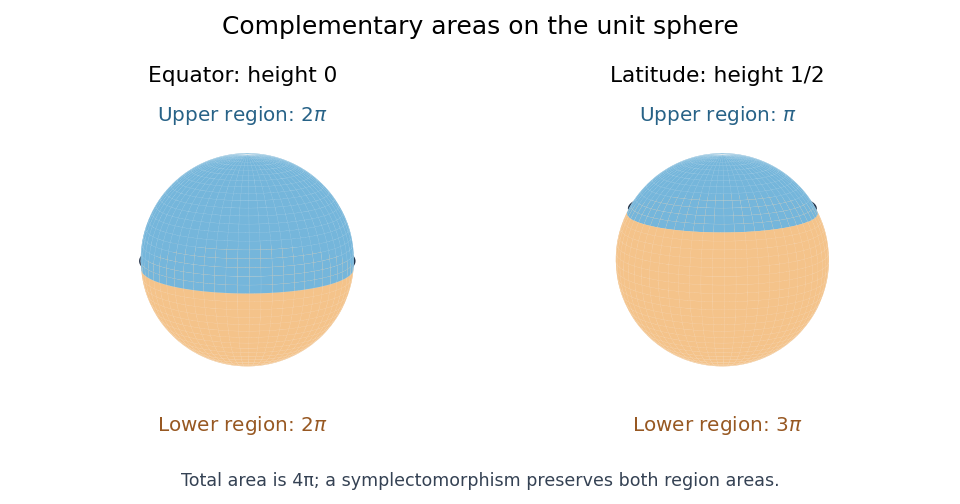
On the unit sphere, the standard symplectic area is . The equator has complementary disks of areas , whereas the latitude at height has complementary disks of areas : the cap above height has area . A symplectomorphism must preserve the unordered pair of complementary areas. Therefore no such symplectomorphism exists, by complementary areas obstruct symplectic equivalence of separating curves.

The symplectic neighborhood theorem says that a symplectomorphism between compact symplectic submanifolds, together with a symplectic vector bundle isomorphism of their symplectic normal bundles, extends to a symplectomorphism of neighborhoods. To outline the proof, use tubular neighborhoods to extend the bundle identification smoothly. The two pulled-back symplectic forms agree as bilinear forms along the zero section. The relative Poincaré lemma writes their difference as , with vanishing there. Their linear interpolation remains nondegenerate on a sufficiently small neighborhood. Solvingand integrating gives the relative Moser theorem; the flow fixes the submanifold and carries one form to the other.
For the symplectic fiber sum along a square-zero surface, the self-intersection is the Euler number of the oriented rank-two normal bundle. Thus each normal bundle is trivial. Rescale one ambient symplectic form if necessary to equalize the areas of the two copies of . The Moser theorem for the surface then supplies a base identification preserving their area forms. The symplectic neighborhood theorem identifies each neighborhood with a product carryingRemove small disk neighborhoods and glue collars with the base identification andfor a suitable positive constant . Both signs reverse, so the normal two-forms match; the base forms already match. They define a closed nondegenerate two-form across the neck, agreeing with the ambient forms elsewhere. This constructs the symplectic sum. Its construction uses the area normalization and the chosen normal-bundle gluing.
For a smooth counterexample, take , and in a small four-ball in each choose an unknotted sphere bounding a three-ball. These spheres are null-homologous and have self-intersection zero. Their standard smooth fiber sum isIndeed, the complement of the standard in is ; doubling these complements gives , and the two ambient projective-plane summands remain as connected sums. This is the smooth fiber sum along unknotted null-homologous spheres.
In the induced orientation, both summands in have positive positive index of the intersection form. The symplectic connected-sum obstruction therefore rules out a symplectic form: connected-sum vanishing of the Seiberg–Witten invariant of a four-manifold contradicts Taubes nonvanishing theorem. In the opposite orientation the intersection form is negative definite, also ruling out a symplectic form, whose class has positive square. Thus the smooth fiber sum need not be symplectic.
A symplectic blowup replaces a small symplectic ball around the point by an exceptional divisor , for . One can construct its form by symplectic reduction. In a Darboux chart, consider with the circle actionOn the action is free because . Its quotient therefore carries a smooth symplectic form. Where , choose the representative with positive real; the reduced form is the original form on . Where , the quotient is the Hopf fibration quotient of , namely . The local quotient is the tautological complex line bundle near its zero section, hence the local blowup. Glue this model to the exterior of the ball to obtain a symplectic form on the blowup.
The area of a projective line in the exceptional divisor is . For a closed , changing this size changes the symplectic volume:Consequently the blowup is not determined up to symplectomorphism without a size choice. The underlying smooth blowup is fixed, but the symplectic construction has a parameter, as in symplectic blowup size changes volume.
For the blowdown map and exceptional divisor , the First Chern class isIn real dimension four this becomes , the first Chern class formula for a symplectic blowup.
The tangent bundle of the standard four-torus is a trivial complex rank-two bundle, so its symplectic canonical class is zero. For a generic fiber of a symplectic Lefschetz pencil, the symplectic adjunction formula gives . Two generic fibers intersect precisely at the base points, each with local intersection number one in the pencil model . HenceThis is base-point count for a Lefschetz pencil on a symplectic four-torus.
An almost complex structure is compatible with if , , and is a positive-definite inner product. To construct one, choose a Riemannian metric and define by . The map is invertible and skew-adjoint, so is positive definite. Its positive square root commutes with , andThe same identities show that preserves . The positive square root depends smoothly on , giving a smooth compatible almost complex structure.
For a compatible , applying this metric construction of a compatible almost complex structure to returns . Given , apply it to to obtain a path joining them. In fact interpolation to any fixed auxiliary metric gives a contraction. Thus the space is nonempty and connected, and even contractible, by contractibility of compatible almost complex structures.
Regularity of a J-holomorphic curve means that its linearized Cauchy–Riemann operator is surjective. Differentiating in coordinates givesup to the harmless factor in the convention for . For constant , the last term vanishes, is constant, and the pulled-back tangent bundle is . Identifying with , this is a direct sum of copies of the Dolbeault operator on the trivial line bundle. Its cokernel is , by Dolbeault cohomology of the projective line. Hence constant maps are regular for every compatible .
The Energy identity for a J-holomorphic curve says that the energy is . If the homology class is zero, this integral is zero, forcing . Thus every zero-class sphere is constant and regular.
In real dimension four, the Fredholm index of the parametrized sphere operator is . At a regular nonconstant sphere, quotienting by the six-dimensional Möbius transformation group gives a local moduli space, or an orbifold for finite stabilizers, of real dimensionThis is the dimension formula for regular J-holomorphic spheres.
For a simple J-holomorphic sphere in class , the adjunction inequality for a simple J-holomorphic sphere gives . If , the displayed moduli dimension is negative, so such a regular simple J-holomorphic sphere cannot exist. To cover nonsimple maps as well, interpret regularity here as regularity for all nonconstant maps under discussion. A degree- cover, , of a simple J-holomorphic sphere in class has , with and . Its local family of rational covering maps of the projective line modulo domain reparametrization has real dimension , while the predicted dimension isIt therefore cannot be regular. This proves there are no regular spheres in a class with square at most minus two, by negative-square exclusion under full sphere regularity. Regularity only for simple curves would not suffice: multiple covers of an exceptional minus-one sphere are the counterexample.
A symplectic capacity assigns to symplectic manifolds in a fixed dimension, is monotone under symplectic embeddings, satisfies for , and is nontrivial in the sense thatThe second domain is the standard symplectic cylinder. A normalized symplectic capacity assigns to both unit domains, hence to both radius- domains. The general axioms already give invariance under symplectomorphisms and quadratic scaling under coordinate dilation. For the rigidity argument, use the assumed existence of capacities in each dimension, including after adding a symplectic plane; normalization is not needed.
Let be symplectomorphisms converging locally uniformly to a smooth diffeomorphism . Work in Darboux charts. For a sufficiently small solid ellipsoid centered at a chosen point and , uniform convergence and degree of a continuous mapping give, for large ,For the second inclusion, is uniformly close to the identity on the larger ellipsoid. Its boundary stays outside and is homotopic there to the identity, so it has degree one about every point of and must cover . Monotonicity and scaling now give . Letting tend to one proves capacity preservation under uniform limits.
At the chosen point, write . The rescaled maps preserve capacities of ellipsoids and converge uniformly on compact sets to . Applying the same sandwich argument proves that preserves the capacities of all solid ellipsoids; so does .
We prove the required linear capacity rigidity explicitly. Write the standard symplectic form as . Suppose andComplete to a symplectic basis, and complete , with the appropriately signed , to another symplectic basis. If their basis matrices are , then has first two columns . Hence sends the unit ball into the symplectic cylinder of radius . This matrix differs from by symplectic linear maps, so it preserves capacities of ellipsoids. Its first coordinate pair is multiplied by , with a possible sign, and therefore sends the unit ball into the cylinder of radius . Monotonicity givesfor every , contradicting finiteness of the right-hand unit-cylinder capacity as tends to infinity. For a normalized capacity, the first iterate already gives the contradiction.
A zero pairing is handled by a small perturbation of . A pairing of absolute value greater than one gives the same contradiction for , after normalizing the transformed pair. Thusfor every pair. The squared bilinear forms agree, so their difference times their sum is the zero polynomial. The real polynomial ring is an integral domain; consequently one factor vanishes identically. Therefore is either symplectic or anti-symplectic.
To eliminate the negative sign, repeat the argument for , which are symplectomorphisms for . If at the chosen point, the limit pulls this product form back to , which is neither the product form nor its negative. This contradicts the preceding derivative classification. Thus everywhere. We have proved the Eliashberg–Gromov rigidity theorem: the symplectomorphism group is closed in the topology on diffeomorphisms.
Finally put , with perpendicularity taken for the standard Euclidean inner product. Its dimension is two, so being nonisotropic means that the restricted symplectic form is nondegenerate. For the standard compatible complex structure , . If , then and for every , forcing . Thus is a symplectic subspace and admits a symplectic basis extended to the whole space.
In the resulting linear symplectic coordinates, is . The projection of the bounded set to the plane is bounded, so lies in a symplectic cylinder of some finite radius . As is nonempty and open, it contains a ball of some radius , which is also contained in . Monotonicity and scaling giveas in capacity of a bounded set thickened by a symplectic subspace. For a normalized symplectic capacity, the two bounds simplify to and .
Articles by others on the same topic
There are currently no matching articles.