Use the truncated tensor algebra , with truncated concatenation product. The step- path signature isThese iterated integrals of a path exist as Riemann-Stieltjes integrals, since a Lipschitz continuous path on a compact interval has bounded variation. The degree-zero coordinate is , and the degree-one coordinate is .
Let and write for its degree- coordinate. Integrating first over all variables except the last givesThus for . If is a standard basis vector, define the linear vector field , with degrees above discarded. The component identities are precisely the controlled ordinary differential equationFor a Lipschitz driver this may also be written almost everywhere. Recursive integration of its levels proves uniqueness and recovers the signature formula. The Chen identity follows by splitting each integration simplex at an intermediate time.
Let be a weak geometric p-rough path, , with increments indexed by words of length at most . Choose a control function for rough paths with . We use the standard sufficient vector-field hypothesis , , with globally bounded regularity norms; smooth bounded fields are a special case. Regard as the differential operator , and put .
A pathlevel solution of a rough differential equation is a continuous state path , with prescribed , satisfying a local expansionfor some on sufficiently small control intervals. One can take under the stated regularity. This definition specifies the state path, without requiring its full rough-path enhancement as additional data. For , the displayed expansion readsRepeated indices are summed.
We use the following discrete form of the Davie lemma. For a finite ordered grid and a continuous superadditive control, suppose nonnegative errors vanish on adjacent grid points and, for every grid triple , satisfyThere are and , depending on but not on the grid, such that whenever . This is the discrete higher-order error estimate: splitting close to half the control size makes the two -power errors contract; a crossing single grid interval contributes zero adjacent error.
Define the local Euler mapFor small it has Lipschitz constant at most . Taylor expansion, the Chen identity and the shuffle identity for iterated integrals give the composition estimateHere is the cancellation underlying the estimate. Assign degree to a level- increment. Expanding each and grouping terms through degree gives the differential-operator coefficients multiplying . Products of coefficients from the first increment are combined by the shuffle identity, which is the iterated Leibniz rule. Chen's identity says that the sum of these products is . Thus every term of degree at most agrees with the corresponding term in . The remaining Taylor terms have control order at least ; bounded norms make the estimate uniform in . For smooth fields the remainder has order .
On a partition , construct the Euler sequence by . For grid endpoints letIt vanishes on adjacent points. Insert into the next local map. The Lipschitz and composition estimates giveThe Davie lemma therefore yields a bound independent of on small control intervals. Together with the Euler expansion this gives . A finite subdivision into small-control intervals gives a uniform global bound as well.
Interpolate each Euler sequence linearly in time, and take partitions with mesh tending to zero. Continuity of the control makes these paths uniformly equicontinuous: the grid estimates apply to the interval enlarged to its neighboring grid endpoints, and the enlargement tends to zero uniformly with the mesh. The paths are uniformly bounded. The Arzelà-Ascoli theorem supplies a uniformly convergent subsequence with continuous limit .
For arbitrary in a small control interval, choose neighboring grid endpoints converging to . Continuity of , the coefficient functions and the control lets us pass to the limit in the grid error estimate. We obtain the defining expansion with , and . This constructs a pathlevel RDE solution. No continuity theorem for the RDE solution map was used to obtain existence.
In the truncated tensor algebra , multiplication isLet be the Lie algebra generated by the degree-one space, with commutator and every term of degree greater than set to zero. The free step-N nilpotent Lie group isIts operation is the truncated tensor product, its identity is , and . Truncated multiplication is associative; the finite Lie exponential and logarithm identify this group with the free nilpotent Lie algebra as a manifold.
The Chow theorem says that on a connected manifold a smooth bracket-generating family of vector fields joins every pair of points by a piecewise smooth horizontal path. Applied to the degree-one left-invariant fields on this group, it says that every is for a piecewise smooth, and hence suitably parametrized Lipschitz continuous, control path starting at zero.
For , every Lie element is , with and . The step-2 planar group coordinates giveWe realize this element explicitly. First traverse the rectangleIf , omit the loop. Its displacement is zero, and its second-level entries areThus the loop signature is . Follow it by the straight segment from zero to , whose signature is . By the Chen identity, concatenation has signaturebecause the commutator lies in the central second layer. Every group element has therefore been realized, proving this case of Chow's theorem.
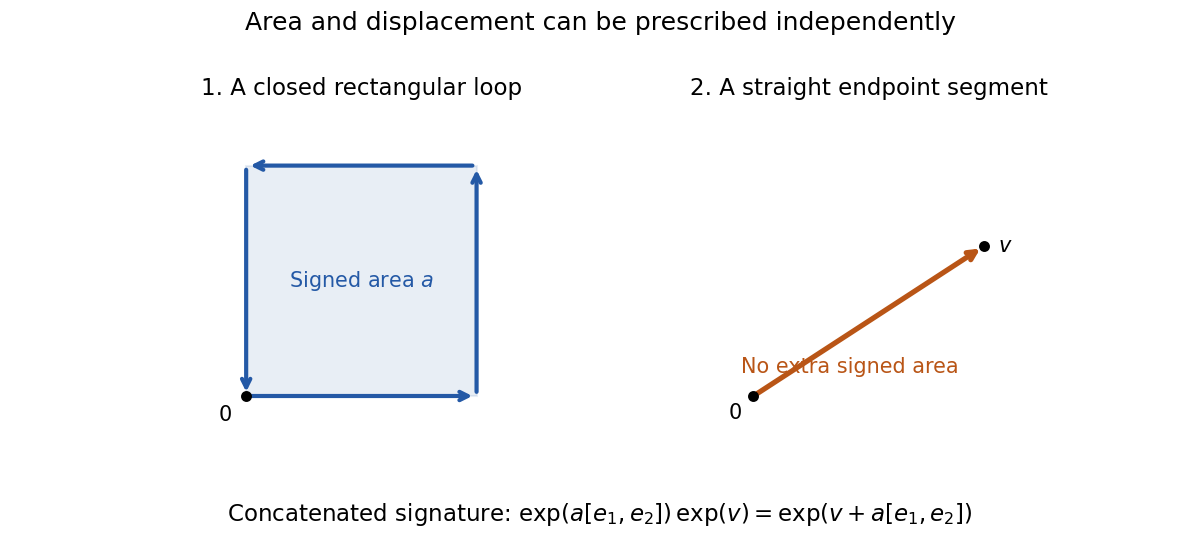

The Carnot-Carathéodory distance is the infimum of lengths of horizontal controls realizing the relative group element. The construction gives the upper bound . Conversely, a control of length has displacement at most , and its antisymmetric area satisfiesHere the control starts at zero, so its maximum Euclidean distance from zero is at most . These estimates show that the homogeneous group norm is comparable to .
The given path is the pure-area rough path . Centrality givesThe graded dilations scale horizontal lengths by . Inversion preserves the norm. Hence, with ,Thus the path is exactly -Hölder continuous: on a compact time interval it has every exponent at most , and none greater.
Its p-variation is finite precisely when . Indeed, the th power of the variation sum is . For it is bounded by ; for , the partition into equal intervals gives . In the usual step-two rough-path range it is weak geometric for , including . For , the same formula in gives the additional levels and a weak geometric -rough path there. The original data alone are a truncated object when those additional levels are required.
For Brownian motion starting at zero, define its enhanced Brownian motion by the Stratonovich second level:The associated group-valued path is . The Stratonovich chain rule givesConsequently its symmetric second level is and the remaining antisymmetric part is Lévy area. Splitting the integral at proves the Chen identity, so these increments lie in and are the relative increments of .
The group norm for the Carnot-Carathéodory distance is comparable to . The planar construction in Question 2 extends to dimension : prescribe every coordinate-plane area with a closed rectangle, concatenate these central-area loops, and finish with the displacement segment. The converse bound follows from length bounds on displacement and on each area integral. Thus the comparison constants depend only on .
Brownian scaling and stationarity of increments imply that has the distribution of . The permitted moment estimates for Lévy area, together with Gaussian moments of Brownian displacement, therefore give, for every finite ,This also verifies the hypothesis of the metric-valued Kolmogorov continuity theorem. We give the dyadic argument to obtain a simultaneous version explicitly.
Fix and choose so large that . The Markov inequality and a union bound giveThe right-hand side is summable. By the Borel-Cantelli first lemma, almost surely there is a finite random constant bounding every adjacent dyadic increment by , including the finitely many exceptional levels.
Decompose any interval with dyadic endpoints into successive dyadic intervals, with at most two intervals of each size and no size exceeding its length. The metric triangle inequality and the sum of the geometric series givefor all dyadic . The finite-dimensional Carnot group is complete, so the path extends uniquely from dyadic times to a continuous -Hölder path. At each fixed time the original stochastic enhancement and its values at approaching dyadic times converge in probability by the moment estimate. The extension has the same limit almost surely, hence is a modification of the original enhancement.
Perform this construction on one countable sequence of exponents increasing to . The extensions agree on the dense set of dyadic times, so they give one modification that is Hölder at every exponent below . On , a -Hölder estimate implies the same estimate at every . Therefore
Put . These sigma-fields increase, and their union generates the continuous Brownian path. Let be the polygonal enhancement. Its coordinates are determined by its displacement and antisymmetric area ; the symmetric second level is .
The given conditional-expectation identities implyFor the second assertion it is important to use area coordinates rather than asserting that the whole tensor signature is a conditional expectation. Write . The local off-diagonal second integral isConditional on their separate dyadic values, the two independent Brownian components remain independent. Thus the conditional expectation of the product in the last term is . The assumed identity for gives the polygonal entry. The reverse entry follows by integration by parts, since the product of the two component increments also has the product of their conditional means. Taking the antisymmetric part proves the area identity. Diagonal second levels are recovered from the geometric identity, rather than from a conditional-expectation claim about squares.
For each fixed dyadic time , the first-level and area conditional expectations are uniformly integrable martingales in . Their targets are measurable with respect to : Brownian area is a limit of stochastic integral sums determined by the path. The martingale convergence theorem gives convergence to and , respectively. The continuous group coordinate formulas then giveat all dyadic times on a common event of probability one.
For the uniform Hölder estimate, fix and put . The given all-order integrability and the group norm comparison implyUse the conditional-expectation formulas, the conditional Jensen inequality, and . The group norm comparison yieldsFirst take all dyadic pairs, a countable collection, and then extend the inequality to all by continuity. Hence the Brownian rough path martingale Hölder bound isFor any , the Doob Lp maximal inequality givesTherefore
To upgrade convergence from dyadic times to every time simultaneously, apply this bound at one positive exponent . The polygonal enhancements are then equicontinuous in the group metric, with a common finite random constant. For a finite dyadic time net, convergence holds at every net point. The triangle inequality bounds the errors at the remaining times by the two Hölder errors to the nearest net point and the error at that point. First let , and then let the net mesh tend to zero. This proves uniform convergence, and in particular convergence for every on one event of probability one.
There is also convergence in each weaker Hölder rough path metric. Uniform convergence of the group coordinates gives uniform convergence of their levelwise increments through the Chen formulas. If , the uniform bounds bound the level- increment differences by a random constant times , while their unweighted suprema tend to zero. Interpolating these two bounds proves convergence with denominators , for . This establishes the nested polygonal approximation of Brownian rough paths in the topology needed for the support argument.
For a Borel probability measure on a Polish space , its support of a measure isEquivalently, for a compatible metric, every open ball about has positive measure. The complement is open: any zero-measure open neighborhood of a point is a zero-measure neighborhood of all its points. Hence the support is closed.
A Polish space has a countable base. Its support complement is therefore a countable union of zero-measure basic open sets, so . If is any closed full-measure set, a point outside has the zero-measure open neighborhood and is outside the support. Thus the support is also the smallest closed set of full measure. Countability is what justifies the full-measure assertion; an arbitrary uncountable union of null sets would not suffice.
Let be the Cameron-Martin space of Wiener measure on : its elements start at zero, are absolutely continuous, and have square-integrable derivatives. For , let solve the controlled ordinary differential equationThe Stroock-Varadhan support theorem in the uniform topology isOne may equivalently take piecewise linear or smooth controls starting at zero. The skeleton uses the displayed vector fields, as appropriate for the Stratonovich equation.
Choose and work in the complete separable space of anchored geometric p-rough paths, with its rough path metric . The enhanced Brownian motion is a random element of this space. Its support of a measure isWe explain this Brownian support step using the permitted results about the enhancement. The almost-sure polygonal convergence proved in Question 3 gives the inclusion of its support in . Indeed, polygonal controls belong to , and the enhancement belongs to their closed signature closure almost surely. Hölder rough-path convergence at an exponent greater than implies -variation convergence: for the level- differences, sum the bound proportional to over a partition. Since , these sums are uniformly bounded and tend to zero with the Hölder distance.
For the reverse inclusion, use Brownian rough path small-ball positivity, namely for every , and Cameron-Martin quasi-invariance of enhanced Brownian motion. These are the Brownian input results used without proof here. For , the rough path translation is continuous and sends to . The law of is equivalent to that of . Given an open neighborhood of , continuity supplies an identity neighborhood mapped into . Small-ball positivity gives positive probability that ; equivalence of the two laws gives . Hence belongs to the Brownian support for every . Closedness of support proves the equality with .
Let be the state-path solution map of the rough differential equation driven by these vector fields, with the fixed initial value . The assumed identification of the Stratonovich solution says . Boundedness of the fields and all their derivatives ensures global existence and the regularity needed by the universal limit theorem. That theorem makes continuous from the rough-path space into the uniform state-path space. For a control signature, consistency with ordinary equations gives .
We use the elementary support under a continuous map identityTo prove it, a neighborhood of with has an open inverse image containing , and therefore positive measure. This puts , and its closure, in the image support. Conversely, the image closure is closed and has full image measure, since the original support has full measure. The minimal closed full-measure characterization from Question 4(i) gives the other inclusion.
Apply this identity to and the Brownian rough-path law. We obtainContinuity and the definition of imply . The reverse inclusion after taking closures follows from . Therefore the last displayed support is exactly the uniform closure of the skeleton paths, proving the theorem.
Finally, piecewise constant and smooth approximations of converge in , hence in on a finite interval. Their controls converge in total variation, their signatures converge in the rough-path metric, and the universal limit theorem gives uniform convergence of the corresponding skeleton solutions. This proves the stated equivalence of the control classes.
Articles by others on the same topic
There are currently no matching articles.