The anti-Hermitian operators represent the compact real form; its complexification also contains the Hermitian and the raising operators and lowering operators , with . Define the roots in the two-dimensional Cartan plane byEach has squared length one. For each , setThe displayed commutators give and . Thus these are the three root SU(2) subalgebras of SU(3).
The commuting Hermitian operators can be simultaneously diagonalized. A weight of a representation is a pair for whichwhere labels independent states of that representation weight. The weight multiplicity is the dimension of this simultaneous eigenspace. Commuting past a ladder operator proveswith zero image allowed when the raised or lowered representation weight is absent.
Choose as positive simple roots. A highest-weight vector is a nonzero simultaneous eigenvector annihilated by ; the third condition follows from the first two and their commutator. In an irreducible representation, its highest weight has multiplicity one and repeated lowering generates the representation. The three root SU(2) subalgebras of SU(3) give nonnegative integer Dynkin labelsEquivalently, with and ,These are the SU(3) highest-weight coordinates in the normalization used here.
The Weyl group is generated by the reflections . The SU(2) Lie algebra root-string symmetry makes these reflections preserve both representation weights and their weight multiplicities. They generate the symmetries of an equilateral triangle: rotations through and three reflections. The outer polygon is the convex hull of the Weyl group orbit of . When it is a hexagon with alternating side lengths in root-step units; when exactly one is zero it is a triangle; when both vanish it is a point. The representation conjugate to has labels and negative representation weights. For , this gives an additional inversion symmetry and a regular hexagon with rotations. A general unequal-sided hexagon need not have that extra symmetry.
The shell multiplicities in an SU(3) weight diagram can be stated precisely. Let be the convex hull of the Weyl group orbit of . For in the root lattice coset ,representation weights outside this coset or outside the outer polygon are absent. This states that boundary representation weights have multiplicity one, each inward shell adds one, and the innermost triangular region has constant multiplicity . When the innermost region is a single point. All representation weights of a triangular diagram have multiplicity one. Counting the diagram gives . The examples below display both triangular orientations, a regular hexagon, an unequal-sided hexagon, a central multiplicity three, and the trivial diagram.
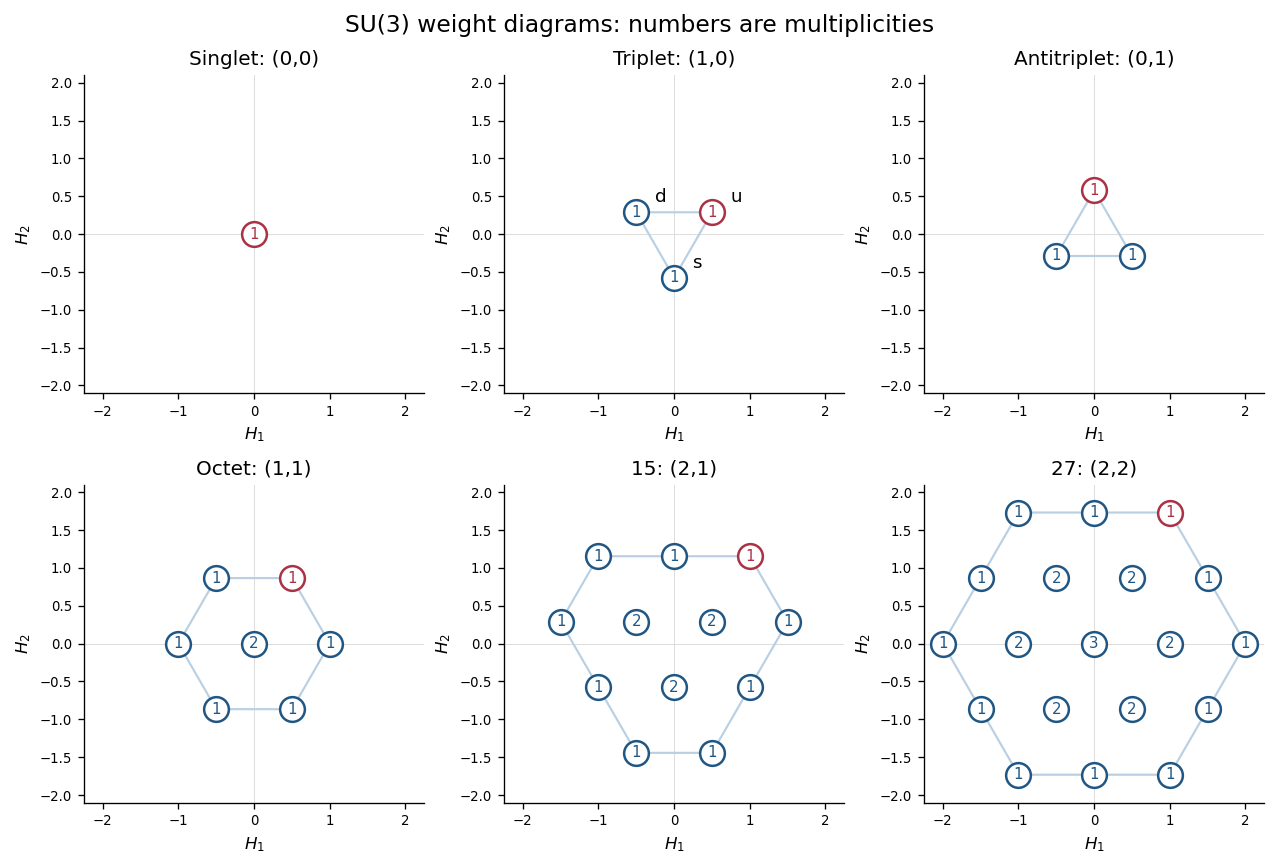
A fundamental matrix realization compatible with the root normalization isThe weights of a representation on the coordinate states are thereforeEach has weight multiplicity one. The weight diagram of the defining SU(3) representation is the corresponding equilateral triangle. These are coordinates; the familiar vertical flavor hypercharge coordinate is .
For the adjoint representation of SU(3), the states are elements of the Lie algebra. The two Cartan generators commute with both , giving representation weight with multiplicity two. Each root generator is an eigenvector of the Cartan adjoint action with representation weight . ConsequentlyThe six nonzero representation weights form a regular hexagon, with a doubly occupied centre. Its highest weight is , so its Dynkin labels are and its dimension is eight. The triplet and octet panels in the preceding figure give these two weight diagrams explicitly.
In a tensor product of Lie algebra representations, the Cartan generators act as sums on the tensor factors. Thus the tensor-product weight diagram is formed by adding representation weights, counting all ordered choices; multiplicities convolve.
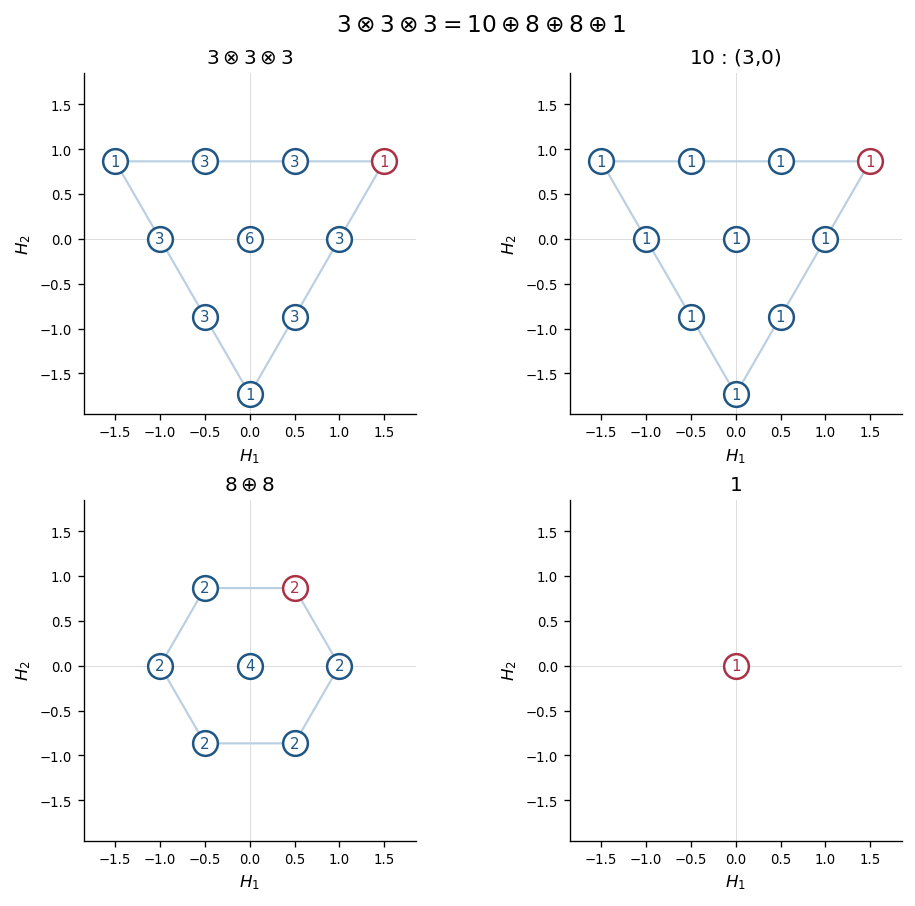
For three triplets, the three vertices each arise once. Each of the six representation weights , , , , , arises in three orders. The central representation weight arises in six orders. The resulting weight diagram has total dimension .
Its maximal highest weight is , with Dynkin labels . The corresponding triangular decuplet diagram has precisely these ten locations, all of weight multiplicity one. Subtract it by highest-weight character subtraction. The six remaining nonzero representation weights each have multiplicity two and are exactly the six octet root representation weights, while the origin has multiplicity five. Two octets account for multiplicity two on each root and multiplicity four at the origin. The remaining origin is one singlet. Therefore the tensor cube of the defining SU(3) representation decomposes asThe dimension check is . The centre multiplicity check is , so the two octets really are distinct copies, rather than one octet with an unexplained degeneracy.
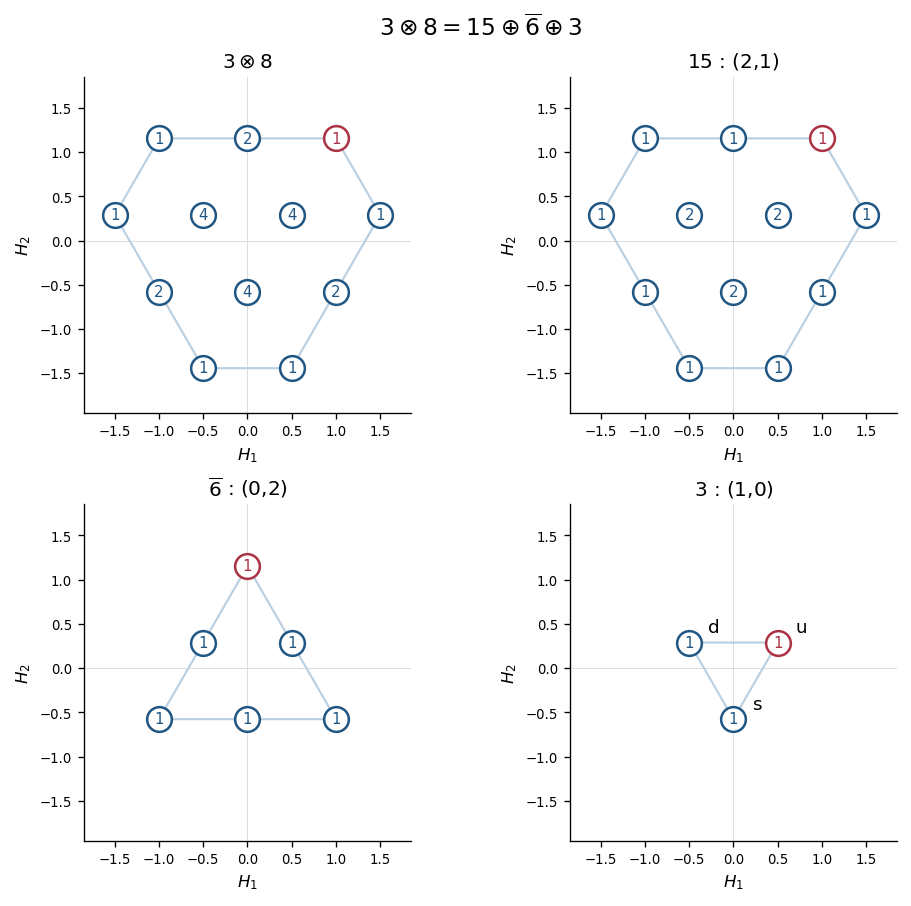
Construct the tensor-product weight diagram by placing one octet diagram at each triplet representation weight and adding multiplicities where the shifted diagrams overlap. Its highest weight isso remove the diagram by highest-weight character subtraction. Its unequal-sided hexagon has nine boundary representation weights of multiplicity one and three interior representation weights of multiplicity two, giving dimension .
To see the remainder explicitly, measure diagram coordinates by . After subtracting this , the residual representation weights areThe next highest weight is , with Dynkin labels . The conjugate sextet is a triangular weight diagram containing each of these six representation weights once. Subtracting it leaves once each in the integer coordinates: precisely the triplet. The SU(3) triplet-octet decomposition is thereforeThe dimensions add to , and the figure below verifies the equality at every representation weight, including overlapping interior representation weights.


Articles by others on the same topic
There are currently no matching articles.