For , define the Adjoint representation of a Lie algebra by . The Jacobi identity gives, for every ,Thus preserves brackets and is a Lie algebra representation. Its Killing form isUsing the representation identity and the cyclic property of the trace,The Killing form is also symmetric by cyclicity.
In a basis , write . The lowered structure constants satisfyThe first expression is antisymmetric in and the second in . These transpositions generate all permutations, so is totally antisymmetric.
An invariant subspace of under its Adjoint representation of a Lie algebra is exactly an ideal of a Lie algebra: . A simple Lie algebra has no nonzero proper ideal, proving the adjoint representation is irreducible.
Put . The same trace calculation proves invariance of the Trace form of a Lie algebra representation:Because the are anti-Hermitian, is a real symmetric bilinear form. The Killing form of a simple compact Lie algebra is negative definite. Define a real linear map by . Invariance of both forms implies that commutes with every , while symmetry makes self-adjoint for the positive inner product . By the spectral theorem, its real eigenspaces are invariant under the Adjoint representation of a Lie algebra. Irreducibility forces a single eigenvalue, so and . This also avoids the extra care needed when applying the complex form of the Schur lemma to a real vector space.
The kernel of is an ideal of a Lie algebra. It cannot be all of : a trivial representation of dimension greater than one is reducible. Simplicity therefore makes faithful. For every nonzero ,Hence the positive trace index for a compact simple Lie algebra givesin the adapted basis.
For the cubic trace tensor of a Lie algebra representation, the identityexpands toSet , , , . Cyclicity of converts to and to . Thus the invariance identity for a cubic trace tensor is
For the final contraction, it is important to keep the specified index-raising convention. In the adapted basis write . Then , while raising the last two indices with gives . Total antisymmetry and the definition of the Killing form implyOnly the antisymmetric part of in contributes, soConsequently the Killing-normalized contraction of a cubic trace tensor isThe negative sign printed in the last requested identity is incompatible with raising indices by the inverse Killing form. The opposite sign is obtained if one instead defines the lowered structure constants using the positive Euclidean metric, a different convention from the one specified.
For a concrete check, take the two-dimensional representation of with , where the are Pauli matrices. ThenTheir contraction is , confirming the positive sign with and providing a counterexample to the printed sign.
The anti-Hermitian operators represent the compact real form; its complexification also contains the Hermitian and the raising operators and lowering operators , with . Define the roots in the two-dimensional Cartan plane byEach has squared length one. For each , setThe displayed commutators give and . Thus these are the three root SU(2) subalgebras of SU(3).
The commuting Hermitian operators can be simultaneously diagonalized. A weight of a representation is a pair for whichwhere labels independent states of that representation weight. The weight multiplicity is the dimension of this simultaneous eigenspace. Commuting past a ladder operator proveswith zero image allowed when the raised or lowered representation weight is absent.
Choose as positive simple roots. A highest-weight vector is a nonzero simultaneous eigenvector annihilated by ; the third condition follows from the first two and their commutator. In an irreducible representation, its highest weight has multiplicity one and repeated lowering generates the representation. The three root SU(2) subalgebras of SU(3) give nonnegative integer Dynkin labelsEquivalently, with and ,These are the SU(3) highest-weight coordinates in the normalization used here.
The Weyl group is generated by the reflections . The SU(2) Lie algebra root-string symmetry makes these reflections preserve both representation weights and their weight multiplicities. They generate the symmetries of an equilateral triangle: rotations through and three reflections. The outer polygon is the convex hull of the Weyl group orbit of . When it is a hexagon with alternating side lengths in root-step units; when exactly one is zero it is a triangle; when both vanish it is a point. The representation conjugate to has labels and negative representation weights. For , this gives an additional inversion symmetry and a regular hexagon with rotations. A general unequal-sided hexagon need not have that extra symmetry.
The shell multiplicities in an SU(3) weight diagram can be stated precisely. Let be the convex hull of the Weyl group orbit of . For in the root lattice coset ,representation weights outside this coset or outside the outer polygon are absent. This states that boundary representation weights have multiplicity one, each inward shell adds one, and the innermost triangular region has constant multiplicity . When the innermost region is a single point. All representation weights of a triangular diagram have multiplicity one. Counting the diagram gives . The examples below display both triangular orientations, a regular hexagon, an unequal-sided hexagon, a central multiplicity three, and the trivial diagram.
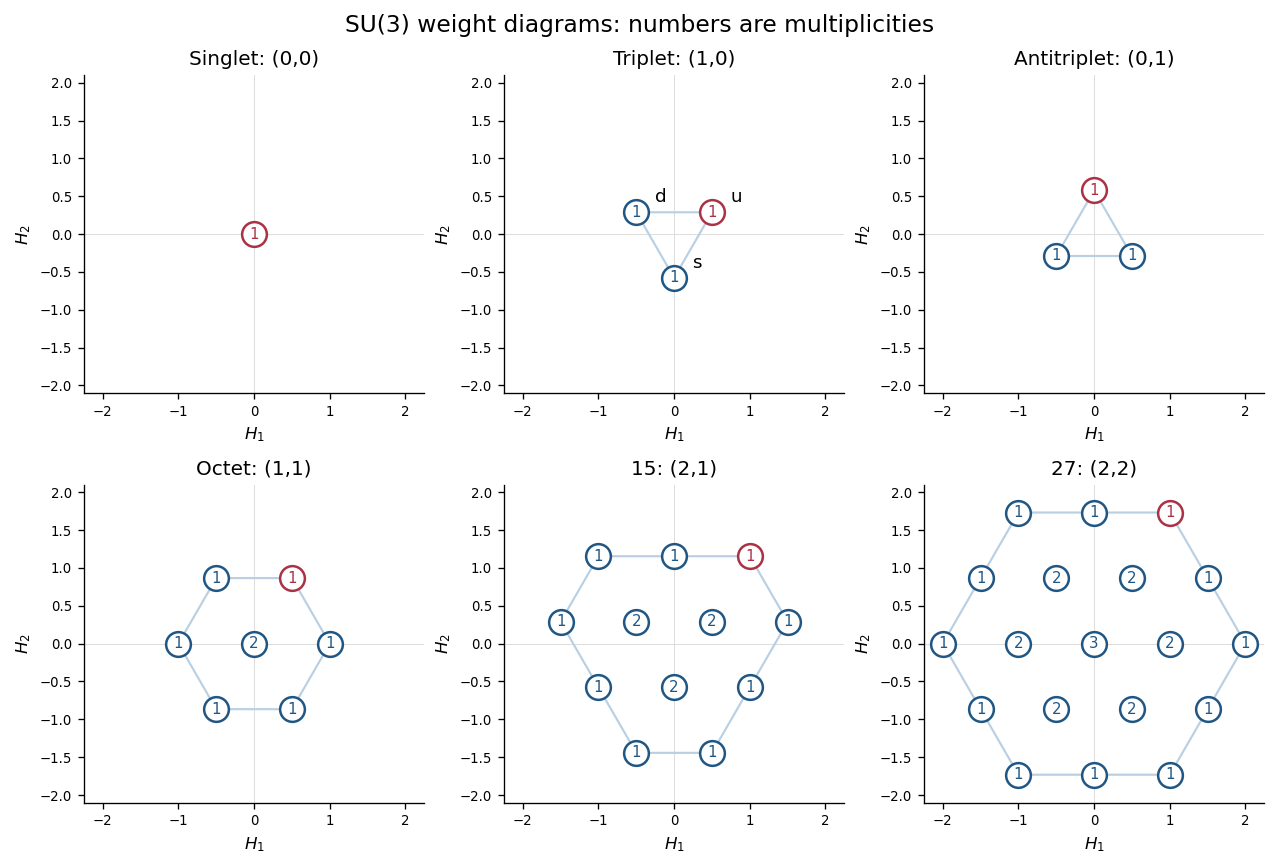
A fundamental matrix realization compatible with the root normalization isThe weights of a representation on the coordinate states are thereforeEach has weight multiplicity one. The weight diagram of the defining SU(3) representation is the corresponding equilateral triangle. These are coordinates; the familiar vertical flavor hypercharge coordinate is .
For the adjoint representation of SU(3), the states are elements of the Lie algebra. The two Cartan generators commute with both , giving representation weight with multiplicity two. Each root generator is an eigenvector of the Cartan adjoint action with representation weight . ConsequentlyThe six nonzero representation weights form a regular hexagon, with a doubly occupied centre. Its highest weight is , so its Dynkin labels are and its dimension is eight. The triplet and octet panels in the preceding figure give these two weight diagrams explicitly.
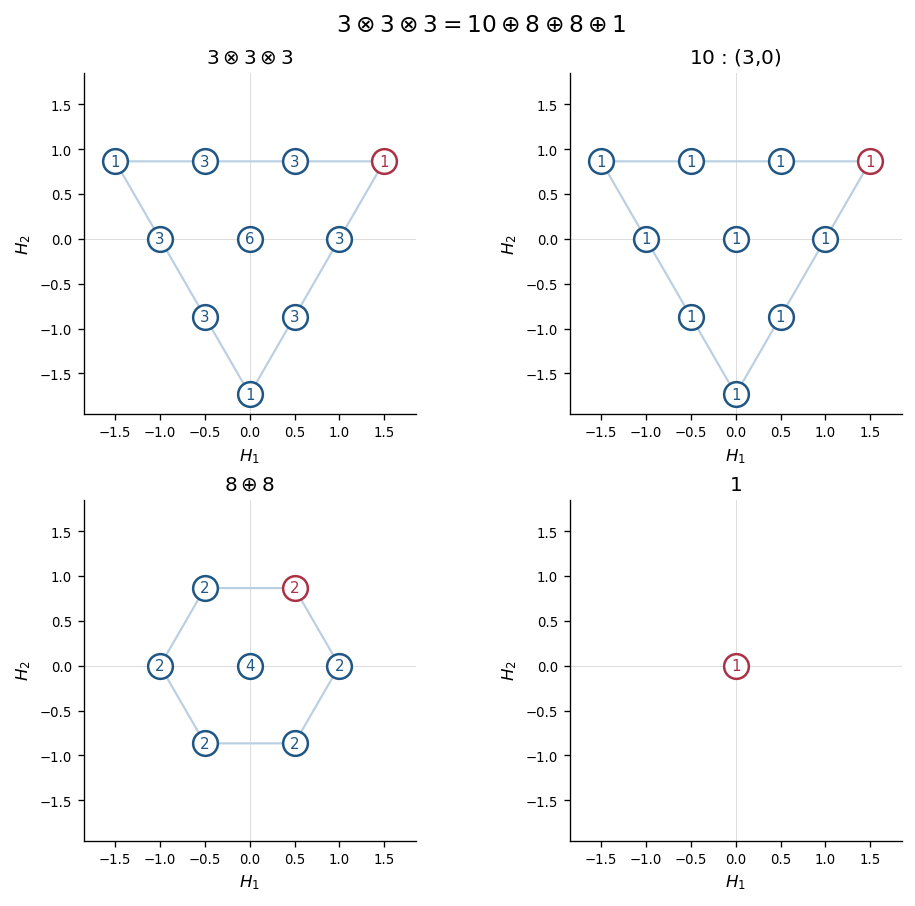
In a tensor product of Lie algebra representations, the Cartan generators act as sums on the tensor factors. Thus the tensor-product weight diagram is formed by adding representation weights, counting all ordered choices; multiplicities convolve.
For three triplets, the three vertices each arise once. Each of the six representation weights , , , , , arises in three orders. The central representation weight arises in six orders. The resulting weight diagram has total dimension .
Its maximal highest weight is , with Dynkin labels . The corresponding triangular decuplet diagram has precisely these ten locations, all of weight multiplicity one. Subtract it by highest-weight character subtraction. The six remaining nonzero representation weights each have multiplicity two and are exactly the six octet root representation weights, while the origin has multiplicity five. Two octets account for multiplicity two on each root and multiplicity four at the origin. The remaining origin is one singlet. Therefore the tensor cube of the defining SU(3) representation decomposes asThe dimension check is . The centre multiplicity check is , so the two octets really are distinct copies, rather than one octet with an unexplained degeneracy.
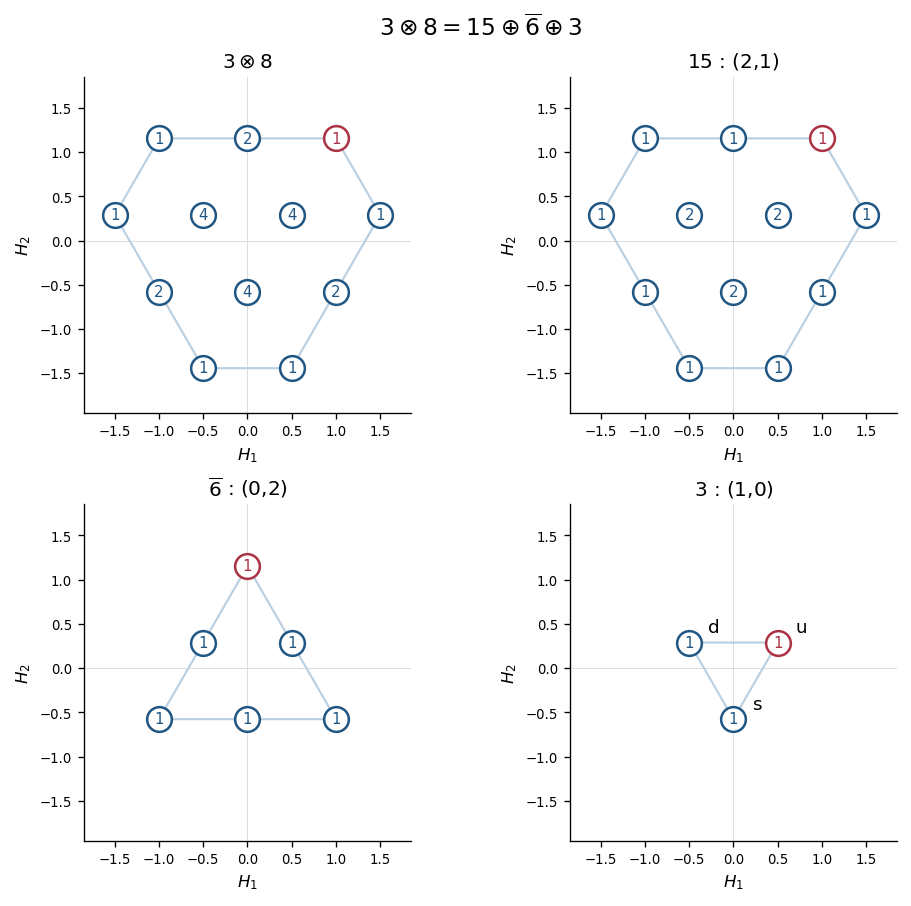
Construct the tensor-product weight diagram by placing one octet diagram at each triplet representation weight and adding multiplicities where the shifted diagrams overlap. Its highest weight isso remove the diagram by highest-weight character subtraction. Its unequal-sided hexagon has nine boundary representation weights of multiplicity one and three interior representation weights of multiplicity two, giving dimension .
To see the remainder explicitly, measure diagram coordinates by . After subtracting this , the residual representation weights areThe next highest weight is , with Dynkin labels . The conjugate sextet is a triangular weight diagram containing each of these six representation weights once. Subtracting it leaves once each in the integer coordinates: precisely the triplet. The SU(3) triplet-octet decomposition is thereforeThe dimensions add to , and the figure below verifies the equality at every representation weight, including overlapping interior representation weights.


Take a local gauge transformation acting on the adjoint field by . The connection convention is compatible withIndeed, differentiating gives the extra commutator , exactly cancelled by the inhomogeneous term in the transformed gauge potential.
For a direct proof of the Yang-Mills gauge transformation of curvature, put and . Differentiation givesSubstituting into the Yang-Mills field strength cancels all terms involving and leavesThis direct calculation also applies when the adjoint action has a kernel.
Expand . The mixed second derivatives of cancel in pairs. The first-derivative terms from differentiating cancel the terms from . The remaining sum isby the Jacobi identity. Thus the gauge-theory Bianchi identity is
For the variation of the Yang-Mills action, write . Differentiating the curvature gives . Invariance of the Killing form impliesThis is invariant integration by parts for a gauge covariant derivative. Using symmetry of the Killing form, antisymmetry of , and compactly supported variations,Since the Killing form of a semisimple Lie algebra is nondegenerate and the variations are arbitrary, the Yang-Mills equations are
For the constant Yang-Mills theta term, symmetry under exchanging the two antisymmetric index pairs givesup to the boundary variation of the Yang-Mills theta term. Contracting the gauge-theory Bianchi identity with makes the last integrand vanish. Therefore a constant theta term does not alter the bulk Yang-Mills equations: . Its variation is a boundary term, so this conclusion uses compact support or boundary conditions that remove that term.
Finally apply to the gauge-theory Bianchi identity, obtainingThe adjoint covariant derivative obeys . Commute past the other derivative. The differentiated divergences vanish by the Yang-Mills equations, leavingIn the last line the second commutator needs its sign tracked carefully: directly,Thus the simplified sum gives the covariant wave equation for the Yang-Mills field strengthAll spacetime derivatives and index manipulations here use the fixed flat metric.
Use the metric and first consider the connected Poincaré group, . Physical half-integer spins require unitary representations of its double cover ; genuine representations of the group without this cover permit only integer spin. Write and . Strong continuity gives self-adjoint generators, with commutators understood on a common invariant dense domain.
The commuting translation generators have a joint spectral resolution. Lorentz transformations carry the spectral four-momentum to , so an irreducible representation has its momentum spectral measure concentrated on a single Lorentz orbit. For positive-energy particles the orbits of interest are the future mass shells , or with and . The zero-momentum orbit and spacelike or negative-energy orbits are outside these two particle cases.
Choose and define the Pauli-Lubanski pseudovector with the overall sign conventionThis sign makes the spatial rest-frame vector equal to . The generators' Hermiticity and the antisymmetric epsilon contraction make Hermitian: the ordering correction from commuting through contracts metric tensors into epsilon and vanishes. The same antisymmetry proves Pauli-Lubanski orthogonality, .
The assumed commutators say that and transform as four-vectors and that commutes with all translations. Consequentlycommute with the entire Poincare algebra. For instance the two terms in the Lorentz commutator with a contracted vector square cancel. The Casimir operators therefore have fixed spectral values in a unitary irreducible representation, by the Schur lemma applied to their spectral projections. A second ingredient, the little group, distinguishes the internal states.
Fix a standard momentum on the orbit. Its little group is the subgroup of Lorentz transformations leaving fixed. Choose with . A Lorentz transformation acts on the internal fibre by the Wigner rotationIf is a unitary irreducible representation of this stabilizer, the induced representation acts on wavefunctions asThe measure on either future mass shell is Lorentz invariant, so this action is unitary. The identityproves the group multiplication law. Conversely, covariance of the translation spectral resolution supplies precisely these fibres and their stabilizer action. A commuting operator acts fibrewise; transitivity relates its fibre values, and irreducibility of makes it scalar. This explains why the construction gives, and classifies, the unitary irreducible representations on each orbit.
For a timelike momentum choose . A Lorentz transformation fixing it acts only as a rotation of its spatial orthogonal complement, so the massive particle little group is , or in the double cover. PutThe Poincare algebra gives . The unitary irreducible representations of are labelled by , with and eigenvalues . Evaluation of the Pauli-Lubanski pseudovector at gives , . Thus the massive Pauli-Lubanski Casimir and particle labels areThe full massive induced representation of the Poincare double cover is infinite-dimensional because momentum ranges continuously over the orbit; its finite internal multiplicity is .
For a null momentum choose with . The infinitesimal stabilizer generators areTheir commutators with momentum, evaluated at , vanish. From the rotation and boost commutators of the Poincare algebra one obtainsThese are the massless little-group generators of : a planar rotation and two commuting null rotations, which act like translations in the little-group algebra. Hence the massless particle little group is the Euclidean plane group, with the appropriate double cover for half-integer spin.
The definition of gives and . At the standard null momentum,Suppose the little-group representation has finite dimension, as for particles with finitely many polarizations. The commuting Hermitian have a finite joint spectrum. Conjugation by rotates this spectrum through every planar angle. The only finite set invariant under all these rotations is the origin. Thus both vanish, proving that finite-dimensional unitary representations of the massless little group have trivial translations. Irreducibility then leaves a one-dimensional rotation character, . The massless longitudinal Pauli-Lubanski eigenvalues arefor the double cover, with for a genuine character. The number is helicity. Different helicities have the same two Casimir eigenvalues, so the little group is indispensable for the classification. A connected-group irreducible representation has one helicity; if parity is also implemented, it exchanges and and normally requires their pair.
Unitarity alone also permits nontrivial null-rotation generators. The rotation-invariant operator is scalar in an irreducible little-group representation; if it has value , one obtains a continuous-spin representation. A concrete realization on angular wavefunctions isThese operators satisfy the same commutators. Periodic or antiperiodic angular wavefunctions give integer or half-integer rotation modes, and the translation generators connect infinitely many such modes. The invariant labels areThese are the additional infinite-polarization massless unitary irreducible representations. Restricting to finitely many particle polarizations excludes them; they must not be ruled out merely by assuming unitarity. This completes the timelike and null cases of the Wigner classification.
Articles by others on the same topic
There are currently no matching articles.