For a pure qubit , the Bloch vector is . Substitution givesBoth lie on the unit Bloch sphere, at the same azimuth and opposite heights. They are reflections across its equatorial plane, not antipodal vectors. Choose and , so their coordinates are . The following original sketch shows those vectors and their common meridian:
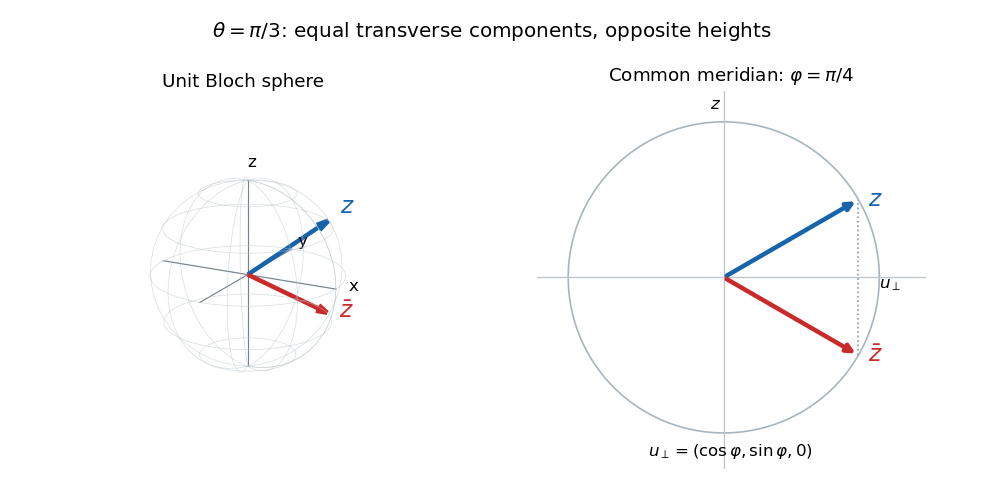

Represent the pure states by density matrices and . The Pauli matrices obey and . ConsequentlyOn the other hand, and make that trace equal to . Thus the pure-qubit overlap identity isFor mixed states the trace formula still holds, but its left side is then a Hilbert–Schmidt overlap rather than this squared pure-state overlap.
Under the prescribed computational-basis measurement and decision rule, the first state is correctly declared when outcome zero occurs, with probability . The second is correctly declared on outcome one, with the same probability. Averaging the two equal priors givesOne can also verify optimality directly: the two density matrices differ by . Since , choosing the positive eigenspace as the decision for the first state maximizes the trace contribution to success. This is the equal-prior discrimination of qubit states construction along the vertical axis.
Continue with equal prior probabilities as in part (c). The two Bloch vectors areTheir density-matrix difference is . If a binary measurement effect declares the first state, its success isDiagonalize . Because , the trace is maximized by taking to be its positive-eigenvalue projector. Thus perform a Pauli measurement of , equivalently measure in . If , identify the first state on the positive outcome and the second on the negative; reverse the labels if . The optimum isFor the states coincide, so the best probability is . This explicit positive-eigenspace optimization proves the Helstrom measurement for two pure states result in the present case, rather than only quoting its name.
Use the optimal three-to-one qubit random access code. For Alice's bits , put and send the pure state with Bloch vectorThese are the eight vertices of a cube inscribed in the Bloch sphere. If an explicit ket is wanted, choose and , and prepare .
Bob wanting bit performs a Pauli measurement of respectively, reporting zero for eigenvalue and one for . Its success for every input and every requested bit isOnly one chosen bit is extracted; the protocol does not recover all three simultaneously and uses no shared entanglement.
To prove that no one-qubit protocol gives a greater guaranteed probability, allow Alice arbitrary mixed encoding vectors and Bob any binary positive operator-valued measure. Write his decision difference as . Its eigenvalues lie in , implying . On input , success for bit is . Average over all eight strings and three choices. The terms in cancel, leavingThe Cauchy-Schwarz inequality and cancellation of cross terms over all sign choices giveHence . Any worst-case guarantee is no greater than this average; the cube protocol attains it uniformly, proving optimality both for guaranteed success and for the uniform-input average. Biased prior information about the bits would define a different optimization problem.
Articles by others on the same topic
There are currently no matching articles.