Model the post-eruption flow as an axisymmetric, shallow, hydrostatic, turbulently mixed layer on a horizontal bed. Neglect entrainment, erosion, heat exchange, rotation and large-scale viscous drag. Particles are dilute, with density , uniform-in-depth particle volume fraction and constant downward settling speed relative to the carrier gas. Deposited particles are not resuspended. Their volume is small enough that settling does not significantly change the bulk carrier volume. Let be ambient air density and carrier-gas density at its local temperature, and use a leading Boussinesq approximation for the mixture motion. DefineThe hot gas reduces the density excess; the ground-hugging current model requires . If density contrasts are too large for Boussinesq dynamics, density-weighted balances would be needed instead. The equations below are a stated shallow-layer model, not a description of the initial explosive vent jet.
For layer height and radial depth-averaged speed , the appropriate shallow-water balances areThe hydrostatic force gives the nonconservative momentum equation . In particular a spatially varying particle fraction must not be treated as constant reduced gravity when differentiating pressure. With no heat exchange or entrainment, a carrier-temperature anomaly is advected:At this order is proportional to . At the bed the carrier has no normal penetration and particles have absorbing deposition flux ; at the top the pressure equals ambient pressure. Axis regularity requires and smooth scalar fields, with no further source after the initial pulse. The initial height, particle inventory and temperature anomaly specify the released volume and ash content. Outside the front , the current layer is absent. At a resolved advancing head, use the material-front condition and the gravity-current front condition , where is an order-one front Froude number and refer to the fluid feeding the head. The front closure replaces unresolved head dynamics; simply prescribing both a zero-depth mathematical edge and a finite-depth box-head speed would be inconsistent.
To obtain a gravity-current box model, assume horizontal as well as vertical mixing, uniform in a disk of radius , and a negligible-volume head whose feeding depth is the box depth. The conserved bulk volume givesA bulk velocity satisfies interior continuity for this box. Rather than impose a uniform pressure on the full shallow-water equations and thereby lose the head force, replace their momentum dynamics by the front closure. Total suspended particle volume is , so bed deposition givesThese ordinary differential equations, together with initial , are the axisymmetric settling box model. The maintained negative thermal term may eventually cancel particle buoyancy and cause lift-off; beyond this horizontal gravity-current model does not apply.
For the requested particle-only calculation set and define the initial reduced gravity . The equations reduce toEliminating time gives . Integrating from the release state yieldsThus the monodisperse circular ash runout has limiting radiusThe maximum outward distance beyond the initial release edge is . When the vent scale is negligible, set in this late-time source idealization. The resulting radius scales as ; it is not obtained by conserving reduced gravity after particles settle out.
To determine the time, put , and . The concentration relation becomes , and the front equation reduces toConsequentlyThe furthest reach is a limiting radius, approached asymptotically rather than attained at a finite stopping time. As the residual particle concentration vanishes, the front slows exponentially. A finite observational threshold for remaining ash would give a finite practical stopping time, but no such threshold is part of these balances.
The local ash deposit density is most naturally its mass per horizontal area, . Once the front has arrived at , its local deposition flux is . For , define ; the arrival time is zero inside the initial footprint and otherwise . Sincewe can integrate the flux exactly. Using gives the circular ash deposit profileIt is constant under the initial disk, then decreases to zero at the limiting edge. Particle solid volume per area is ; deposit thickness is if a bulk deposit density including voids is supplied. The problem does not determine that packing density.
For a negligible initial radius this simplifies toIts integral confirms that the complete initial ash inventory is deposited. The finite- formula gives the same budget including its central flat portion.
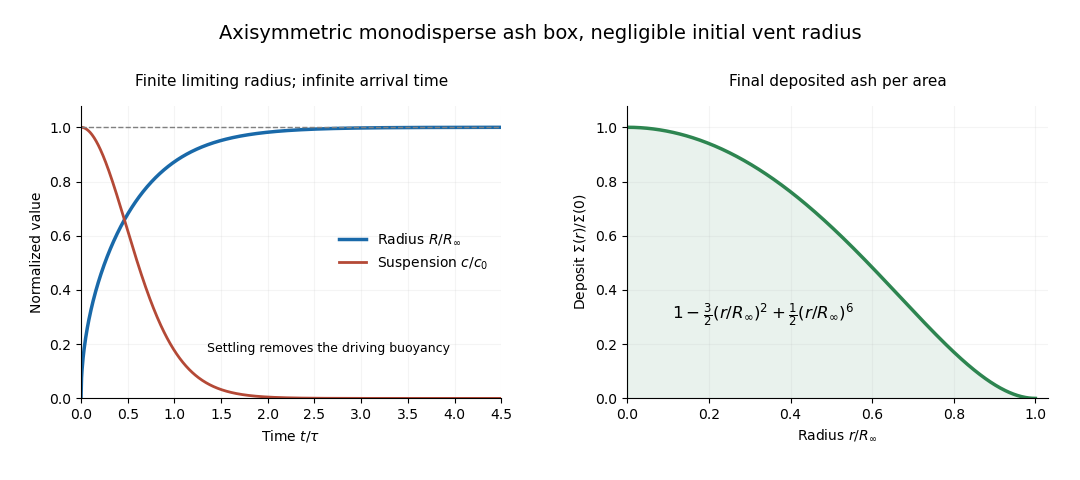
Monodisperse axisymmetric ash box: asymptotic runout and decreasing radial deposit density
. Details. 
The diagram uses the negligible-vent-radius idealization and time normalized by . It illustrates both the asymptotic approach to and the smoothly vanishing outer deposit. All these predictions depend on the mixing and constant-Froude head closure; they do not claim to resolve the initial blast or the ultimate inertia-dominated motion of almost particle-free gas.
Articles by others on the same topic
There are currently no matching articles.