Let denote isotropic permeability of a porous medium, the fluid dynamic viscosity, the reference fluid mass density, its volumetric thermal-expansion coefficient and gravitational acceleration. The Boussinesq approximation uses only in the gravitational force. With upward coordinate , hydraulic pressure and Darcy flux , the equations arewhere is the perturbation to the conductive temperature. To keep porous heat-capacity conventions explicit, let be effective heat capacity per bulk volume, the liquid volumetric heat capacity, effective thermal conductivity, , and . The thermal equation is . If the usual unit-capacity convention is adopted, and is the thermal diffusivity. Thresholds below do not depend on ; it only changes temporal rates.
For a conductive state with upward temperature decrease , linearization giveswhere . The second equation follows by taking the divergence of Darcy law to eliminate and then differentiating its vertical component. It is important that the Laplacian on its right is horizontal.
In the horizontal layer, both boundary planes prescribe the temperature and are impermeable, so at . Use a normal mode proportional to , with horizontal wavenumber , . Writing , the momentum relation gives , and the thermal relation givesA neutral mode therefore requires . Since , the smallest value is , attained at and . This derives the onset of convection in a horizontal Darcy layer rather than simply importing its critical number. ThusEvery small disturbance decays for ; at equality the critical roll is neutral. Strict decay has this threshold as a supremum, not an attained maximum. The first roll wavelength is , compatible with the very large horizontal extent. Cooling from above gives the opposite, stable buoyancy feedback.
For the tall square column, define as its side length and as its height. The insulated vertical walls impose , while impermeability imposes zero normal Darcy flux. Away from the remote ends, a nearly height-independent mode has hydrostatic pressure adjustment and , with zero cross-sectional mean. The transverse temperature modes arewhere but is excluded: a closed column cannot support a net vertical discharge. Its horizontally uniform density perturbation is balanced by pressure, rather than driving overturning. The rate of a nonconstant mode isThe smallest allowed eigenvalue is , so the insulated square-column Darcy convection onset isAgain strict decay requires . This is the leading long-column result. End conditions that maintain the basic gradient require the vertical velocity to turn around near the ends and give small finite-height corrections; their exact coefficient cannot be inferred from insulation of the vertical walls alone. For a separated vertical mode of small wavenumber , the neutral expression is , which tends to the displayed value as .
Just above threshold, warm fluid rises along one side and colder fluid sinks along the opposite side, with horizontal return flow at the top and bottom. The two lowest modes, proportional to and , have the same threshold. A square therefore admits either orientation or a superposition, including diagonal overturning. Linear theory predicts the weak columnar circulation and its degeneracy; it does not select a unique nonlinear planform.
Use constant porosity , isotropic rock permeability of a porous medium , common liquid dynamic viscosity and gravitational acceleration . Treat the two liquids as separated by a sharp interface, with negligible capillary pressure, molecular mixing, ambient-current resistance and inertia. At distances beyond the initial source scale the current is shallow relative to its horizontal length, so its pressure is hydrostatic. The initial release is symmetric about and has actual liquid volume per unit length of source. Consequently its geometric thickness integral is , not .
Below the interface the excess pressure relative to the ambient hydrostatic field is , so Darcy law gives horizontal discharge . The vertically integrated discharge is . Take the specified downward leakage to mean Darcy flux per bulk horizontal area. Mass conservation then givesIf is instead defined as interstitial seepage speed, the actual leakage discharge is and the corresponding coefficient is . Stating the velocity convention removes that otherwise ambiguous porosity factor. For a shale of thickness and permeability , a simple hydrostatic leakage model has , if the reservoir below it has the same ambient pressure reference and no capillary entry threshold.
Let be the half-width of the support; the full end-to-end length will be . Appropriate conditions are symmetry , , no flux beyond the support, and the moving-front condition . Initially converges weakly to , expressing the concentrated line release. The equations describe the spreading porous gravity current, not the singular immediate release itself.
With , conserved volume and balance of against give width proportional to and height proportional to . Write , . Substitution givesIntegrating from the symmetry axis gives . Inside the support , so and . Thus the compact Barenblatt solution isThe positive-part notation makes outside the current. Volume fixes its remaining constant:If “length” denotes the distance from the source to one front, it is rather than ; both conventions are given explicitly. Differentiating gives , so the front condition holds. Using on each reflecting half-line gives the same normalization.
For positive leakage define actual retained volume . Since the edge thickness and boundary flux vanish, integration of the equation yieldsPut , where . Because , substitution cancels the leakage term and leaves . This derives the exponential drainage transform for porous-medium diffusion. Its conserved geometric volume is still , soThe full length is again . In particular,At early times , recovering impermeable-bed spreading. At late times, drainage reduces the current thickness and therefore its hydrostatic driving pressure; the effective spreading time saturates at . The current approaches a finite horizontal reach while its retained volume and thickness vanish exponentially. This does not mean a positive-volume pool remains at a finite final depth. For small positive the length scale diverges as , consistently with unbounded spreading when leakage is absent.
Model the post-eruption flow as an axisymmetric, shallow, hydrostatic, turbulently mixed layer on a horizontal bed. Neglect entrainment, erosion, heat exchange, rotation and large-scale viscous drag. Particles are dilute, with density , uniform-in-depth particle volume fraction and constant downward settling speed relative to the carrier gas. Deposited particles are not resuspended. Their volume is small enough that settling does not significantly change the bulk carrier volume. Let be ambient air density and carrier-gas density at its local temperature, and use a leading Boussinesq approximation for the mixture motion. DefineThe hot gas reduces the density excess; the ground-hugging current model requires . If density contrasts are too large for Boussinesq dynamics, density-weighted balances would be needed instead. The equations below are a stated shallow-layer model, not a description of the initial explosive vent jet.
For layer height and radial depth-averaged speed , the appropriate shallow-water balances areThe hydrostatic force gives the nonconservative momentum equation . In particular a spatially varying particle fraction must not be treated as constant reduced gravity when differentiating pressure. With no heat exchange or entrainment, a carrier-temperature anomaly is advected:At this order is proportional to . At the bed the carrier has no normal penetration and particles have absorbing deposition flux ; at the top the pressure equals ambient pressure. Axis regularity requires and smooth scalar fields, with no further source after the initial pulse. The initial height, particle inventory and temperature anomaly specify the released volume and ash content. Outside the front , the current layer is absent. At a resolved advancing head, use the material-front condition and the gravity-current front condition , where is an order-one front Froude number and refer to the fluid feeding the head. The front closure replaces unresolved head dynamics; simply prescribing both a zero-depth mathematical edge and a finite-depth box-head speed would be inconsistent.
To obtain a gravity-current box model, assume horizontal as well as vertical mixing, uniform in a disk of radius , and a negligible-volume head whose feeding depth is the box depth. The conserved bulk volume givesA bulk velocity satisfies interior continuity for this box. Rather than impose a uniform pressure on the full shallow-water equations and thereby lose the head force, replace their momentum dynamics by the front closure. Total suspended particle volume is , so bed deposition givesThese ordinary differential equations, together with initial , are the axisymmetric settling box model. The maintained negative thermal term may eventually cancel particle buoyancy and cause lift-off; beyond this horizontal gravity-current model does not apply.
For the requested particle-only calculation set and define the initial reduced gravity . The equations reduce toEliminating time gives . Integrating from the release state yieldsThus the monodisperse circular ash runout has limiting radiusThe maximum outward distance beyond the initial release edge is . When the vent scale is negligible, set in this late-time source idealization. The resulting radius scales as ; it is not obtained by conserving reduced gravity after particles settle out.
To determine the time, put , and . The concentration relation becomes , and the front equation reduces toConsequentlyThe furthest reach is a limiting radius, approached asymptotically rather than attained at a finite stopping time. As the residual particle concentration vanishes, the front slows exponentially. A finite observational threshold for remaining ash would give a finite practical stopping time, but no such threshold is part of these balances.
The local ash deposit density is most naturally its mass per horizontal area, . Once the front has arrived at , its local deposition flux is . For , define ; the arrival time is zero inside the initial footprint and otherwise . Sincewe can integrate the flux exactly. Using gives the circular ash deposit profileIt is constant under the initial disk, then decreases to zero at the limiting edge. Particle solid volume per area is ; deposit thickness is if a bulk deposit density including voids is supplied. The problem does not determine that packing density.
For a negligible initial radius this simplifies toIts integral confirms that the complete initial ash inventory is deposited. The finite- formula gives the same budget including its central flat portion.
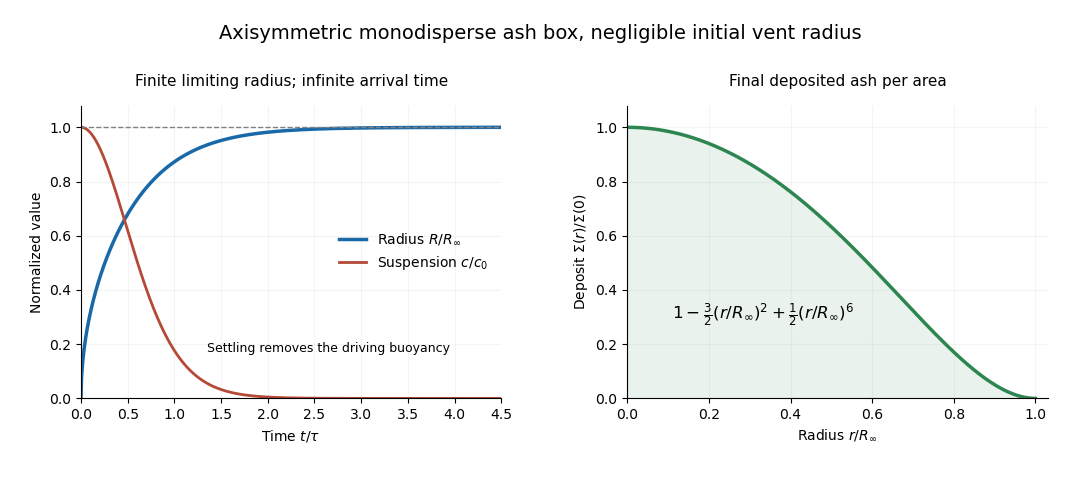
Monodisperse axisymmetric ash box: asymptotic runout and decreasing radial deposit density
. Details. 
The diagram uses the negligible-vent-radius idealization and time normalized by . It illustrates both the asymptotic approach to and the smoothly vanishing outer deposit. All these predictions depend on the mixing and constant-Froude head closure; they do not claim to resolve the initial blast or the ultimate inertia-dominated motion of almost particle-free gas.
Let the two populations have settling speeds and particle volume fractions . In the same mixed box their scalar equations are , while the common reduced gravity is after neglecting thermal buoyancy. Both populations are carried by the same radius and depth:The coarse ash deposits rapidly near the source; the fine ash remains aloft longer, sustains the current's buoyancy and is carried farther. The composition of the deposit therefore fines outward. Since the remaining fine ash drives the flow transporting both classes, the runout is not obtained by superposing two independent monodisperse currents.
Define the settling exposure for a particle size distribution . Then andThe integral is finite when both settling speeds are positive. Each deposited mass is ; their sum is the total deposit, with a coarse proximal component and a finer distal tail. If the actual hot-gas density deficit is retained, early loss of coarse ash can make vanish and loft the remaining fine-rich cloud, shortening its ground-hugging reach relative to this particle-only calculation.
For a continuous size distribution, let be initial particle volume fraction in a settling-speed interval. The settling exposure for a particle size distribution givesThe spectrum continually shifts toward slower-settling particles. The deposit becomes progressively finer outward, with a smooth range of depositional distances instead of two distinct size components. Size-resolved deposition is per speed interval.
There is no universal monodisperse runout formula with an arbitrarily chosen mean settling speed. The box relation isA spectrum bounded away from zero settling speed has a finite limiting radius, but an arbitrarily slow-settling tail can extend the reach substantially or remove a finite runout bound. For example, if near , , its Laplace transform behaves as . The runout integral converges only for . A positive population with exactly zero settling speed retains buoyancy indefinitely and spreads without a finite radius limit in this no-entrainment model. Thus the fine tail of the actual distribution, and possible lofting when thermal buoyancy is restored, control the distal outcome.
Let measure height from the lower edge and distance from one face of the vertical plate. Use the steady Boussinesq approximation, homogeneous isotropic permeability of a porous medium , reference fluid mass density , dynamic viscosity , thermal expansion coefficient , effective thermal conductivity and liquid volumetric heat capacity . Define and , consistently with the thermal convention used above. Write , where is the uniform ambient temperature.
Interpret as uniform wall heat-flux density: a plate segment of height inputs heat per unit horizontal span. The cumulative heat input up to height is therefore . If instead denotes the sum of flux densities into two identically heated faces, replace it by in each face formula before summing. A specification only of total power per span, without its distribution in height, would not determine this uniformly heated-wall problem. We calculate one heated face; identical heating on both faces doubles the integrated fluxes.
Away from the leading edge, suppose the boundary layer is slender, , and porous inertia and longitudinal heat conduction are negligible. Lateral pressure adjustment leaves the vertical Darcy velocity proportional to buoyancy:At the plate, and ; in the far field . Darcy law permits tangential discharge at an impermeable plate, so imposing a further no-slip condition would be inappropriate in this leading porous model.
Balance , and to obtainThus the warmed layer thickens and accelerates upward. Define a streamfunction by , and setThe last two expressions agree because . Differentiation gives . Substituting in the thermal equation leaves the single nonlinear equation for the uniformly heated vertical plate in a porous medium:The first condition is impermeability; the second fixes the wall heat flux; the third fixes ambient temperature and vertical velocity. Seek the positive-temperature branch with and finite . Decay also gives . The far-field transverse inflow need not vanish: supplies the increasing discharge.
An approximate solution can be obtained without a numerical shooting calculation. Integrate the differential equation over . The boundary conditions and integration by parts giveThus the exact thermal budget is . Assume an exponential thermal shape, . The wall derivative requires , and the integral condition requires . Hence , and the integral exponential profile for porous wall convection isIt satisfies all boundary conditions, has positive decaying temperature, and matches the exact integrated heat budget. It is an integral approximation, not an exact pointwise solution of the differential equation; its mass-flux coefficient should be read accordingly.
Define the volume discharge, kinematic Darcy momentum flux and buoyancy flux per horizontal span byWith these standard discharge conventions the mass flux is . Their similarity expressions areThe integral identity evaluates two of them exactly:Equivalently : all the heat supplied below height is carried upward through that section. Although these fluxes are exact within the boundary-layer equations, porous drag means that the momentum flux itself is not conserved with height.
The approximate mass flux isFor clarity, if “momentum flux” means actual pore-fluid momentum rather than the commonly quoted kinematic Darcy diagnostic, constant porosity and pore speed give . The mass flux remains because already denotes discharge per bulk area. Stating both prevents an implicit porosity error. Validity also requires and a sufficiently slender, low-inertia porous boundary layer; the approximation is not the immediate leading-edge conduction field.
Articles by others on the same topic
There are currently no matching articles.