An integral of motion is a function of phase space that is constant along a trajectory. Put , so the stellar acceleration is . In a time-independent spherical Newtonian gravitational potential,The second equality uses the radial direction of . Thus both the binding energy and the full specific angular momentum vector are integrals of motion.
The Collisionless Boltzmann equation isFor a stationary galactic distribution function, this says on every characteristic, so is constant on each stellar orbit. Locally choose a complete set of orbit labels , themselves integrals of motion; constancy along the characteristic means . Conversely, for any such differentiable , the chain rule gives . This proves Jeans theorem in its orbit-invariance form. It does not claim that just two particular integrals classify every orbit in an arbitrary potential. For the specified spherical model, is a rotationally invariant stationary choice.
For the velocity integration, write , , , and set . At fixed position the velocity-dependent factor isUse and integrate over . The mass density isSince ,These integrals use the stated untruncated galactic distribution function over all velocities; an additional escape-energy cutoff would change the result.
In local orthogonal velocity components the same exponent is . Each component is a centred Gaussian distribution. The one-dimensional identity yieldsIn particular the velocity-anisotropy parameter is . This is Gaussian angular-momentum suppression in a stellar distribution.
The radial laws also require self-consistency through the Poisson equation for Newtonian gravity:For , outside a sufficiently small core, the model is almost isotropic and isothermal. Seek its scale-free envelope with . Its distribution-density relation gives , and the Poisson equation for Newtonian gravity gives . Thus the intended intermediate singular isothermal sphere behaviour iswhere a core scale is .
The stated law cannot be the actual central limit of a regular finite-density model. For finite and , regularity and the Poisson equation for Newtonian gravity instead giveand . A broad intermediate region exists only if ; the radius alone does not ensure it.
For the outer radially anisotropic isothermal halo asymptotics, put , and . At the density relation and Poisson equation becomeThe slow outer balance is , so , giving . Its consistency check is , for which . ThereforeThe reference radius changes only subleading logarithmic terms. The circular speed falls as , rather than remaining exactly flat.
Physically, the model has an almost isotropic central region and, if the scales separate, a flat-rotation isothermal envelope. Beyond , suppression of large specific angular momentum leaves predominantly radial orbits: radial velocity dispersion remains , while transverse dispersion falls as . The outer density acquires a logarithmic suppression and the galaxy rotation curve declines slowly. The enclosed mass still grows approximately as , so this untruncated model has infinite total mass.
The divergence theorem states . With the Poisson equation for Newtonian gravity, this givesor gravitational-acceleration flux .
Use cylindrical radius , so . An arbitrary reference length in the logarithm only adds a constant potential. Off the equatorial plane, the radial part of is . Writing , its angular part is on either open hemisphere. The two cancel: there is no volume density away from .
At the plane, and . Applying the gravitational flux law to a thin pillbox gives . ConsequentlyThis is the Mestel disk potential-density pair. There is no additional point mass at the origin: the enclosed mass tends to zero linearly as the enclosing radius shrinks.
At , up to a constant, so radial circular balance givesOn a sphere of radius , at every nonsingular angular point. Its flux is , and henceDirect integration of the surface density confirms . Thus even though the source is a razor-thin disk. This equality is a special scale-free property of the Mestel disk, not evidence that the source is spherical. In a general disk, matter outside the orbit and nonspherical interior forces prevent this enclosed-mass formula for the local circular speed. The model has infinite total mass, so its potential is defined by differences rather than a zero at infinity.
Adopt the planar Fourier transform conventionExtend the disk potential to three dimensions. The Poisson equation for Newtonian gravity becomesFor , decay away from an isolated disk and continuity across it give . Integration through the plane yields , hence the razor-thin disk Poisson kernelThe given transform of is . The convolution theorem therefore gives the forward potential relationFor the reverse relation, , soInvert the transform to obtain the thin-disk potential-density inversionAn additive constant in is annihilated by . These formulas hold for suitable isolated finite disks, and in a distributional or regularized sense for less regular profiles. The uniform zero-wavenumber sheet needs a separate vertical solution; the infinite Mestel disk requires potential differences or an infrared regularization, since its absolute forward integral diverges.
For a bound Kepler orbit, the semimajor axis is half the long diameter of the ellipse; if are its apsidal distances, . The orbital eccentricity is , with and semiminor axis . The gravitating centre is a focus, displaced by from the ellipse's geometric centre.
Choose a reference plane, a positive normal and a fixed reference direction in that plane. The ascending node is where the orbit crosses toward positive normal displacement. The longitude of ascending node is the reference-plane angle from the fixed direction to that node. The argument of periapsis is the angle from the ascending node to periapsis, measured in the orbital plane in the direction of motion. The orbital inclination is the angle between the reference normal and the orbital angular-momentum normal, with . The diagram separates the ellipse's shape from these orientation angles.
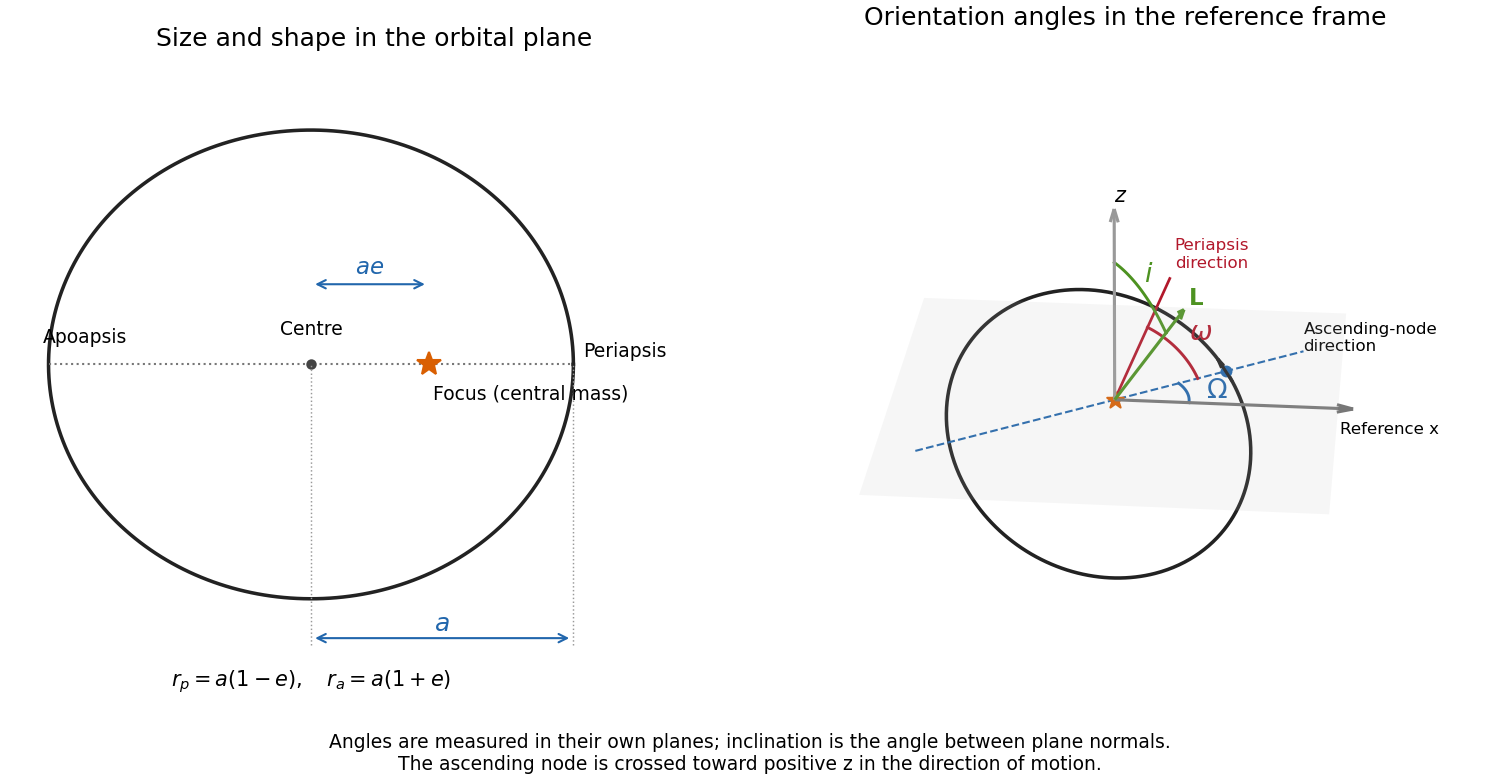
Size and shape of a Kepler ellipse, and the node, periapsis and inclination angles in a fixed reference frame
. Details. 
Let and use actions per unit test-particle mass. In the prograde spherical-action chart underlying the stated Hamiltonian, and , so . The radial action then satisfies , consistently with . DefineIf are the old angles, a type-two generating function isDifferentiation with respect to the old angles recovers , and differentiation with respect to the new actions gives the canonical transformationIts triangular integer action matrix has determinant one, so it preserves the angle periodicities. In the new coordinates,These are the Delaunay variables:With the usual choices of angle origins, is mean anomaly, is argument of periapsis, and is longitude of ascending node. The generator rotates the orbit within its plane, whereas rotates that plane about the reference normal; this explains the angular identification. The fast angle obeys Kepler's equation , where is eccentric anomaly.
For retrograde orbits, signed gives and the spherical Hamiltonian uses . The stated plus-sign form is therefore a prograde chart, not a global signed-action formula. The Delaunay variables still use ; on the retrograde branch the generating function is . At , periapsis is undefined, and at or the node is undefined: these are angle-chart degeneracies, not physical singularities.
For the perturbed planet orbit, the radial and vertical frequencies mean small oscillations about a circular equatorial orbit of cylindrical radius . Write and retain the stated quadrupole potential. On the equator,At fixed axial specific angular momentum , the radial effective potential is . Its second derivative at circular balance gives the radial epicyclic frequencyReflection symmetry decouples vertical motion to first order. Expanding the potential in givesso the vertical epicyclic frequency isThe circular orbit is radially stable only for . For in that domain, . Vertical node crossings repeat at frequency while azimuth advances at , so the line of nodes has nodal precession rate . Radial periapsis passages repeat at , giving apsidal precession rate . To leading quadrupole order, with ,This is oblate-quadrupole epicyclic precession. Here denotes the nearly equatorial longitude of periapsis, not alone.
The precession signs above have a small-eccentricity, small-inclination domain. They are not a universal claim for every inclined Kepler ellipse. To see the distinction with the same Delaunay variables, average the perturbation over an unperturbed orbit. Since and , the term linear in integrates to zero and the average in the integral is . ThusDifferentiating at fixed other actions yields the first-order secular ratesTheir nearly equatorial sum reproduces the prograde . For a polar orbit, however, the node is fixed and . This supplies a concrete counterexample to extending the requested forward periapsis precession beyond the intended epicyclic regime.
For an isolated, virialized three-dimensional Newtonian system with negligible boundary-pressure terms, the virial theorem gives . Hence its total energy is . Defining the kinetic temperature by givesThus losing energy makes the system hotter, while adding energy makes it cooler. This negative heat capacity of a virialized gravitational system uses the inverse-distance potential and the stated boundary assumptions; it is not a dimension-independent consequence of self-gravity.
A gravothermal catastrophe occurs when a stellar core loses heat to its halo through two-body relaxation, contracts and becomes hotter because of its negative heat capacity. The larger temperature gradient then drives more heat outward and accelerates contraction. In the confined three-dimensional isothermal sequence this runaway is associated with loss of a regular thermodynamic equilibrium at a finite total energy. It is different from a fast collisionless instability.
For the rods, use energies and masses per unit axial length, consistently with their logarithmic interaction. DefineIntegrating the two-dimensional Maxwell-Boltzmann velocity distribution gives , with a positive normalization . The proposed potential has , so this requires . Direct differentiation givesConsequently the Poisson equation for Newtonian gravity is satisfied precisely byThe free normalization of the velocity distribution can be chosen to give this density. Its enclosed line mass verifies total-mass normalization:At the wall , so the required potential value is also satisfied. This establishes the two-dimensional self-gravitating rod equilibrium, including its field equation, distribution law, mass and boundary condition.
A regular positive solution needs . Since ,The minimum is an infimum of regular equilibrium temperatures. At equality the central logarithm is singular; for , vanishes inside the box. Thus equality is not a regular isothermal rod configuration.
Each of the two velocity components has second moment , so the kinetic energy is . With the given reference potential, the gravitational potential energy is . Using givesThe remaining integral can be evaluated explicitly:Adding therefore yieldsNow , and . The energy-temperature curve of a two-dimensional self-gravitating rod gas is consequentlyAt fixed box area, differentiation givesTo establish its sign rather than infer it from a plot, expand the logarithm for :The series and its derivative converge locally uniformly in . Moreover as and as . Thus every finite energy on this mean-field isothermal sequence has a unique regular equilibrium temperature, and there is no finite-energy termination or turning point. The central density diverges only in the infinite-negative-energy limit.
There is no finite-energy gravothermal catastrophe in this two-dimensional rod model. Its logarithmic interaction gives a different caloric curve from the three-dimensional inverse-distance problem. This microcanonical conclusion does not prohibit a distinct fixed-temperature collapse: in the canonical ensemble, a bath at or below admits no regular equilibrium of this family.
Articles by others on the same topic
There are currently no matching articles.