The neutral-hydrogen column density is , with units . Define the neutral-hydrogen column-density distribution byHere counts absorption systems along a quasar sightline. A histogram per logarithmic column interval instead measures ; forgetting this factor changes the inferred slope. Another common convention uses the absorption distance , with , and .
At a fixed epoch, weak Lyman-alpha forest lines have an approximately falling power-law distribution, with – over representative low-column ranges. Stronger absorbers deviate from one universal slope, and the normalization and fitted slopes depend on epoch and sample. The low-column fit is measured, for example, in Kim and collaborators' forest survey. The sketch distinguishes that empirical low-column trend from an illustrative higher-column continuation.
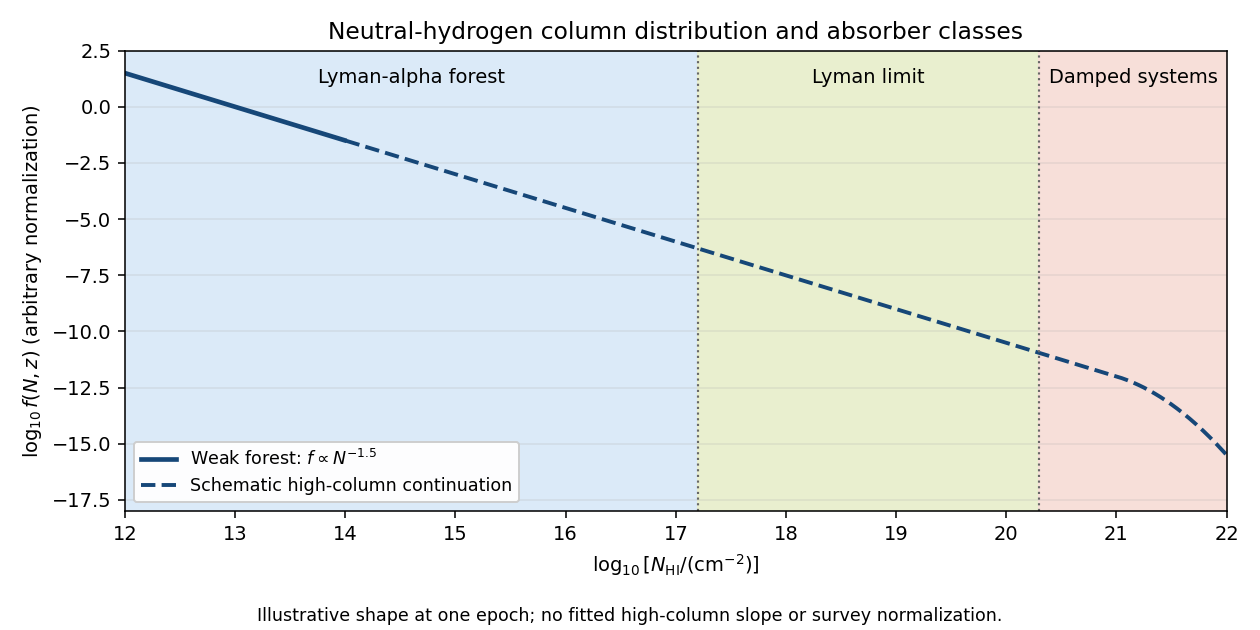

Ordinary Lyman-alpha forest lines cover roughly . They are numerous resonant Lyman-alpha absorption features from intervening gas at different cosmological redshifts, collectively resembling a forest in a quasar spectrum. Many are optically thin at the ionization edge even when their line centers are saturated.
A Lyman limit system becomes optically thick at the hydrogen ionization edge. With , requiresIts spectrum consequently has a strong continuum decrement below the redshifted Lyman edge. In a classification separating the highest columns, Lyman limit systems extend up to the damped-system boundary.
A damped Lyman-alpha system conventionally has . Its Lyman-alpha absorption is sufficiently strong that the Lorentzian wings of the Voigt profile are prominent. “Damped” refers to the finite radiative lifetime of the atomic excited state, not an inference that the gas has a high temperature. These systems trace substantial neutral reservoirs, usually associated with galaxies.
Articles by others on the same topic
There are currently no matching articles.