Write and , with . Direct differentiation givesThus the Cole-Hopf transformation with this negative-flux convention maps the heat equation to the stated viscous Burgers equation. Conversely its residual is independent of and can be removed by multiplying by a function of .
Convolving each initial exponential with the Gaussian heat kernel givesThe resulting finite-exponential Cole-Hopf solution isIt is a softmax function average of the constant states, so and .
For , put and . Equality of the two exponents occurs atThereforeThis is an increasing viscous shock from to , moving at speed and with transition width of order . That speed agrees with the Rankine-Hugoniot condition for flux ; its concavity makes the increasing jump the entropy shock.
For general , use the shock frame . The leading coefficient in is . The endpoint coefficients coincide, and every interior coefficient is smaller by . The extremal-state asymptotics of exponential Burgers solutions therefore reduce the large- profile to the same tanh shock with states and centreAt a fixed , rather than in the moving frame, the endpoint of largest dominates. If , both endpoint rates coincide and the limiting shock is stationary. Intermediate plateaus disappear in the moving-frame limit.
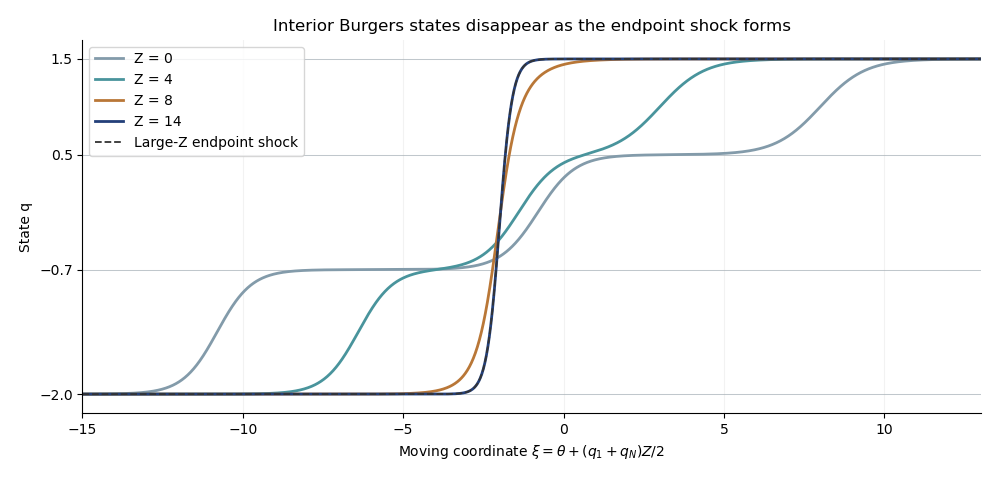
Intermediate states disappear from the finite-exponential Burgers solution in the moving shock frame
. Details. 
Use time dependence and consider fields independent of , with . The source-free Maxwell's equations are and . The first givesSubstitute these into the component of the second equation. The TE wave equation in a stratified magnetodielectric isBecause its coefficients depend only on , obeys the same equation. Since it is proportional to , substitution and division by giveFor a conserved transverse wavenumber , replace by to obtain the corresponding ordinary Helmholtz equations.
If “propagating along the axis” is read as strict normal incidence with no dependence, then identically. The nonzero magnetic component is , and its equation isThe equation above applies to the oblique transverse electric polarization used in the next part and also includes the zero normal-incidence solution. This distinguishes the named component from the usual transverse magnetic field.
With constant permeability, the electric equation reduces to . Insert the oblique-wave dependence and set . The inverse-square refractive-index profile givesSubstituting gives the Bessel equation of order . On either side of the profile singularity, when ,Equivalently use Hankel functions for an incoming/outgoing wave basis. If , write and replace by modified Bessel functions with argument . For , the solutions are and , with a logarithmic second solution in the repeated-root case . The constants on each side require incident-wave and boundary or matching data; the supplied singular profile alone does not choose them.
Articles by others on the same topic
There are currently no matching articles.