Work in the finite-group setting. If is maximal in a nonabelian simple , then : otherwise every nonidentity element would generate , forcing a cyclic group of prime order. Choose a minimal normal subgroup of . Every characteristic subgroup of is normal in , so minimality makes a characteristically simple group. Its normalizer contains . By maximality it is or , and the latter would make a nontrivial normal subgroup of the simple group , impossible because . This proves the maximal subgroup normalizer criterion:
For , stabilizer subgroups have order 12. Stabilizer subgroups of a two-element subset have order , and are isomorphic to ; for example . The normalizer of a Sylow 5-subgroup has order 10: its normalizer in has order , and exactly half its permutations are even, since a multiplier of order four on is an odd four-cycle. This gives a dihedral group of order 10.
To prove completeness, an intransitive subgroup either fixes a point, or its orbits on five letters have sizes two and three. It therefore lies in one of the first two types. A transitive proper subgroup has order divisible by 5. Its number of Sylow 5-subgroups is one or six, since has six and the count is modulo 5. A count of six would make , forcing an index-two subgroup and contradicting Simplicity of the alternating group A5. Therefore normalizes its unique Sylow 5-subgroup and lies in the order-ten normalizer.
Stabilizer subgroups are maximal because their index is prime. The order-ten group is transitive and cannot have a larger proper transitive overgroup by the preceding argument. The order-six group has no fixed point, cannot lie in a stabilizer subgroup, and cannot lie in the order-ten type because 3 does not divide 10. Thus all three types are maximal. is transitive on points and on unordered pairs, while Sylow conjugacy handles the normalizers. Consequently
Now let . Choosing independent columns gives . Its simplicity follows from the elementary projective-transvection proof in part 4(i), which does not use this subgroup classification.
A stabilizer subgroup and a plane stabilizer subgroup each have index seven and order 24. To construct the remaining type, identify with and take the Singer cycle of multiplications by nonzero field elements, of order seven. Any linear map commuting with a primitive multiplication commutes with all of , so its centralizer is precisely . A normalizer sends a primitive element to another root of its minimum polynomial, namely . The Frobenius map realizes those three choices. Hence
If for a proper , its Sylow count is one or eight. Eight would make , hence . Its index-three coset action would inject the simple group into : the kernel is normal and cannot be all of . This is impossible. Thus normalizes a unique Sylow 7-subgroup and lies in the order-21 normalizer.
If , its order divides 24. In its action on seven nonzero vectors, an odd orbit has size one or three. A one-point orbit gives a fixed point. If a three-point orbit is collinear, it is the set of nonzero vectors of an invariant plane. If its three vectors are independent, their nonzero sum is fixed by . Thus lies in a point or plane stabilizer subgroup.
The index-seven stabilizer subgroups are maximal, and any proper overgroup of the order-21 normalizer would again have a unique Sylow 7-subgroup and normalize that same subgroup, so the normalizer is maximal too. The point and plane stabilizer subgroups are not conjugate: a stabilizer subgroup fixes a point, whereas a plane stabilizer subgroup is transitive on its three internal points and its four external points, so fixes no point. Each type is one conjugacy class. We have proved maximal subgroups of GL3 over F2:
The Fano plane has as points the seven nonzero vectors of , because every one-dimensional vector subspace has just one nonzero vector. Its lines are the seven two-dimensional vector subspaces. Every line has three points, every point lies on three lines, two points determine the line , and two lines meet in one point.
The two order-24 classes are therefore stabilizer subgroups of points and of lines. Each is isomorphic to : fixing a vector gives the block group , the full affine group on four points; inverse transpose gives the dual line stabilizer subgroup. Their distinct fixed-point behavior in part (i) distinguishes the two conjugacy classes.
For a point and line , stabilizes the ordered pair . There are incident pairs and nonincident pairs. A change of basis takes any pair to a fixed model of its type, so each type is a single orbit. Orbit-stabilizer theorem gives the Fano point-line stabilizer intersection:Both occur: take and choose or .
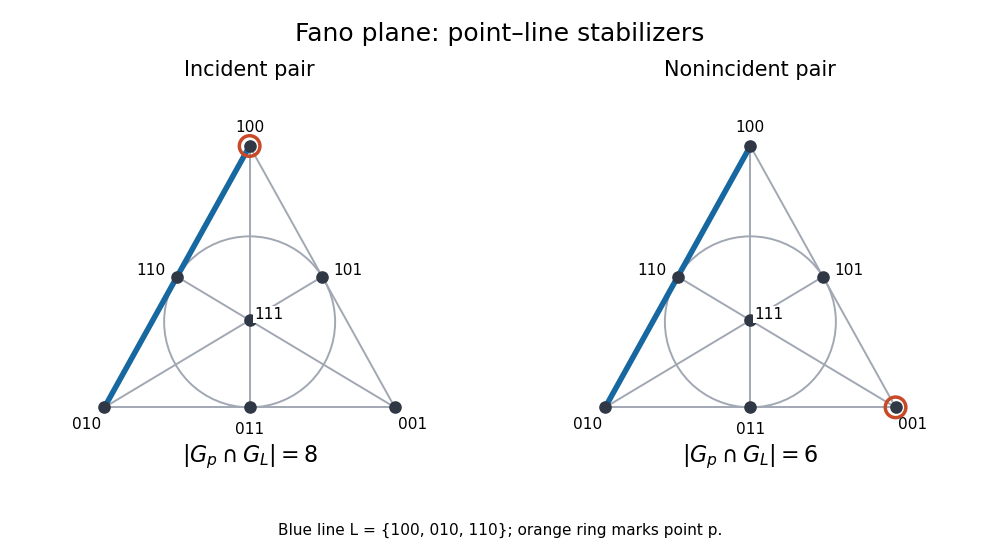
Fano plane with incident and nonincident point-line pairs
. Details. 
For the extension, identify vectors and covectors by the standard pairing. The inverse-transpose automorphism exchanges a point with its orthogonal plane and exchanges the two order-24 classes. Thus it is outer. The Fano plane duality group has order 336 and acts on points and lines, preserving incidence while allowing their types to be swapped.
The stabilizer subgroup of an unordered point-line pair has twice the corresponding ordered-pair stabilizer subgroup: some element outside swaps the pair, since duality produces a pair of the same incidence type and is transitive on such pairs. Hence these stabilizer subgroups have orders 16 and 12. Also every outside conjugate of a Sylow 7-subgroup can be moved back by an element of , giving
We prove these exhaust the maximal subgroups other than . Let be such a maximal subgroup and . Since is not contained in , is normal in and . If , part (i) gives a unique Sylow 7-subgroup of . It is characteristic in , hence normalized by . Therefore maximality forces .
Suppose and . The classification argument in part (i) says fixes a point or a line. Because is normal in , an element outside swaps its fixed-point and fixed-line sets, so it fixes at least one of each. WriteFixed lines are kernels of fixed nonzero covectors, since the only nonzero scalar is one. Duality gives , hence .
If , there is a unique fixed point and unique fixed line; preserves their unordered pair. If , put and . For every , contains the plane and lies in the line . Over there is only one nonzero linear map , so has order two. Invertibility forces : for one needs . Thus and are its unique image point and kernel line. These are canonically swapped by duality, so again preserves their unordered incident pair.
If , then has order two, generated by an involutory duality . For any point , the pair is preserved by . Hence lies in an order-12 or order-16 pair stabilizer subgroup and is not maximal. We have exhausted all cases.
The pair stabilizer subgroups are themselves maximal: a proper maximal overgroup is one of the just-listed types, and divisibility excludes orders 12 inside 16 or 42, and 16 inside 12 or 42. The order-42 normalizer is maximal by the unique-Sylow argument. Incidence types give one conjugacy class each; Sylow conjugacy gives one normalizer class. Thus, apart from the normal index-two subgroup ,
Articles by others on the same topic
There are currently no matching articles.